
Since the previous research note · Earlier expectation not tested
Track continuity
Since the previous research note: Why fast lithium transfer may not solve a battery’s contact problem
Previous expectation: Favorable lithium transfer kinetics could reduce losses at a lithium–ceramic interface if effective contact can be maintained.
What this study adds: A different sodium-system simulation explains how grain-boundary geometry and electronic disconnection can leave metal remnants that accelerate penetration across repeated cycles. It does not test lithium/Ga-LLZO transfer or the earlier contact-dependent benefit.
What changed in this study
A battery cycle is supposed to work in two directions. During plating, sodium metal is deposited; during stripping, it is removed. So why might a metal branch keep advancing through a solid electrolyte even after the reverse part of the cycle?
A July 16, 2026 arXiv preprint offers a computational explanation for that puzzle in all-solid-state sodium batteries. Its phase-field simulations suggest that removal can be geometrically uneven inside a polycrystalline electrolyte. A narrow connection may disappear first, leaving sodium beyond a grain-boundary junction cut off from the electronic pathway needed for rapid dissolution. That isolated metal can then remain in place and become a starting point for renewed penetration during the next plating step.
The result is a proposed mechanism for cumulative dendrite growth, where dendrites mean branching deposits of metal. It is a result about a defined sodium model, not a measurement of longer battery life in a working commercial cell.
Two calculations describe different parts of the problem
The researchers combine atomic-scale and larger-scale calculations because the question has two linked parts. First, density-functional-theory calculations examine the surface electron density of Na3SbS4, the solid electrolyte represented in the model. The calculations compare crystal planes including (100), (110), and (111). The reported surface electron density varies by plane, with the value for (100) about 2.6 times that of (110) and about 2.3 times that of (111). The study also reports that the calculated anisotropy has little influence on the overall simulation outcome, supporting an isotropic approximation in later modeling.
That atomic information supplies parameters for the second calculation. The phase-field model follows how sodium and the electrolyte interface change shape across a much larger region, rather than resolving every atom. The simulations use a finite-element method in COMSOL Multiphysics 6.2, with a 200 by 200 micrometre domain divided into a 250 by 200 rectangular mesh. Within that setting, the model can track connected metal, narrowing necks, grain-boundary junctions, and isolated regions as a cycle proceeds.
This division of labor matters. The DFT calculation characterizes a local electronic property of the crystal surfaces. The phase-field calculation asks how that property participates in an evolving structure. Neither level alone answers why a branch could persist from one cycle to the next; together, they let the authors test a mechanism that links surface behavior to changing geometry.
The connection can fail before the metal is gone
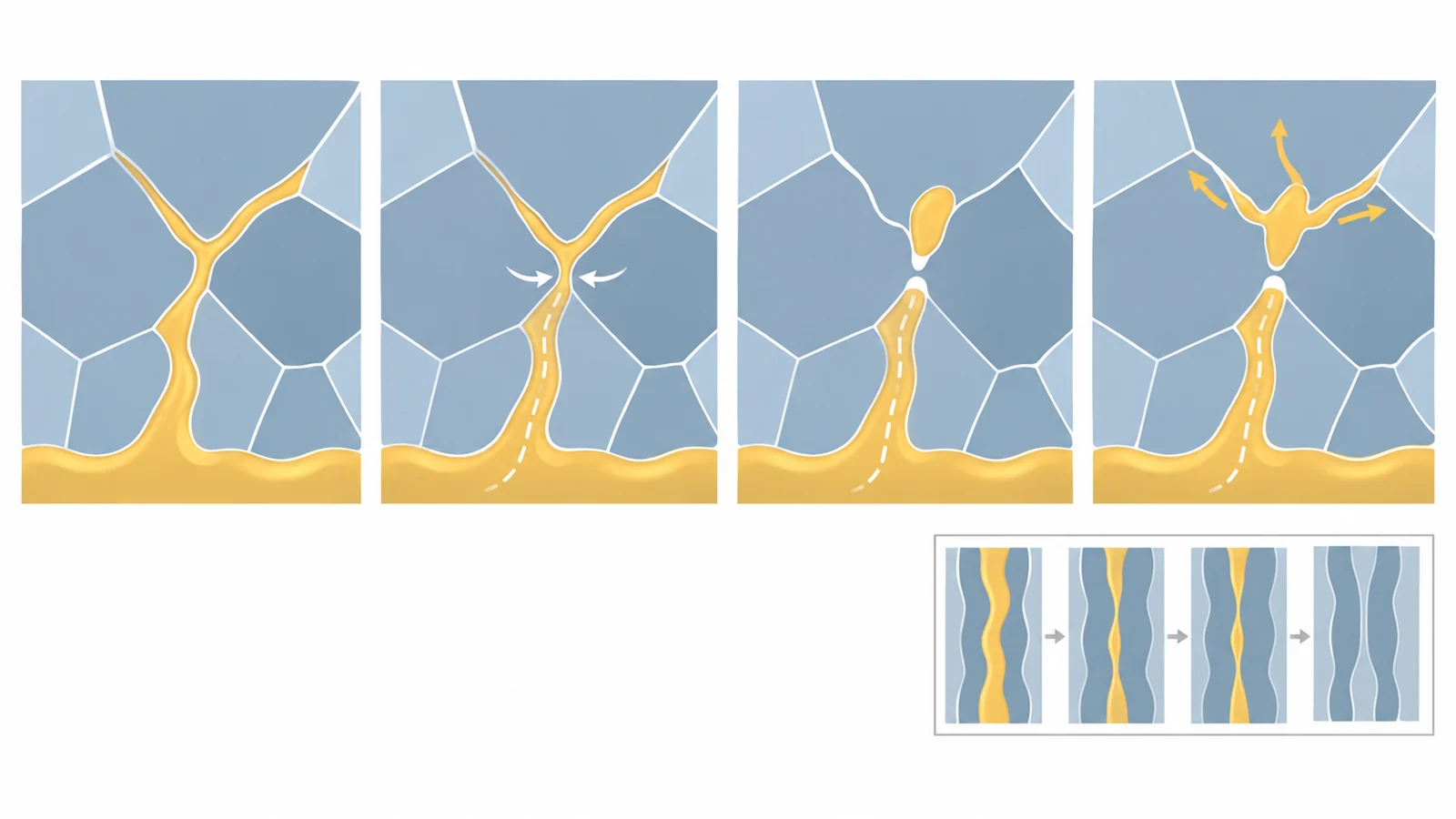
During plating, sodium advances into paths associated with the electrolyte’s grain boundaries. When stripping begins, sodium that remains connected to the bulk anode can continue receiving the electronic supply needed for dissolution. In the simulated junction geometry, however, the shape of the network creates an uneven contest between a narrow stem and a more stable region beyond the junction.
The narrow connection can dissolve first. Once it breaks, sodium on the far side is electronically isolated from the bulk anode. At first, some dissolution may continue while electrons remain available locally. After that local supply is depleted, the sharp interface curvature does not restore the lost electronic connection. The isolated sodium is thermodynamically unfavorable, yet its removal slows sharply because the route for sustained charge transfer has been cut.
That is the crucial distinction between being unstable and disappearing quickly. A connected dendrite can dissolve comparatively rapidly because it remains part of the conducting structure. An isolated piece can become kinetically trapped. When the next plating step begins, the surviving metal is already positioned inside the electrolyte. The model therefore treats it as a structural starting point for renewed penetration, rather than requiring a new branch to form from an initially clear interface.
The paper describes this cycle-to-cycle persistence as a key contributor to continued sodium penetration. The important claim is not that stripping fails everywhere. It is that the reverse step can leave behind a strategically placed remnant when the grain-boundary geometry disconnects it prematurely.
A parallel grain structure changes the outcome
The geometry dependence becomes clearer in the comparison with a parallel grain structure using the same parameter setup. In that case, the simulated sodium metal dissolves fully, with little to no isolated sodium left after stripping. The contrast indicates that the remnant is not simply an unavoidable consequence of reversing the applied process. It emerges from how the metal pathway meets the grain boundaries and junctions.
This comparison gives the proposed mechanism a sharper shape. Grain boundaries are not just passive lines through which metal happens to move. Their arrangement can determine whether a narrowing connection remains electronically tied to the anode long enough for the attached sodium to dissolve, or whether a junction causes the connection to sever while metal remains beyond it.
The study also investigates applied voltage, electrolyte microstructure, and anode chemistry, including pure sodium and a sodium–antimony alloy. Those are important variables in the model, but the evidence considered here does not support ranking the two anodes, naming a best voltage, or identifying one universally optimal grain structure. The parallel-grain case demonstrates sensitivity to geometry; it is not a complete design recipe for every sodium solid-state battery.
From a modeled mechanism to a working cell
A phase-field result can make a hidden sequence easier to see, but a visible sequence in a model is still different from a demonstrated operating outcome. This preprint shows how a junction can produce electronic disconnection, slowed dissolution, and renewed penetration under its represented sodium chemistry and computational conditions. It does not by itself establish a measured improvement or loss in cycle life, safety, energy density, or commercial performance.
The same caution matters when extending the finding across battery systems. The mechanism is tied to sodium metal, the modeled Na3SbS4 polycrystalline electrolyte, and the structures represented in the calculations. Other electrolytes, interfaces, anode compositions, and operating conditions may alter the balance between deposition, dissolution, and electronic connection. The model also does not make this a result about lithium batteries by analogy.
What it does provide is a concrete way to think about repeated penetration. Instead of treating each cycle as an independent contest in which stripping resets the interface, researchers can ask whether the prior cycle leaves electronically disconnected metal at a grain-boundary junction. That question can guide later comparisons between microstructures and interface designs without turning this simulation into a performance claim.
What this could change
If the proposed mechanism holds under relevant operating conditions, and if electrolyte grain structures or anode–electrolyte interfaces can be engineered to prevent persistent metal accumulation, sodium solid-state cells might tolerate more repeated cycling before penetration becomes a limiting failure mode. The potential benefit would come through a specific chain: fewer trapped sodium remnants, less structural assistance for renewed growth, and a greater chance of maintaining an intact electrolyte over time.
That is a conditional engineering opportunity, not a service-life result reported by the simulation. The value of the study is that it identifies a geometrical and electronic event that could otherwise be missed when only the beginning and end of a cycle are compared. Confirming how often that event occurs in relevant cells will determine whether controlling it can translate into more durable sodium battery operation.
Key Sources
- Primary source: Phase-Field Simulation of Dendrite Evolution in All-Solid-State Sodium Batteries during Cycling
arXiv · Preprint · 2026-07-16