
Since the previous research note · Earlier expectation not tested
Track continuity
Since the previous research note: From crystal-structure data to a tested battery electrolyte recipe
Previous expectation: Predictions from structure and property data could help researchers select sodium-electrolyte recipes that retain useful conductivity after fabrication and cell integration.
What this study adds: This source models a different system, a lithium-metal interface with a ceramic-filled polymer electrolyte, and examines how particle design and polymer viscoelasticity affect contact over time. It adds an interface-mechanics contribution to Solid-State Battery Development without testing the earlier recipe-selection forecast.
What changed in this study
A solid-state lithium battery contains more than materials with desirable properties on paper. Its layers must also meet one another across real surfaces, which are rough rather than perfectly flat. At the boundary between lithium metal and a solid electrolyte, that physical contact can influence how the interface behaves as pressure is applied and time passes.
The September 24, 2024 arXiv preprint Interfacial performance evolution of ceramics-in-polymer composite electrolyte in solid-state lithium metal batteries studies that problem with a theoretical and numerical model. The electrolyte in question is a composite: ceramic particles are dispersed through a polymer matrix. The ceramic phase can contribute to the material’s electrical behavior, while the polymer can deform and conform around the electrode surface. The paper asks how those ingredients shape the evolving lithium–electrolyte interface.
A battery interface is more than a boundary
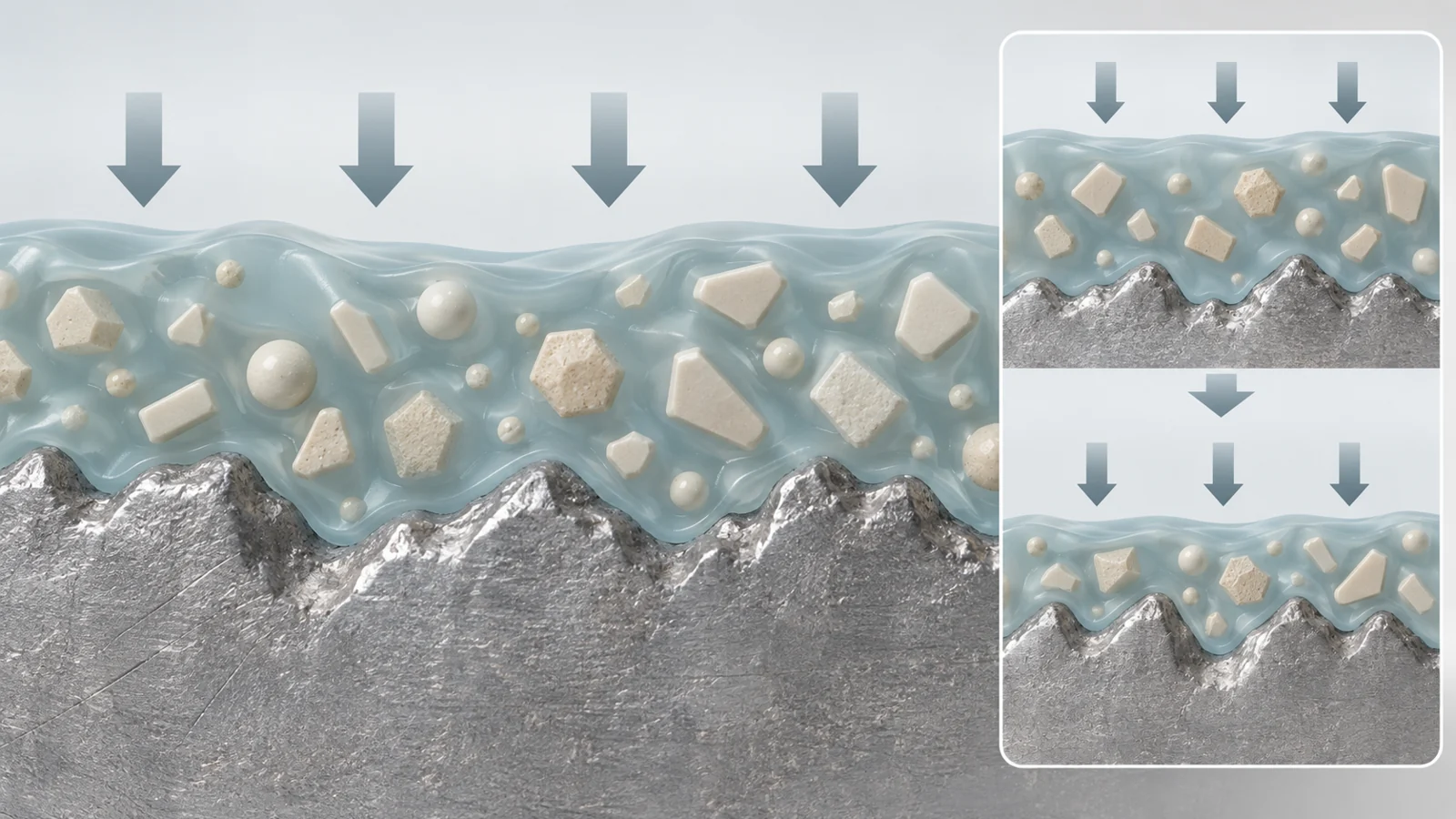
Imagine pressing a rough lithium surface against a polymer containing small ceramic inclusions. Only parts of the two surfaces may touch directly at first. The applied compression, called stack pressure, holds the battery layers together, but it also changes how the softer parts of the composite settle around surface features and embedded particles.
That makes the interface a mechanical system as well as a materials junction. Local stresses can vary around ceramic inclusions, and the pattern of real contact can change as the polymer responds to sustained loading. A calculation that treats the interface as fixed would miss part of the design question. The relevant issue is not simply whether a composite electrolyte conducts or whether a polymer is compliant. It is how the assembled layers meet under the pressure used to hold them together, and how that meeting evolves.
The study represents the rough contact between lithium metal and the solid composite electrolyte while accounting for oxide ceramic inclusions and the polymer matrix’s viscoelasticity. Viscoelasticity means that a material’s deformation depends partly on the timing of the load. A polymer can respond differently when compressed quickly than when it remains under pressure, because its internal mechanical response relaxes over time.
Pressure meets a material that changes with time
For a battery stack, sustained compression is not just a setting in the background. It is part of the interface conditions. As the polymer relaxes, the pressure distribution and the shape of the contact region can change. Some local features may carry more of the load than others, while ceramic particles interrupt or redirect the surrounding mechanical response.
To represent the polymer more realistically, the authors fit its response to experimental material data. The model uses a spectrum of ten relaxation times, allowing the calculation to describe several timescales of mechanical change rather than a single instantaneous or long-term value. The fitting is therefore a way to supply the model with a time-dependent description of the polymer, not a demonstration that a complete battery interface has been experimentally reproduced.
This time dependence matters because an interface can appear mechanically acceptable at one moment and behave differently after the layers have remained compressed. The paper follows the evolution of mechanical and electrical interface performance under a given stack pressure, connecting the material’s changing deformation with the modeled resistance associated with contact.
Three design choices shape the local response
The composite is not defined by ceramic content alone. The study varies three separate features of the ceramic phase: particle size, weight concentration and spatial distribution. Each describes a different design choice.
Weight concentration asks how much ceramic is present relative to the polymer. Particle size asks how large the individual inclusions are. Spatial distribution asks where those inclusions sit within the matrix. Two composites could contain the same ceramic fraction but produce different local stress patterns if their particles are arranged differently or occupy different size ranges.
The particle-size comparison makes that distinction concrete. One set of calculations uses four cubic-particle geometries, including sizes of 7.2 micrometres by 7.2 micrometres by 4 micrometres, 3.6 by 3.6 by 2, 1.8 by 1.8 by 1, and 0.9 by 0.9 by 0.5. The associated stress maps show why microstructure is a spatial design problem: changing the scale of an inclusion changes how stress is distributed through the surrounding composite under stacking pressure.
Those maps are useful for seeing differences in local mechanical response, but they should not be read as a universal recipe. The supplied study evidence does not identify a generally usable winning combination of particle size, loading, distribution or pressure. Its contribution is to show how these variables can be examined together when designing a solid composite electrolyte.
What the comparisons actually test
Before applying the model to a complex battery interface, the authors compare parts of the calculation with earlier contact-mechanics work. In one example, a single elastic inclusion is placed in an elastic matrix beneath a rigid spherical indenter. The predicted von Mises stress distribution is compared with an earlier calculation for several inclusion depths. In physical terms, this checks how the model predicts stress around a buried elastic inclusion in a familiar test geometry.
A second comparison considers a rigid sphere moving across a viscoelastic half-space containing a spherical inhomogeneity. The calculated contact-pressure profiles at different times are compared with earlier results. This tests the model’s treatment of a moving contact on a material whose response changes with time.
These are important checks of the calculation’s ingredients. Agreement with earlier elastic and viscoelastic contact calculations supports confidence that the implemented mechanics behaves as intended in those benchmark settings. It is not the same as validating the full behavior of a lithium-metal battery operating through charge and discharge. The comparisons establish correspondence with selected computational problems, while the composite-electrolyte application remains a model-based investigation.
Electrical contact is only part of the picture
The paper reports mixture conditions that optimize modeled contact resistivity and interface stability over time. Here, contact resistivity refers to the electrical penalty associated with how the two materials meet. Mechanical stability concerns how that meeting changes under the modeled loading history. Considering both matters because an interface that is mechanically persistent may still impose an electrical cost, while a low modeled contact resistance may not tell the whole story about long-term mechanical behavior.
There is also a crucial separation between electrical contact at the boundary and lithium-ion movement through the electrolyte itself. The study explicitly does not include a lithium-ion conduction model. Its electrical analysis therefore cannot, by itself, resolve how ions travel through the ceramic-filled polymer or how the modeled interface behavior combines with bulk transport.
That missing connection is central to interpretation. The work can examine how rough contact, ceramic inclusions and polymer relaxation affect the interface calculation. It cannot turn those results into a complete account of electrolyte conductivity, cell cycling or battery performance. Claims about cycle life, charging speed, energy density, dendrite suppression or safety would require evidence beyond the modeling surface described here.
What this could change
If these mechanical predictions hold in relevant lithium–composite-electrolyte interfaces, and if coupling them to ion-transport calculations confirms useful electrical behavior, battery developers could design composite electrolytes around a more durable interface capability. Ceramic content, particle geometry and placement could be chosen with the polymer’s time-dependent deformation in mind, helping the electrolyte maintain effective contact with lithium as the battery layers remain under pressure.
That could make interface-related resistance a design variable that is managed over the course of use rather than judged only at the moment of assembly. The practical payoff remains conditional: the mechanical model must connect successfully to ion transport and then be tested against operating interfaces. But the study points toward composite-electrolyte designs that seek both sustained physical contact and useful electrical function at the lithium boundary.
Key Sources
- Primary source: Interfacial performance evolution of ceramics-in-polymer composite electrolyte in solid-state lithium metal batteries
arXiv · Preprint · 2024-09-24