
Since the previous research note · Earlier expectation not tested
Track continuity
Since the previous research note: How materials must work together in a solid-state sodium battery
Previous expectation: Solid-state sodium batteries could become an additional renewable-energy storage option if ion transport, durable contact, operating conditions and scalable materials can work together.
What this study adds: The current lithium-interface simulations identify an unexpected reaction product, transport-limited layer growth and sideways lithium motion associated with creep. They add an atomistic interface mechanism to the track without testing the sodium-cell integration or storage-use forecast.
What changed in this study
A battery interface can look settled long before it is chemically finished.
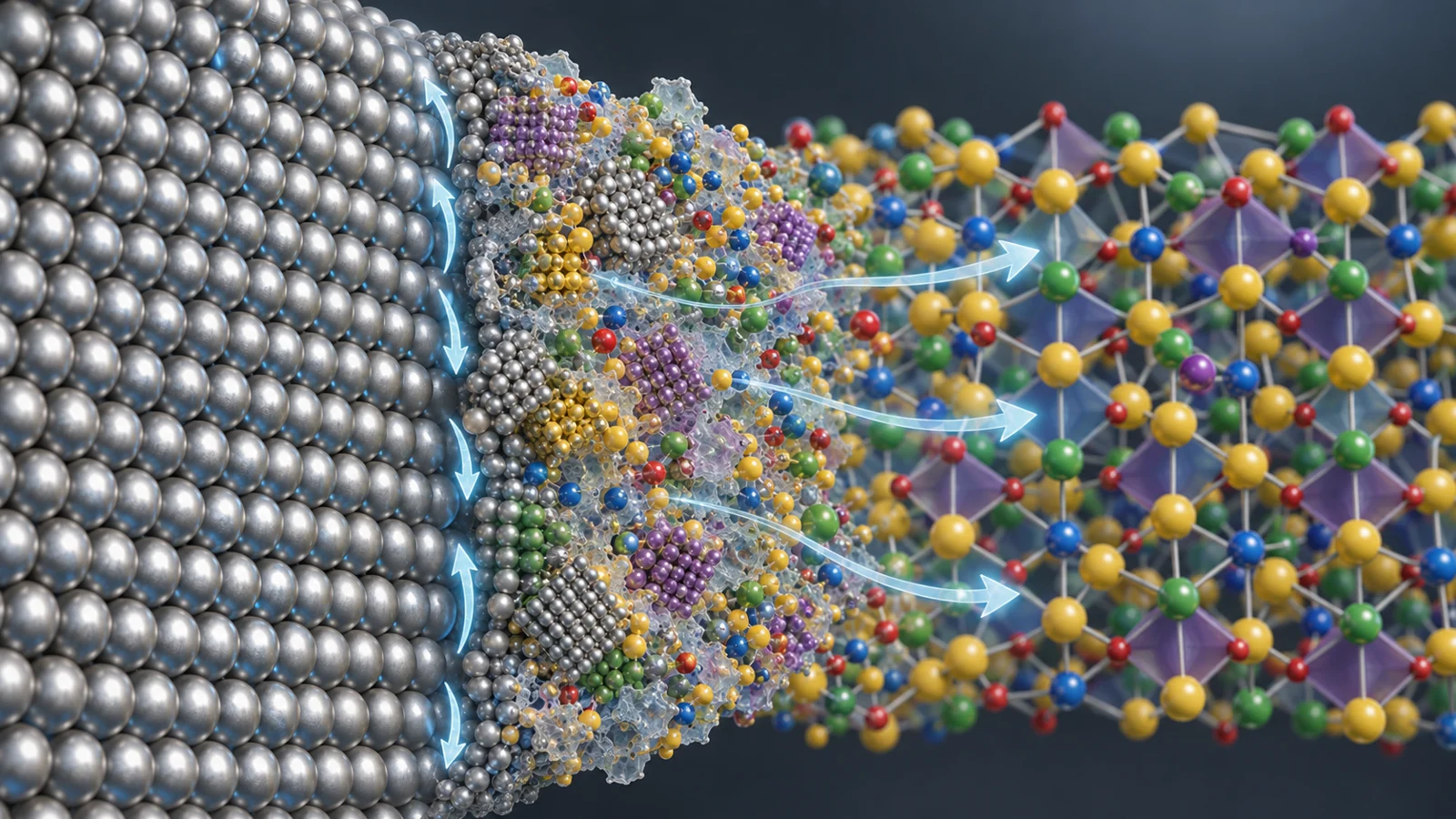
In these simulations, lithium metal reacts where it meets the solid electrolyte Li₆PS₅Cl. The products form a thin region called the solid-electrolyte interphase, or SEI. It is not simply an inert coating that appears once and then stays unchanged. As atoms move through the contact, the layer can keep developing, reorganizing and changing how the next reaction proceeds.
A computational preprint published on June 12, 2025, investigates that process in a symmetric solid-state battery cell. The study follows reactions and atomic motion directly with large-scale simulations. Its central result is a predicted SEI phase with the composition Li₂S₀.₇₂P₀.₁₄Cl₀.₁₄, a product the authors say was missed by approaches based mainly on thermodynamic expectations.
The result is not an independently confirmed experimental discovery. Its value is more specific: it shows how a reaction layer can be shaped by the timing and movement of atoms, not only by which compounds appear most stable once everything has equilibrated.
Building a moving picture of the interface
The simulation method combines three kinds of work that are often separated by computational cost.
Quantum-mechanical calculations provide reference information about atomic configurations, energies, forces and stresses. A machine-learned interatomic model then approximates those interactions much more quickly, allowing the researchers to follow a larger system for longer. Molecular-dynamics simulations use that learned model to let the atoms move and react. An unsupervised classification step groups similar local atomic environments so that the changing products can be identified after the simulation rather than being fully specified beforehand.
That middle step is important because a learned model can be fast without automatically being chemically reliable. The researchers first built training data through on-the-fly active learning and then added configurations for expected reaction products. In the example discussed in the paper, the initial model produced errors as high as 331 millielectronvolts per atom for some products. After the additional product data were included, the reported energy errors fell below 3 millielectronvolts per atom for those benchmarks.
Those numbers show why chemical coverage matters when a model is asked to describe reactions. They do not, by themselves, prove that every reaction pathway or emergent material property is correct. The authors also benchmarked bulk lithium, electrolyte diffusion, energy changes for reactants, forces, stresses and melting behavior before using the model for the interface simulations.
This combination turns the calculation into something closer to a digital experiment. It can expose atomic sequences that are difficult to observe inside a buried contact, while still depending on the approximations used to represent quantum interactions and electronic behavior.
The layer forms in stages
The simulated interface does not jump directly from two clean materials to a final protective barrier.
Early crystal nuclei appear at roughly 1 nanosecond. By about 30 nanoseconds, a polycrystalline layer has formed. The interphase then grows more slowly, although the reaction continues. In the simulated configuration, the rate becomes limited by the movement of relatively slow reacting components, including phosphorus, sulfur and chlorine.
That sequence separates three ideas that are easy to merge together. Nucleation is the appearance of small developing regions. Layer formation is the growth and joining of many such regions. Later slowing is a transport problem: once a reaction zone has developed, the atoms needed for further change must still reach the right places.
The timescale is a feature of this particular computational experiment, not a general clock for every solid-state battery. Its importance lies in the change of regime. The interface first creates new structures, then builds a mixed layer, and finally encounters increasing difficulty moving the ingredients needed for continued growth.
An unfamiliar phase can hide in familiar signals
To identify what the layer contained, the researchers did not force every atomic environment into a list of known materials. Instead, they used unsupervised clustering. Local environments that resembled one another were grouped together, while structures that did not match known categories could remain unlabelled until their composition and geometry were examined.
That approach led to the predicted crystalline disordered phase Li₂S₀.₇₂P₀.₁₄Cl₀.₁₄. The composition is unusual because it combines lithium, sulfur, phosphorus and chlorine in a structure that does not appear in the crystal database considered by the authors. It formed and grew rapidly in the simulations, making it a major part of the evolving interphase in the modeled system.
The phase also illustrates why identification can be difficult. Its calculated X-ray diffraction pattern resembles that of ideal lithium sulfide in peak positions and relative intensities. Thermal motion, small crystallite size, defects and microstrain would broaden the features. In a mixed SEI containing several products, a phase with this composition could therefore produce a signal that is easy to associate with a more familiar material.
The calculation offers a possible explanation for why a product predicted by the simulations might be difficult to distinguish in diffraction measurements. It does not replace direct synthesis or experimental verification. The authors propose synthesis at the suggested stoichiometry as one possible way to test the prediction.
A solid layer can still be chemically open
The formation of a solid interphase does not automatically stop the reaction. In the predicted phase, the simulations show lithium-ion movement through defects in the structure. That transport gives lithium ions a route through the layer, allowing additional reaction to continue after the phase has formed.
This is different from asking whether electrons can cross the same material. The authors’ calculations characterize the predicted phase as a semiconductor and suggest that it could passivate electron transport more effectively than a conducting reaction zone. Its electronic behavior is not identical to that of ideal lithium sulfide, however, and the distinction between ionic motion and electronic leakage matters.
A layer can therefore be structurally solid while remaining open to some forms of transport. Lithium ions may continue to migrate through defects, bringing reactants into contact. At the same time, the layer’s electronic character may influence whether further redox reactions can proceed. Understanding the interface requires both kinds of movement, not just a snapshot of the final-looking structure.
Lithium also moves along the contact
The simulations identify a second kind of motion that runs parallel to the interface. Lithium atoms near the reacting boundary undergo diffusive in-plane movement as buffer lithium participates in the reaction. The authors connect this sideways motion with lithium creep, a deformation process relevant to how dendrites can begin at an interface.
This adds a mechanical dimension to the chemistry. The interface is not only a place where compounds are exchanged across a boundary. It can also redistribute the metal along that boundary. The result is a proposed microscopic mechanism linking reaction-driven atomic motion with deformation of lithium, rather than a complete demonstration of a dendrite-growth pathway or a proven route to prevent one.
What the simulation still cannot settle
The calculation follows a detailed atomistic process, but its conclusions remain tied to the model and the simulated window.
Electron-transfer reactions are especially difficult to represent. The authors note that the semi-local density-functional calculations used for the reference data can struggle with electron localization and charge transfer. Ground-state charge distributions do not reproduce the full physics of electron transport. An insulating layer may therefore permit artificial electron tunnelling in the calculation, potentially allowing reactions that would be more strongly suppressed in a real passivating interface.
That limitation affects how confidently the simulation can describe the final approach to passivation. The modeled layer slows substantially after about 30 nanoseconds, but it does not stop within the reported runs. Longer simulations are needed to establish how the late-stage transport bottlenecks develop and whether the interface would eventually become effectively passivating.
Finite size matters as well. The reaction rate and mechanical response depend on the simulation cell’s dimensions and composition. The authors report that a smaller cell can produce a faster single-crystal layer, showing that the geometry perpendicular to the growth direction must be large enough for the interphase kinetics to converge.
These constraints do not erase the result. They define what it establishes: a plausible, explicitly resolved route by which reaction, diffusion, nucleation and metal motion can interact at a lithium–solid-electrolyte contact. They do not establish cycle life, capacity, charging speed, manufacturing scalability or safety in operating cells.
What this could change
If the predicted phase and its transport behavior are confirmed, this approach could make solid-state battery interfaces more deliberately engineerable. Researchers could use first-principles-informed reactive simulations to compare not only which products are thermodynamically favored, but also how quickly they nucleate, how ions move through them and how the adjoining lithium deforms.
That added information could support the design of contacts that remain chemically and mechanically stable for longer periods of operation. It could also help identify interface compositions whose apparent protective behavior depends on a temporary slowdown rather than true passivation. The practical payoff would be a more targeted path from atomic-scale reaction mechanisms to durable solid-state battery designs, provided the predictions survive direct experimental tests and the remaining electronic, transport and scale limitations are resolved.
Key Sources
- Primary source: Coupled reaction and diffusion governing interface evolution in solid-state batteries
arXiv · Preprint · 2025-06-12