
Since the previous research note · Earlier expectation not tested
Track continuity
Since the previous research note: How carbon and a protective coating shape a solid-state battery's life
Previous expectation: Balancing carbon and a protective cathode coating could help solid-state lithium cells retain useful capacity in cold and warm conditions if the design survives practical operating conditions.
What this study adds: The current source examines the electrolyte function of the interphase in separator-free lithium-metal test cells, with formation chemistry, deposition location and mechanical reinforcement as engineering variables. Its reported first-cycle comparison addresses a different cell component and endpoint from the earlier temperature-dependent durability forecast.
What changed in this study
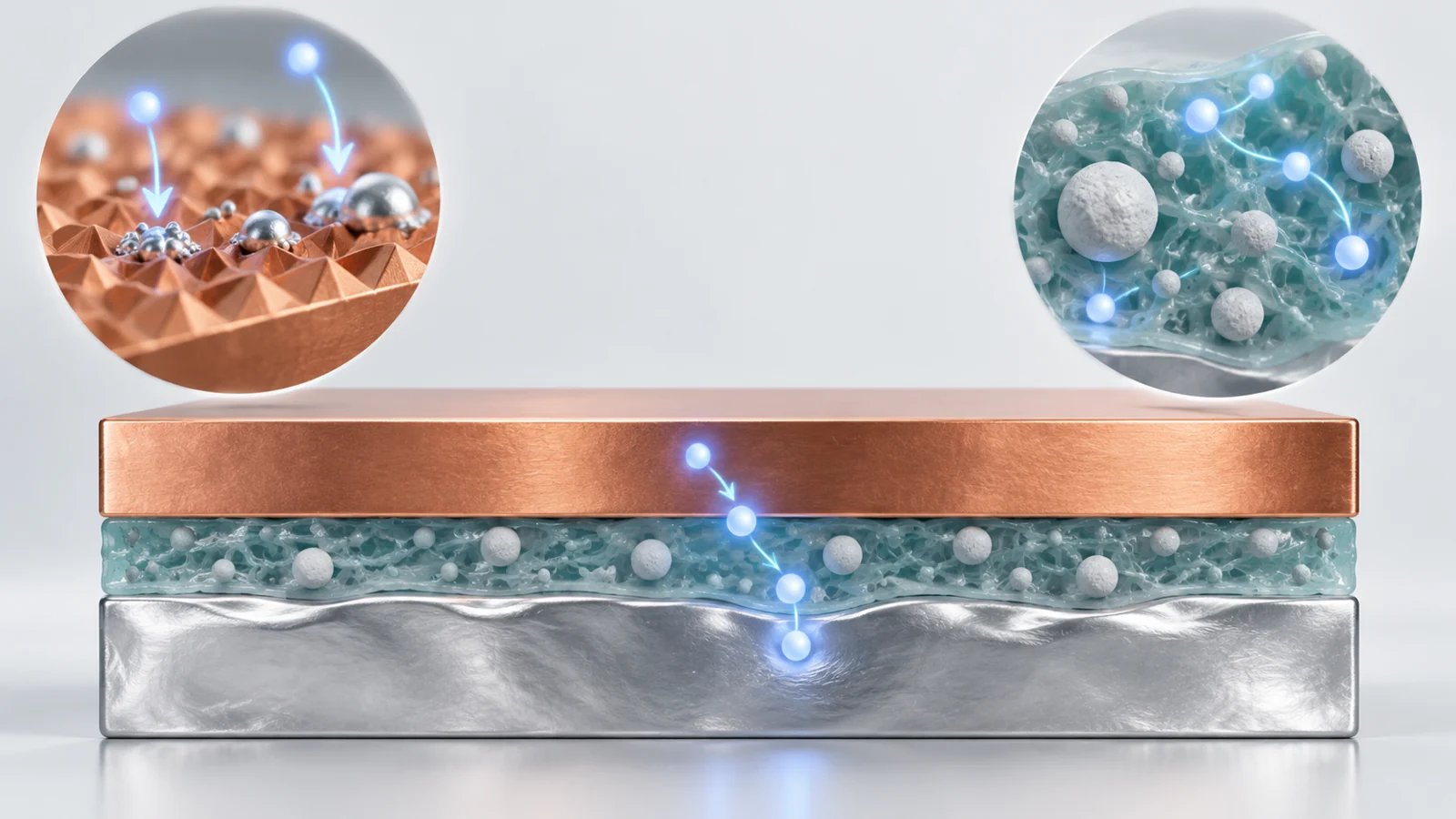
A battery’s electrodes do not meet the electrolyte at a perfectly clean boundary. As the battery begins operating, reactions at the electrode surface can build a thin layer known as the solid electrolyte interphase, or SEI. It is often treated as necessary protection around lithium metal. The more ambitious idea examined in the July 27, 2026 research article “Engineering the solid electrolyte interphase as a solid-state electrolyte” is that this layer might also do the electrolyte’s job: carry lithium ions between the electrode surfaces while its electronic transport is also measured.
That changes the engineering question. Instead of describing the interphase mainly as a helpful or harmful film, researchers can ask whether its ion transport, electronic transport and lithium-ion selectivity are good enough for a specific battery architecture. The study tests that possibility in separator-free copper–interphase–lithium cells, where the interphase itself occupies the critical space between the current collector and lithium.
A formation recipe changed the first charge-recovery result
The clearest comparison varies the concentration of lithium bis(fluorosulfonyl)imide, or LiFSI, salt in the solvent DME. Moving from 4 M to 6 M was reported to produce an interphase associated with a rise in first-cycle coulombic efficiency from 32% to 85%. Coulombic efficiency here is a charge-recovery measure: it compares the charge recovered from lithium during a cycle with the charge supplied to form or move it. A higher value means less of that supplied charge was lost in the first cycle under the tested conditions.
The comparison also involved an eightfold difference in current density, so it should not be read as a concentration-only experiment performed with every other condition held constant. Its significance is more specific. The authors connect the salt-rich formulation with a shift toward interphase products derived more heavily from the anion and enriched in inorganic material. That chemical change is proposed to improve how lithium ions move through the layer, helping the interphase function more like a solid electrolyte in the test arrangement.
The 32% to 85% result therefore shows a strong change in first-cycle charge recovery alongside a change in formation chemistry. It is not, by itself, a direct measurement of ionic conductivity, nor does it isolate salt concentration as the sole cause. The useful point is that the chemistry created at an electrode boundary can be treated as something to tune rather than as an unavoidable by-product.
Where lithium starts matters separately from layer strength
Transport is only one part of the problem. Lithium also has to begin depositing in a location that does not create an easy path toward a short circuit. The study treats this as an interfacial nucleation question: surface modification of the current collector can influence where lithium begins to form relative to residues in the interphase that may conduct electrons.
That spatial control is different from making the layer physically tougher. In a separate structural approach, the researchers incorporated ceramic nanoparticles such as silica, titania and alumina into chemically formed interphases. The particles are intended to reinforce the layer, much as a filler can strengthen a composite material. In this picture, surface treatment governs the starting location of lithium, while ceramic reinforcement addresses whether the interphase can withstand the stresses associated with repeated plating and stripping.
Keeping those functions separate helps explain why a single headline number cannot summarize the whole design problem. An interphase may transport ions effectively yet still fail if lithium nucleates in an unfavorable place. A mechanically robust layer may still be inadequate if ions cannot cross it efficiently. The experiments present chemistry, deposition location and physical integrity as connected but independently addressable engineering concerns.
What a separator-free test can show
A separator-free Cu|SEI|Li arrangement makes the interphase’s role unusually visible. If plating and stripping can proceed without a conventional separator in the test structure, the result supports the idea that the interphase can provide a solid ion-conducting pathway in that limited architecture. The reported first-cycle comparisons also show why formation conditions and interface design deserve to be measured rather than described only with broad labels such as “protective.”
But first-cycle coulombic efficiency is a narrow endpoint. It does not establish energy efficiency, long-term capacity retention or useful battery lifetime. Nor does separator-free operation alone show that no liquid was involved during preparation or testing, or that the arrangement is already a finished all-solid-state battery. The evidence supports a laboratory demonstration of a functional role for the interphase; it does not settle how the approach would behave in a sustained full cell, under practical manufacturing constraints or across commercial operating conditions.
The same caution applies to combining the interventions. The selected results identify separate ways to alter formation chemistry, nucleation behavior and mechanical robustness. They do not establish from this evidence surface modification, salt adjustment and ceramic reinforcement working together in one integrated battery with sustained performance. Cost, scale, pack safety, charging speed and application-level behavior remain separate questions.
What this could change
If these interphases can be made reliably and remain stable over extended cycling, a battery could form part of its own solid ion-conducting structure at the electrode boundary instead of relying on a separately manufactured solid electrolyte layer for every function. That could open a route to thinner or more tightly integrated lithium-metal architectures, with the potential to simplify how the active interface is built and tuned.
The benefit would depend on solving the coupled problem revealed by this work: chemistry must support ion transport, lithium must deposit in a controlled location, and the resulting composite must retain its structure. A first-cycle improvement is an early sign that those properties can be engineered, not evidence that the full route is ready for a product. The larger possibility is a battery design in which the boundary between liquid-electrolyte and solid-state approaches becomes less absolute because an in situ formed interphase carries more of the electrolyte’s job.
Key Sources
- Primary source: Engineering the solid electrolyte interphase as a solid-state electrolyte.
DOI or Journal Page · Peer-Reviewed Paper · 2026-07-27