
Since the previous research note · Earlier expectation not tested
Track continuity
Since the previous research note: How preparation keeps a sulfur battery’s charge-carrying particles connected
Previous expectation: Preserving connected lithium-ion and electron pathways in sulfur composite cathodes under practical cycling conditions could support more durable solid-state lithium-sulfur batteries.
What this study adds: This preprint examines a different problem, the moving lithium–electrolyte boundary, and identifies a modeled role for long-range feedback in suppressing shape disturbances. It proposes candidate self-regulating material mechanisms without testing the earlier cathode-connectivity forecast.
What changed in this study
A solid-state battery replaces a liquid electrolyte with a solid one, but the boundary between the lithium metal and that solid still moves during charging and discharging. As lithium is deposited or removed, the boundary can develop shape changes that feed back into how current flows. An August 6, 2024 arXiv preprint asks whether a material could sense those changes and help correct them as they develop.
Its reduced-order model connects interface growth with mechanical deformation, temperature, and electrochemical behavior. The central proposal is that a corrective response may need to travel across the interface rather than act only at the spot where an uneven feature first appears.
A solid battery still has a moving boundary
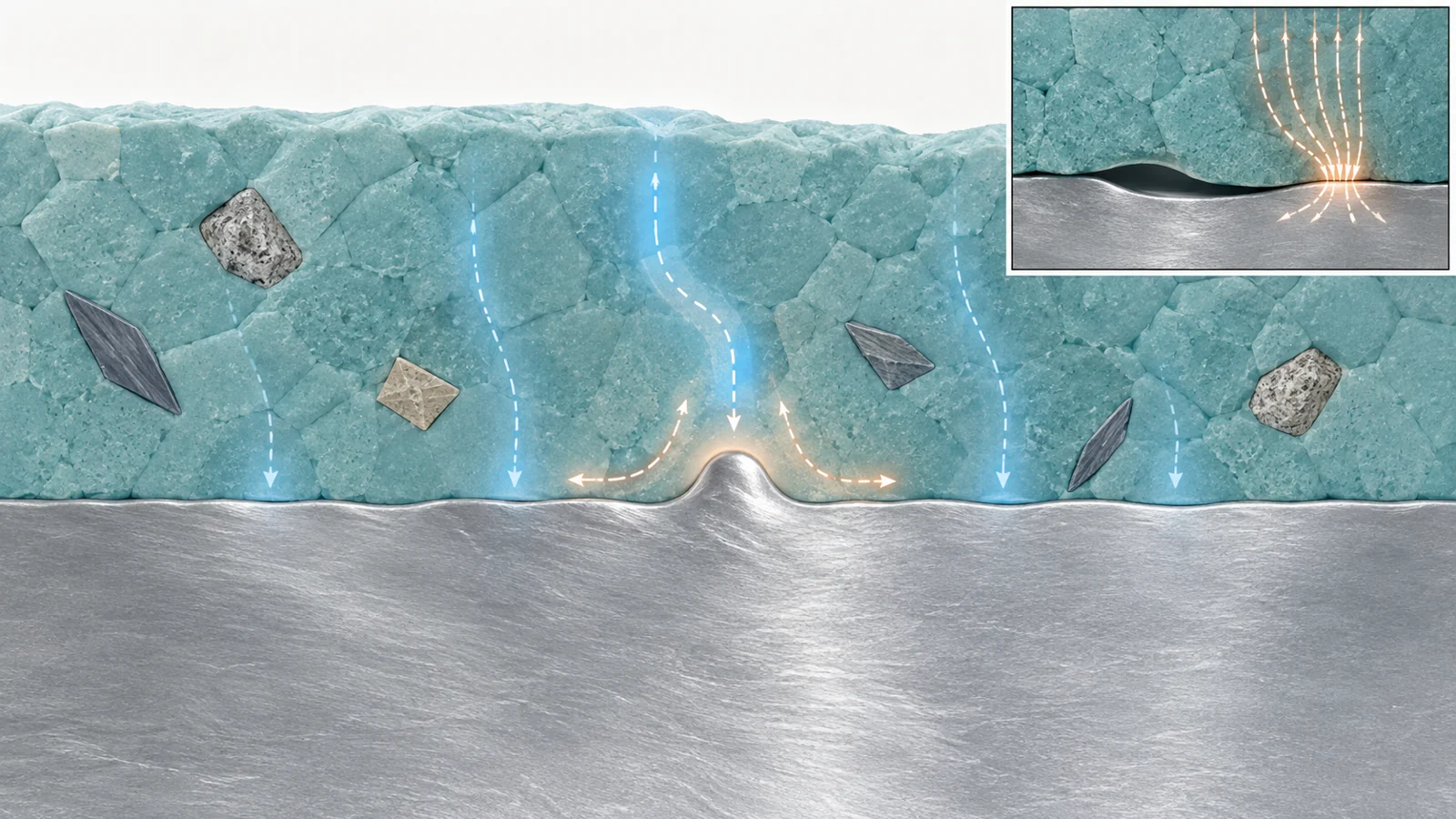
An initially assembled lithium–electrolyte interface can be flat and fully contacted. During lithium plating, however, deposition may not remain uniform. Some parts of the metal surface can advance more than others, causing the once-flat boundary to deform while contact is still maintained.
That roughening is an important early stage, but it is not the same as complete contact loss. As the lithium surface becomes more curved, it can become incompatible with the relatively flat electrolyte. At sufficiently high current density or after sufficient time, the two surfaces may separate locally. Those gaps are voids.
The separation then changes the electrical and electrochemical landscape. Current has fewer regions through which to pass, so it becomes concentrated in the portions that remain in contact. That concentration can accelerate lithium deposition there, encouraging filament-like growth and making the interface more unstable. The sequence is therefore cumulative: uneven growth can create deformation, deformation can promote void formation, and lost contact can intensify the uneven growth that started the process.
Stability means disturbances die away
The preprint treats the boundary as a moving interface and asks what happens to small departures from a flat shape. In this setting, stability has a practical mathematical meaning. A small shape disturbance is stable when it shrinks with time; it is unstable when it grows.
The model describes disturbances with different wavelengths. A short-wavelength disturbance represents a change over a relatively narrow region. A long-wavelength disturbance represents a broader rise or dip spread across the interface. Looking across wavelengths matters because a design can suppress one kind of roughness while allowing another to keep growing.
The authors use a linear stability analysis to calculate growth rates for these small disturbances. A negative growth rate means that the corresponding modeled disturbance decays. A positive rate means that it expands. Slowing the fastest-growing disturbance is not the same as making every analyzed disturbance decay. A genuinely stable regime requires the growth rate to be negative across the relevant disturbance range in the model.
That distinction gives the study a sharper target than simply making a surface look smoother at one location. The question is whether the coupled mechanics, transport, temperature, and electrochemical response can prevent the interface from amplifying shape variations at all of the wavelengths that matter to the analyzed system.
Why local correction eventually runs out
In the uncontrolled case considered by the authors, the instability includes long-wavelength changes. These broad variations are difficult for a response that acts only near the original disturbance. A local correction may reduce roughness over a nearby patch, yet still leave a larger-scale deformation untouched. In the model, local feedback therefore does not provide lasting interface stability: roughening eventually remains possible.
The comparison changes when the corrective response can operate over a longer distance. Suitable long-range feedback can couple separated parts of the interface, allowing a broad variation in shape to influence material behavior beyond the point where it began. Under modeled conditions, increasing the relevant long-range feedback can move the system into a regime where the disturbance growth rates are negative.
This does not mean that every local surface treatment in every solid-state battery must fail. It means that, for the instability and parameter ranges analyzed here, a response confined to the immediate neighborhood of a defect cannot address the full set of growing modes. The proposed advantage of long-range feedback is its reach across the interface, not simply a stronger version of a local patch.
A material response could travel through the interface
The study takes inspiration from biological growth systems that maintain an overall shape while their parts continue to change. The authors use that idea to propose self-regulating electrochemical interfaces in which embedded inclusions respond to the local state of the material and influence the surrounding region.
One possible mechanism involves a species called a morphogen in the model. Inclusions could release or absorb it as the interface changes. The species would then diffuse through the material, carrying information about a local transition to neighboring regions. Its concentration could alter mechanical behavior, such as swelling or a preferred curvature, or it could change an electrochemical property that affects lithium transport.
The preprint gives sodium as an illustrative electrochemical possibility. If sodium occupies sites important for lithium diffusion, a concentration-dependent response might reduce deposition where lithium growth is becoming too strong. In a mechanical version, the same kind of concentration field could influence swelling and reshape the forces acting on the boundary. These are proposed ways a material might turn a spatially distributed chemical response into feedback on interface growth.
The important feature is not the name of one candidate species or inclusion. It is the combination of sensing, transport, and response. A local change would need to generate a signal, that signal would need to move far enough through the interface, and the resulting mechanical or electrochemical change would need to oppose the original shape disturbance. The model provides a way to compare such mechanisms before a specific material has been established.
A stable calculation is not yet a working cell
The most encouraging result is a stability result within a modeled system. The analysis indicates that suitable long-range feedback can produce negative growth rates for the disturbances it examines, while local feedback eventually leaves the interface vulnerable to roughening. That identifies a design principle and a set of relationships for future material discovery.
It does not, by itself, show that an operating battery will recover from a large deformation. Linear analysis starts with small disturbances, so its conclusions do not automatically cover arbitrary voids, severe roughness, changing operating conditions, or every stage of a charge cycle. A material that behaves as required in the reduced-order equations would still need to be fabricated and tested to determine whether its feedback response can persist in a real interface.
The preprint therefore supports a narrower conclusion than a claim of a self-correcting battery. It shows how a moving lithium–electrolyte boundary could be analyzed and why the distance over which feedback acts may determine whether roughness is suppressed or merely delayed. Questions about cycling durability, charging performance, safety improvement, manufacturing, and deployment remain outside what this modeled result establishes.
What this could change
If materials can implement the proposed corrective response and keep it effective during practical cycling, battery designers could gain an interface that counters uneven lithium growth as it develops. By helping preserve contact, such a response could reduce the progression from roughening to void formation and concentrated current, potentially supporting more durable operation in high-energy lithium-metal cells.
That possibility was still a materials-design direction in August 2024, not a demonstrated device capability. Its value lies in changing the engineering question from how to make an interface rigid enough to resist every disturbance to how a material might actively redistribute mechanical or electrochemical responses across a moving boundary.
Key Sources
- Primary source: Controlling moving interfaces in solid state batteries
arXiv · Preprint · 2024-08-06