
Since the previous research note · Earlier expectation not tested
Track continuity
Since the previous research note: The hidden material between ceramic grains helps explain the best pellet
Previous expectation: Reproducible control of material between LAGP ceramic grains could reduce internal ion-transport losses if electrode interfaces did not become the larger bottleneck.
What this study adds: The current preprint introduces thermal sensing of the buried lithium–LLZO contact and reports contact evolution during operation with a microscopy cross-check. This adds an interface-diagnostic milestone without testing the earlier LAGP materials forecast.
What changed in this study
A solid-state battery replaces the familiar liquid electrolyte with a solid ion-carrying material. Lithium metal touches the solid electrolyte inside the cell, where the contact can change during operation. Opening the cell to inspect that boundary changes the conditions being studied, so a dismantled-cell image is not the same thing as watching the interface work.
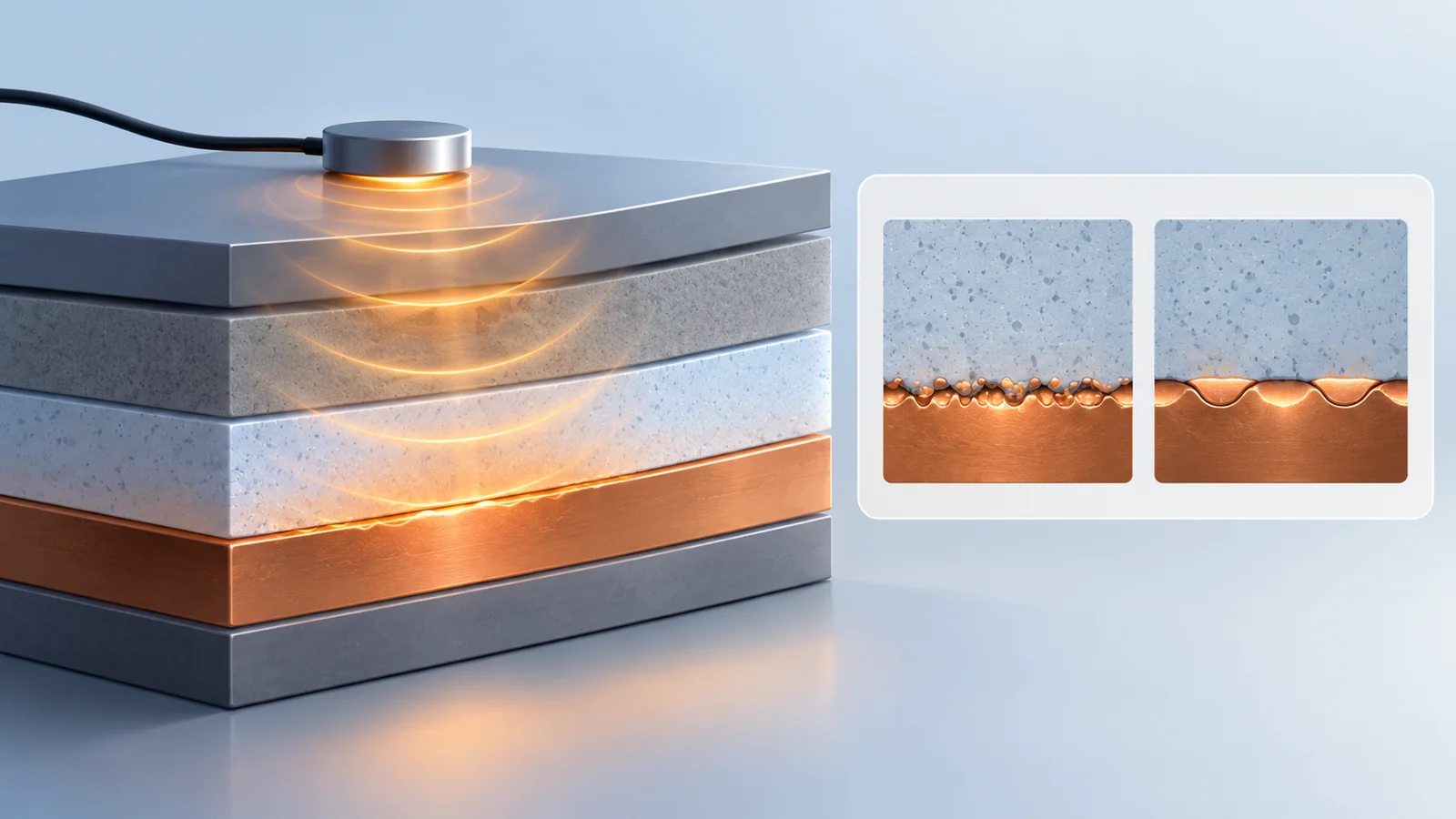
A December 24, 2022 experimental preprint proposes a way to follow that hidden boundary from outside the cell. The approach uses modified 3-omega thermal sensors attached to the lithium–solid-electrolyte cell. Instead of trying to see the interface directly, the experiment measures how heat crosses it and uses that response to estimate how the physical contact is evolving.
The measurement turns heat flow into a contact estimate
The basic idea is easier to understand as a chain of translations. A sensor sends a thermal disturbance through the cell assembly. The response is fitted to obtain a thermal interface resistance, a quantity that describes how difficult it is for heat to pass across a boundary. That fitted resistance is then interpreted with a contact model to connect the thermal result to physical features of the lithium–electrolyte interface.
The 3-omega name identifies the thermal sensing method; the important reader-facing point is what the method does. It converts an external thermal response into an estimate of how well the two materials are physically touching. The preprint uses the fitted resistance and its model to reason about changes in contact morphology rather than presenting a camera-like image of the buried surface.
That distinction matters. The result is an indirect measurement of contact morphology, not a direct picture of every feature at the interface. It can still be useful because the cell remains assembled while the measurement is made, preserving the operating experiment that a destructive inspection would interrupt.
Cycling revealed fewer contacts with larger individual footprints
The reported interface trend was not simply that contact disappeared. The analysis indicated a decrease in contact density together with an increase in the size of individual contacts. Those changes can occur at the same time. Imagine a surface that begins with many separate touch points. As the interface changes, some of those points may be lost while the remaining ones become larger. The number of contacts falls even as the typical size of each surviving contact grows. Contact size, in other words, is not the same as total contact area.
The measurements were made during galvanostatic tests using a 20 μA current, corresponding to 17.68 μA/cm². The experiments transferred 450 μAh of lithium, described as an equivalent thickness of about 2 μm between the two sides of the ceramic electrolyte. These details set the laboratory conditions for the reported evolution; they do not turn the thermal estimate into a universal rule for every solid-state cell.
Microscopy provided a separate check on the general direction of the inferred change. After the relevant experiments, scanning electron microscope images of lithium deposited on the LLZO surface were consistent with the pattern of lower contact density and larger individual contact size. The images supported the trend, while the thermal measurement supplied the route for monitoring the interface during operation.
Electrical response depends on the interface configuration
The preprint also helps separate two questions that are easy to blend together: what the lithium physically touches, and what an electrical measurement records under a particular layer arrangement.
In the reported gold-layer configuration, electrical impedance was unaffected by external pressure when a thin gold layer was present. The interface overpotential, however, varied with pressure when the gold layer was absent. This is a configuration-specific result. The layer changes how the electrochemical response is produced, so an electrical quantity that appears stable under pressure in one arrangement does not automatically provide a complete readout of physical contact evolution.
That comparison is useful because the thermal approach is aimed at the buried physical contact. It does not establish that electrical impedance is generally insensitive to changes in lithium contact. Rather, it shows why the same pressure change can look different depending on the measurement configuration and why a thermal contact estimate can add information that a single electrical readout may not capture.
Pressure and material properties set different limits
Two limitations sit at different points in the measurement chain. The first is mechanical. Sensor durability restricted the experiments to a maximum pressure of 1.25 MPa. That is an operating limit of the sensing arrangement, not a statement that the interface stops changing above that pressure or that the method has been validated across higher-pressure conditions.
The second limitation concerns interpretation. The measured resistance must be fitted with thermal properties for the materials in the stack and then translated through a contact model. The preprint identifies uncertainty in lithium’s thermal conductivity as the main contributor to the error bars in the reported results, with the uncertainty estimated at 5% of the standard conductivity value used in the analysis. A thinner lithium foil, below 100 μm, was identified as one way the overall measurement uncertainty could be improved.
The 5% figure should not be read as 5% accuracy for the entire sensing method. It describes one important input uncertainty. The final contact estimate also depends on the fitting procedure, the other material properties and the assumptions built into the elastoplastic thermal contact conductance model. The method therefore offers a way to monitor a hidden interface, but its quantitative interpretation remains tied to the model and to the conditions under which the sensor can survive.
What this could change
If the sensor remains durable under the pressures and cycling conditions relevant to a wider range of cells, and if the contact model can be kept reliable as those conditions change, battery developers could follow buried lithium–electrolyte deterioration in assembled test cells without dismantling each one for every observation. That would make it easier to compare interface designs and pressure choices while preserving the cell for continued operation. If those comparisons eventually lead to designs that preserve contact and demonstrably retain usable capacity over more charge–discharge cycles, the downstream benefit could be longer-lasting solid-state batteries. That performance benefit still requires separate testing; it was not demonstrated here.
The near-term value is a new kind of experimental visibility: not a direct map of individual defects, but a non-invasive way to connect an external thermal measurement with the changing physical contact inside. Used alongside electrochemical tests and occasional microscopy, it could help researchers identify when a solid-state cell’s internal boundary is reorganizing and distinguish that evolution from what a single electrical measurement happens to show. The preprint establishes that possibility at the laboratory scale; it does not establish longer battery life, commercial readiness or a guaranteed way to prevent failure.
Key Sources
- Primary source: Using thermal interface resistance for non-invasive operando mapping of buried interfacial lithium morphology in-solid state batteries
arXiv · Preprint · 2022-12-24