
Since the previous research note · Earlier expectation not tested
Track continuity
Since the previous research note: A nearly pure silicon anode meets a sulfide solid electrolyte
Previous expectation: Silicon-rich anodes could help complete batteries store more energy in a given space or mass if their capacity and durability survive scale-up.
What this study adds: This source introduces a model distinguishing two lithium transport mechanisms and benchmarks it against a lithium-metal/LiPON/lithium-cobalt-oxide thin-film cell. It adds a modeling milestone without testing the earlier silicon-anode forecast.
What changed in this study
A battery is more than a material that lets lithium move. The important question is how that movement affects the behavior of the complete cell: its electrical potential, currents at interfaces, changing concentrations and eventual operating limit.
An April 7, 2021 arXiv preprint addresses that question with a mathematical model for a solid-state battery, meaning a battery whose electrolyte is solid rather than liquid. The work distinguishes two ways lithium can travel through the electrolyte, represents the full cell in three dimensions and uses finite-element calculations to follow several connected quantities. It then compares the model with a previously published experiment on a lithium-metal, LiPON and lithium-cobalt-oxide thin-film battery.
The result is a modeling milestone, not a report of a new battery performance gain. Its value lies in making the path from microscopic transport assumptions to whole-cell behavior explicit enough to examine.
A battery question hidden inside an ion pathway
The paper begins from a practical tension in all-solid-state battery research. Solid electrolytes are being investigated partly because conventional liquid electrolytes raise safety concerns and partly because solid-state designs are associated with the possibility of high energy density. But a useful calculation must connect the behavior of ions inside the electrolyte with what happens at both electrodes.
The authors therefore do more than survey earlier work. They select three earlier modeling papers for ideas that shaped their formulation, then assemble those ideas into a new model intended to be compatible with multiple spatial scales and fully three-dimensional. The proposed description includes the electrolyte, the electrodes and the interfaces between them, so it can be used to calculate how the parts of a cell behave together.
That whole-cell emphasis matters. A description of lithium transport in an isolated material can say something about movement through that material. It cannot by itself show which electrode becomes limiting, how interface currents develop or how the cell’s potential and concentrations evolve as lithium is extracted or inserted.
Two ways lithium can move through the electrolyte
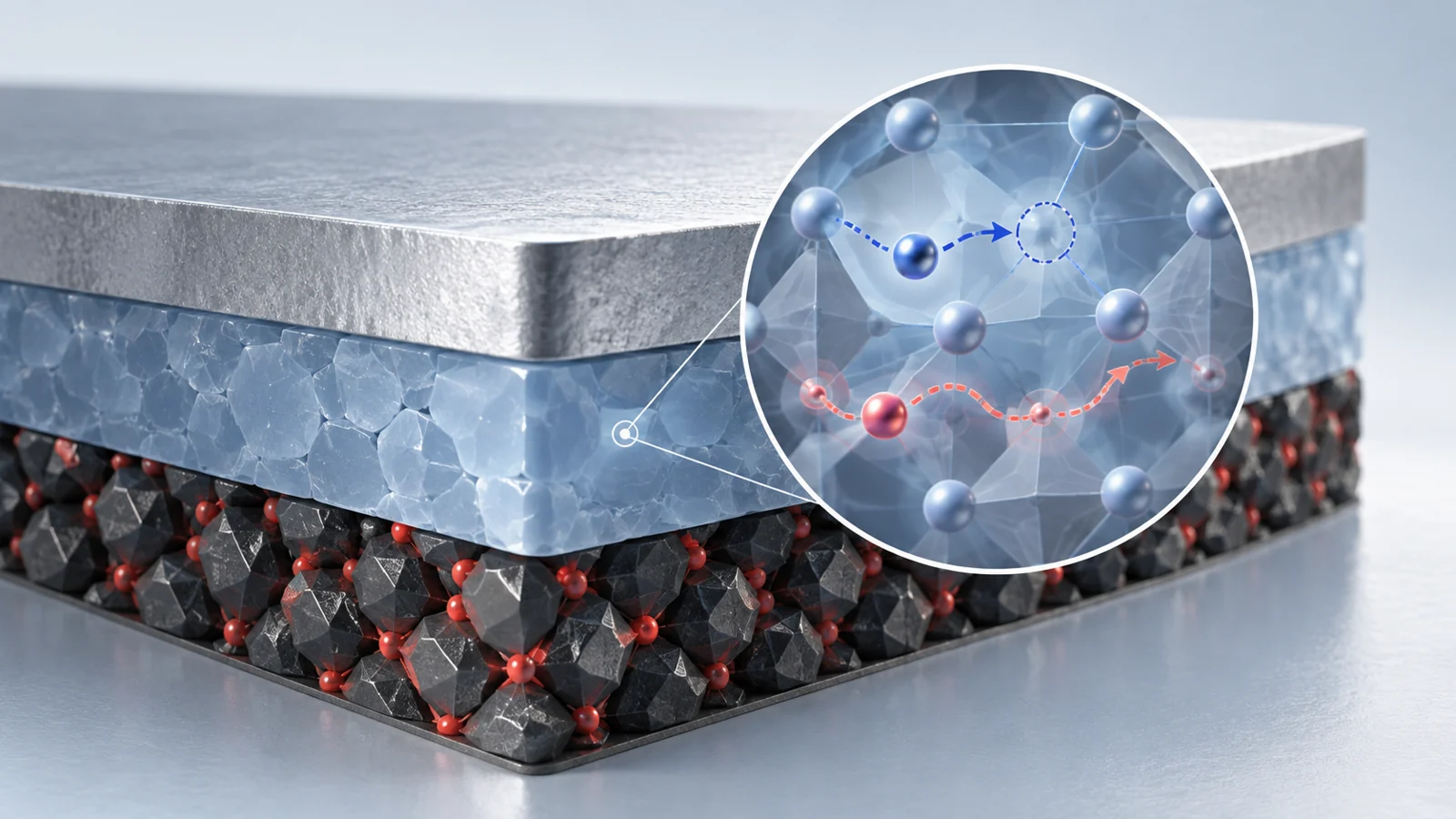
The model starts with lithium in different physical states inside the solid electrolyte. Some lithium is bound to host sites associated with the material’s structure. When a chemical ionization process makes mobile lithium available, it also creates vacancies: sites where lithium was originally present but is now absent. The vacancy carries uncompensated negative charge in the model.
From there, the mobile lithium is divided between two transport mechanisms. One part can hop into a neighboring vacant site. In that picture, movement proceeds through a sequence of available sites, with a vacancy providing the place the ion can occupy next.
Another part moves through a metastable interstitial state. These ions are not described as filling the same neighboring vacancies in the same way. They occupy an alternative mobile state within the solid and contribute to transport through a different physical route.
These are two mechanisms within the electrolyte, not two battery layers and not two external current paths. That distinction is central to interpreting the paper. The model is asking how different kinds of lithium motion can coexist and how their combined flux affects the cell around them.
The authors also treat the populations as connected. The chemical process makes lithium available, while a further reaction determines how much enters the hopping population and how much remains in the metastable interstitial state. This gives the calculation a way to represent changing concentrations rather than treating transport as a single uniform stream.
From local motion to full-cell behavior
The next step is to turn those local transport rules into quantities that can be compared across a battery. The finite-element calculations produce spatial profiles of electrical potential and lithium concentration, along with fluxes and currents at the interfaces. In other words, the model does not stop at asking whether lithium can move. It follows where the relevant variables change across the cell and how those changes interact.
This is also where the claimed three-dimensional, multiscale-compatible formulation becomes useful as a mathematical structure. A spatially resolved calculation can represent gradients through the electrolyte and electrodes, rather than collapsing the cell into one average value. Interface conditions then connect the regions, allowing the calculation to examine the transfer of lithium from one material to the next.
That description should be read as a capability of the formulation, not as proof that every scale or architecture has already been validated. The practical test in this paper comes from a particular thin-film cell. The authors compare two model formulations with previously published experimental outcomes for that cell, using material and geometrical parameters from the same experimental source.
A thin-film cell gives the model something concrete to test
For the benchmark, the authors use previously published measurements from a Li/LiPON/LiCoO2 thin-film battery. The positive electrode is a 0.32-micrometre layer of lithium cobalt oxide deposited on platinum. The negative electrode is a 0.50-micrometre lithium-metal foil, with the solid LiPON electrolyte between them.
Those dimensions make the comparison tangible. This is not an abstract battery with unspecified layers; it is a small, defined stack whose material and geometrical parameters are taken from the earlier experimental study. The paper evaluates two model formulations against the experimental outcomes and calculates the potential profiles, fluxes, concentrations and interface currents associated with the benchmark.
The comparison provides an anchor for the new transport description. It also sets a clear boundary around what the benchmark can show. Agreement with one previously studied thin-film configuration would support the usefulness of the formulation for that kind of calculation, but it would not by itself establish a numerical advantage over every predecessor model or show that the same description transfers unchanged to different chemistries, larger cells or practical battery architectures.
The receiving electrode can set the operating limit
Following the complete cell changes the interpretation of transport. The electrolyte may contain more than one route for lithium to move, yet the cell can still stop operating effectively when an electrode reaches its allowable concentration.
In the reported simulations, the cathode reaches its saturation limit and is identified as the factor that limits operation in the described cases. The important point is not a single time value. It is the relationship between transport through the electrolyte and the capacity of the electrode receiving lithium. Once that electrode reaches its modeled saturation, improving or rearranging the path through the electrolyte would not automatically remove the bottleneck.
This whole-cell result is why the paper’s scope extends beyond a study of ion motion. Potential differences drive interfacial processes, interfacial processes alter fluxes, and fluxes change concentrations in the electrodes. A limiting condition can therefore emerge at the far end of a transport pathway, even when the scientific question begins inside the electrolyte.
One thermodynamic question remains open
The model’s two mechanisms are physically different enough that their common mathematical treatment deserves scrutiny. The authors explicitly note that hopping and interstitial motion have different thermodynamic character, so using the same thermodynamic description for both may be questionable. They derive constitutive laws from a rigorous thermodynamic setting for the present work while identifying this issue for future development.
That reservation is more specific than a general warning that models are imperfect. It points to a place where the assumptions may affect how the two transport populations divide, how their fluxes respond to conditions and how confidently the calculated whole-cell limit can be interpreted.
The paper also does not turn the model into a demonstrated improvement in battery capacity, energy density, lifetime, charging speed or safety. The documented benchmark is a lithium-metal thin-film cell with LiPON and lithium cobalt oxide. It does not establish applicability to silicon-rich anodes, sulfide electrolytes or vehicle-scale batteries. The main advance described here is the attempt to connect two electrolyte transport mechanisms with the behavior of a complete cell, together with a defined experimental comparison.
What this could change
If this transport description, and its connection to whole-cell limits, proves reliable across relevant thin-film designs, battery researchers could use calculations like these to match an electrolyte’s transport behavior more closely with the electrodes it serves and with the current demand a cell is expected to handle.
If those predictions are confirmed across relevant designs, better matching the electrolyte and electrodes could help designers build thin-film cells that supply a required current for longer before cathode saturation ends operation. That benefit would have to be demonstrated in cells designed using the model; the reported benchmark does not establish it.
Key Sources
- Primary source: A novel two-mechanism full battery model for solid state Li-ion batteries: review and comparisons
arXiv · Preprint · 2021-04-07