
Since the previous research note · Earlier expectation not tested
Track continuity
Since the previous research note: A repairable polymer is cast onto both battery electrodes
Previous expectation: A repairable polymer cast directly onto electrodes could help lithium–sulfur cells preserve contact during use while simplifying interface assembly.
What this study adds: This preprint models how active-material loading, electrolyte deformation and external pressure affect mechanical defects within a composite cathode, including an NMC-based design map. It adds a distinct mechanical-design contribution without testing the earlier polymer or casting approach.
What changed in this study
Adding more energy-storing material to a battery’s positive electrode sounds like a straightforward route to higher energy density. In an all-solid-state battery, however, that material is part of a packed composite rather than a standalone slab. Active particles sit alongside a solid electrolyte, and the whole mixture must accommodate the particles’ movement during charging and discharging.
A theoretical preprint published on June 30, 2023, investigates what happens mechanically when that balance changes. Its subject is not a demonstrated improvement in working-cell performance. Instead, it models how active-material loading, the mechanical properties of the solid electrolyte and pressure applied to the assembled cell influence three different forms of cathode disruption.
The energy tradeoff begins inside the cathode
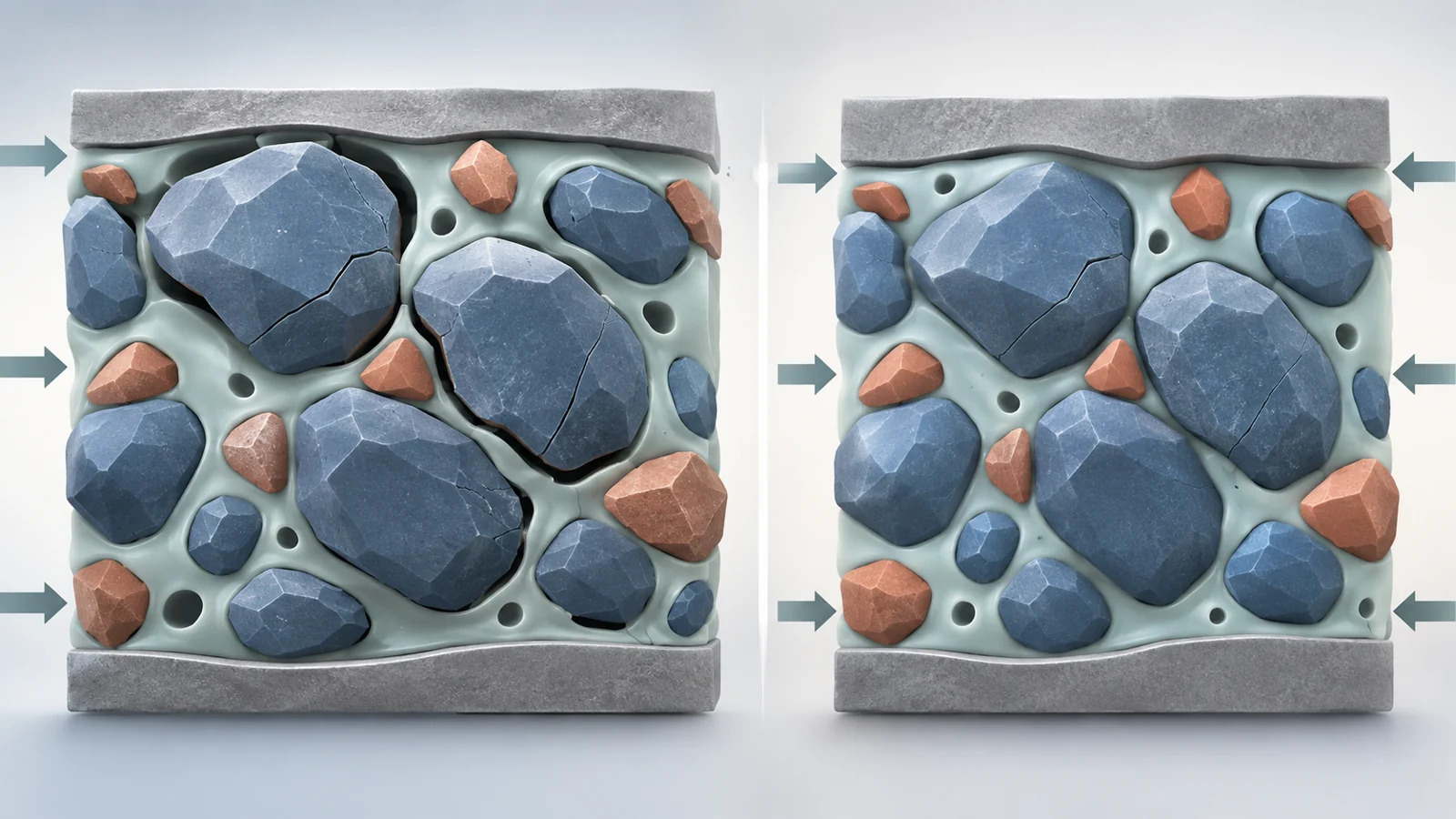
During lithiation and delithiation, the cathode’s active particles expand and contract at the lattice level. In a composite electrode, those small changes can accumulate into larger changes in the cathode’s volume and internal structure. The solid electrolyte has to deform around the particles while helping keep ionic and physical pathways connected.
The design tension is easy to state. Increasing the share of active material can leave more of the cathode occupied by the component that stores energy, but it also leaves less electrolyte available to accommodate movement. The preprint therefore treats cathode composition as a mechanical design problem as well as an energy-density problem.
The study represents the composite with a continuum representative volume element, or RVE. This is a modeled region containing active-material and electrolyte particles that stands in for the larger composite. To make the calculation more manageable, a two-part three-dimensional representation was reduced to a two-dimensional form using axial and plane symmetry. The result is a way to compare mechanical responses under controlled changes in composition and boundary conditions, not a microscopic image of a particular battery.
Three defects tell different parts of the story
The analysis follows three indicators: overall cathode volume expansion, loss of contact at the active-material and electrolyte interface, and porosity. They describe related consequences of particle movement, but they are not interchangeable.
Volume change asks how much the composite swells or contracts. Interfacial contact loss asks how much of the boundary between the two materials becomes detached. Porosity describes empty space that develops within the composite. A cathode can therefore perform differently on these measures at the same time. Less detached interface area does not automatically mean that the total volume change or pore formation has also improved.
That distinction matters because a single label such as degradation can hide the direction of individual changes. The modeled results are most useful when read as a set of mechanical signals: how much the composite moves, how much of its internal contact is lost, and how much empty space appears.
Material softness and pressure play different roles
The preprint compares solid electrolytes with different elastic and plastic properties. In the material comparisons, the three defect indicators generally increase as the electrolyte becomes stiffer elastically and plastically. A softer electrolyte can deform more readily around changing active particles, while a harder or stiffer one resists that accommodation within the modeled composite.
The abstract identifies a Young’s modulus below 10 GPa and a hardness below 2 GPa as favorable properties within the study’s design analysis. Those values are guidance from this particular model, not universal limits for every solid electrolyte or cathode architecture.
Applied stack pressure is a separate control. It is external compression applied to the assembled cell, expressed as force per unit area, rather than an intrinsic property of the electrolyte. The calculations compare 1, 3, 5 and 7 MPa. Across those conditions, the mechanical defect indicators generally decrease as pressure rises, and the abstract reports that pressure up to 7 MPa reduces defects while preventing internal fracture in the modeled cathode. That result should be read as a relationship within the analysis, not as a declaration that 7 MPa is an optimal or universally safe operating pressure.
The distinction between these levers is important. Choosing a material that deforms more easily changes how the composite responds internally. Applying pressure changes the boundary condition around the assembled structure. They may both reduce some modeled defects, but they are not interchangeable prescriptions.
The loading result is not a one-direction score
The study’s loading results show why readers should keep the three indicators separate. The abstract highlights active-material loading above 50 volume percent as a regime associated with larger mechanical defects, including cathode volume change above 5 percent, contact loss of 50 percent and porosity above 1 percent in the reported analysis.
A more detailed loading comparison uses a sulfide electrolyte and reports active material by weight rather than volume. That difference is not cosmetic. Weight fraction and volume fraction describe composition on different bases, so a threshold stated in one cannot simply be substituted for a threshold stated in the other.
In the specified comparison, increasing the active-material weight ratio from 60 to 80 percent raises modeled cathode volume expansion from about 3 to 5 percent. Porosity stays near 0.6 percent below 75 weight percent, then rises above 1 percent at 80 weight percent. At the same time, modeled interfacial contact loss decreases as the active-material loading increases.
That opposing movement is the central interpretive lesson. More active material does not necessarily make every mechanical indicator worse in the same way. A design may show less contact loss while developing more porosity and greater total expansion. The correct question is not whether loading produces a single higher or lower degradation score. It is which physical response is changing, under which composition definition, and whether the combined structure remains useful for electrochemical operation.
A design map turns tradeoffs into choices
The preprint combines the three indicators in a design map for an NMC-based cathode. It compares a named oxide electrolyte, LLZO, a named sulfide electrolyte, LPSCl, and a predicted electrolyte with desired mechanical properties. The predicted case is a modeled material description, not an experimentally realized substance established by the analysis.
The map’s contours represent a combined degree of defect based on cathode volume change, interfacial contact-area loss and porosity. The authors organize those dimensions with thresholds of 3 percent volume change, 50 percent contact-area loss and 1 percent porosity. These thresholds make it possible to visualize regions where different combinations of defects become more or less favorable in the modeled design space.
They are organizing choices for this analysis, not general physical failure boundaries or accepted industry criteria. Their value is practical and comparative: they show how active-material loading, pressure and electrolyte properties can be considered together instead of optimized one variable at a time.
What the model can and cannot tell us
The calculations turn a complicated composite into a tractable mechanical problem. That makes them useful for exploring relationships that would be difficult to isolate in a full cell, but it also shapes how the outputs should be interpreted. The symmetry-based reduction represents a selected geometry rather than every possible particle arrangement, and the loading analysis assumes that structural optimization allows all active-material particles to be fully utilized.
Some of the reported observations concern the mechanical state after one cycle. The model can therefore indicate how a given design responds under the chosen conditions, including whether volume expansion, contact loss or porosity trends upward or downward. It does not by itself establish a measured increase in working-cell energy density, longer cycle life or commercial readiness. The mechanical indicators must still correspond to realizable materials and preserve electrochemical function in working cells.
What this could change
If these modeled relationships hold in practical composite cathodes, they could give battery developers a way to accommodate a larger share of energy-storing material without treating mechanical damage as an afterthought. Instead of pursuing active-material loading alone, designers could pair it with an electrolyte whose deformation and hardness fit the intended structure, then consider external pressure as a distinct part of the cell design.
That would open a possible route toward higher cathode energy density while controlling swelling, detached interfaces and pore formation. The opportunity remains conditional: the favorable mechanical behavior would need to persist in realizable materials and assembled cells, without sacrificing the electrochemical function that makes the added active material valuable.
Key Sources
- Primary source: Mechanical investigations of composite cathode degradation in all-solid-state-batteries
arXiv · Preprint · 2023-06-30