
Since the previous research note · Earlier expectation not tested
Track continuity
Since the previous research note: Following lithium through different structures of the same solid electrolyte
Previous expectation: Deliberately controlling Li2ZrCl6 crystal arrangements could reduce resistance to lithium-ion motion if those arrangements can be produced and retained in working cells.
What this study adds: This review broadens the engineering picture to interfaces between crystals, electronic leakage, fracture and processing tradeoffs. Its iodide-doped halide example concerns boundary resistance and does not establish a test of that earlier forecast.
What changed in this study
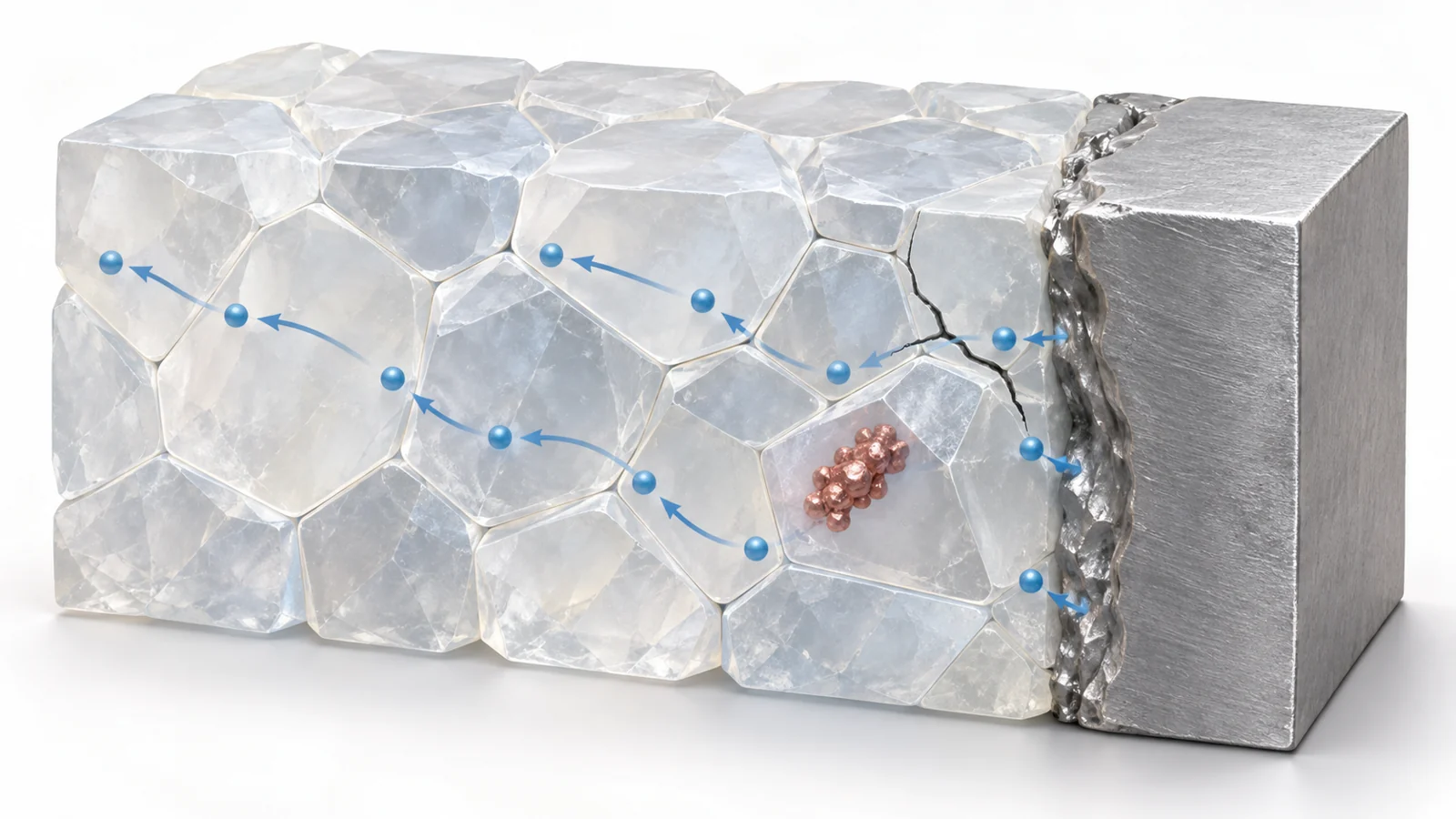
A ceramic solid electrolyte can look like one solid piece while being built from many adjoining crystals. The interfaces between those crystals are called grain boundaries. They are narrow regions where the atomic arrangement and chemistry can differ from the crystal interiors, and they can influence what moves through the material and what happens when the battery is pushed hard.
That makes them central to a practical tension in lithium-metal batteries. The ceramic must let lithium ions cross between the electrodes, while limiting unwanted electronic leakage and surviving the stresses created as lithium is deposited and removed. A path that is useful for ions is not automatically safe for the rest of the cell.
A review published as an August 2025 arXiv preprint brings together research on these boundaries in ceramic solid electrolytes and lithium-metal anodes. It connects boundary structure with ionic and electronic transport, dendrites, voids, fracture and processing. The review does not turn those separate studies into one universal treatment. Instead, it shows why the seams between crystals deserve attention alongside the crystals themselves.
The same ceramic can carry ions yet host internal lithium
Lithium-ion conduction and electronic conduction have very different consequences inside a solid electrolyte. Ions are supposed to travel through the ceramic between the electrodes. Electrons taking a similar journey can change the chemistry of the electrolyte itself.
The review discusses evidence from garnet-type LLZO in which its modest electronic conductivity is linked to lithium forming inside the solid electrolyte. The proposed sequence is important: electrons can allow lithium ions to be reduced prematurely to metallic lithium within the electrolyte. In that picture, a damaging lithium feature need not begin only at the visible electrode interface. It can initiate inside the ceramic, where electronic leakage helps create the metallic phase.
The comparison with LiPON makes the distinction clearer. LiPON has lower electronic conductivity and, in the reviewed discussion, does not show the same dendrite growth. That is not a claim that ionic conduction alone determines battery reliability. It is a reminder that a ceramic may transport lithium ions adequately while its electronic behavior creates another route to failure.
Grain boundaries matter because they can alter local transport and defect chemistry. The review describes space-charge layers at these interfaces, where charged defects can redistribute and change the local conditions for ion and electron movement. Whether a boundary behaves as a relatively helpful ion pathway or a vulnerable site depends on the material, its chemistry, its structure and the surrounding defects.
Grain size changes more than one ranking
The practical question is not simply whether a ceramic has many boundaries or few. Reducing boundary area can lower resistance to ion flow, but the same microstructure may not give the best resistance to cracking.
In the LLZTO examples discussed by the review, samples with larger grains and fewer grain boundaries reached higher total ionic conductivity. One reported LLZTO sample reached 1.01 × 10⁻³ S cm−1, and the review connects that result with larger grains and fewer boundaries. Processing additives also changed the boundaries through densification and interphase formation, so grain count was not the only variable involved.
Mechanical behavior followed a different pattern. Finer grains can strengthen a polycrystalline ceramic by encouraging cracks to deflect and lengthening their paths. Across all four samples, elastic modulus varied little, at 75–77 GPa; the review concludes that grain-boundary modification mainly affected fracture strength rather than stiffness. In other words, the boundary-related processing differences were more visible in fracture strength than in stiffness in that comparison.
This is why “largest grains” is not a complete design rule. Ionic resistance, fracture strength and stiffness describe different parts of the battery problem. A choice that improves one measured property may shift another, and the result depends on how the sample was made and which failure mode matters in operation.
Order inside the crystal is not the whole transport story
The review also offers a short counterexample to the idea that a more orderly crystal arrangement must always provide the best lithium-ion movement. In iodide-doped Li2ZrCl6, greater amorphization was associated with reduced grain-boundary resistance. The material showed shorter, more temperature-stable relaxation times than the compared composition, behavior that suggested improved ionic conductivity.
The useful lesson is specific rather than universal. Altering the boundary region can improve the way ions cross a polycrystalline material even when the change involves less local crystallinity. This example concerns boundary resistance; it does not establish that the same approach will simultaneously improve fracture behavior, electronic insulation and full-cell operation in every ceramic electrolyte.
A powder compact becomes a film with its own compromises
The boundaries do not disappear when ceramic particles are assembled into a usable electrolyte layer. Manufacturing must create enough contact between particles to form continuous ionic paths, while also producing a film that can withstand handling and electrochemical stress.
The review describes a LATP composite in which a PTFE binder network fills voids between particles, distributes the ceramic more uniformly and bridges contacts. That network can help suppress microcracks and lower grain-boundary and electrode–electrolyte impedance. Separately, its discussion of dry manufacturing identifies a tradeoff involving the degree of PTFE fibrillation.
Highly fibrillated films showed better mechanical strength but were more prone to PTFE reduction and current leakage. Films with less fibrillation were more electrochemically stable but mechanically weaker. The engineering task is therefore to create enough fiber structure for contact and integrity without making a continuous binder network that becomes a reduction-prone route for leakage.
This is a manufacturing-scale version of the same underlying challenge, but it is not interchangeable with the LLZTO grain-size results. The materials, preparation routes and measured properties differ. They illustrate related design pressures, not a demonstrated recipe that has already combined high conductivity, strong fracture resistance and electronic stability in one working cell.
Models can describe deposition without capturing every flaw
A model discussed in the review predicts a density-driven regime in which electrodeposition can remain stable. It also incorporates the molar volume of lithium ions in ceramic solid electrolytes and suggests that softer electrolytes may be more effective at preventing dendrite initiation under its assumptions.
That prediction has a defined boundary. The model does not account for surface imperfections such as defects and cracks, and those features can provide the places where dendrites eventually grow beyond an otherwise favorable idealized condition. A stable result in a model with smooth or simplified interfaces cannot automatically predict what happens in a ceramic whose real surface contains flaws.
Taken together, these examples do not establish that LLZO electronic leakage, LLZTO grain size, iodide-doped halides and PTFE fibrillation have been assembled, optimized and demonstrated together in a lithium-metal cell. Even the halide example is not an experimental test of whether useful Li2ZrCl6 arrangements can be produced and retained during operation.
A credible engineering path will therefore have to preserve several properties at once: ion transport across contacts, low enough electronic leakage, resistance to fracture and stable behavior at imperfect interfaces. The review’s value is to make those dependencies visible, not to erase them with a single ranking of materials.
What this could change
If researchers can control contact between ceramic crystals, limit electronic leakage and manage fracture without sacrificing ion transport, lithium-metal cells could eventually operate at useful rates with less external compression. The likely practical benefit is not merely a better material measurement. It could reduce the hardware burden needed to keep the stacked layers pressed together, provided the improvements survive the changing stresses and interfaces of a working cell.
That possibility remains conditional. The review points toward grain-boundary engineering, compliant interlayers and better processing as ways to address voids, dendrite problems and stack pressure together. Turning those possibilities into a durable cell would require the improvements to coexist in the same architecture and persist during operation.
Key Sources
- Primary source: Grain Boundaries in Ceramic Solid-State Lithium Metal Batteries: A Review
arXiv · Preprint · 2025-08-09