
Since the previous research note · Earlier expectation not tested
Track continuity
Since the previous research note: Inside LLZO, the lithium-conducting ceramic with two crystal forms
Previous expectation: A better understanding of LLZO's structure might help produce ceramic electrolytes that carry lithium ions more effectively, provided they also work with stable interfaces and suitable mechanical properties.
What this study adds: The current preprint models void evolution and current distribution at the lithium–electrolyte interface, with a lithium–LLZO material setting identified in the supplied text. It addresses an interface condition relevant to that expectation without testing whether structural understanding produces better ion transport.
What changed in this study
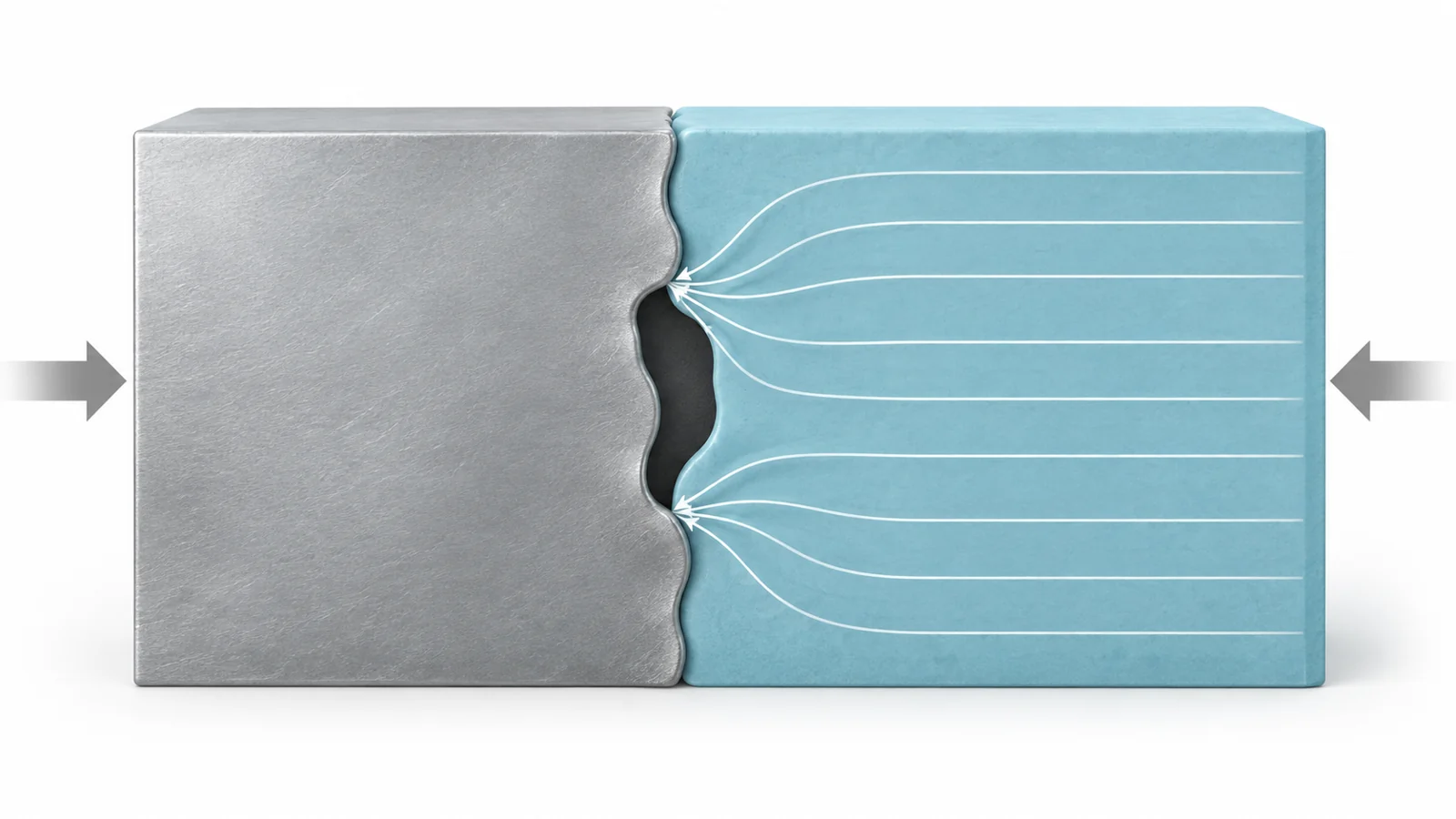
At the boundary between lithium metal and a solid electrolyte, physical contact helps determine how electrical current is distributed. As lithium is deposited or removed during cycling, that boundary can change shape. A local gap in the metal may then alter the routes available for current, creating concentrated regions that are relevant to later failure mechanisms.
A June 2022 preprint develops a numerical model for following that evolving interface. It treats the lithium electrode and the solid electrolyte as parts of one coupled electro-chemo-mechanical problem, linking material movement, deformation, mass transport and electrical current. The result is a way to ask how an interfacial defect develops under different conditions, without presenting the simulation as a demonstrated battery-life solution.
A gap is part of a moving system
The model does not treat a void as a fixed hole cut into an otherwise unchanged electrode. Lithium can move through the metal, dissolve from one region, deposit in another and deform gradually under stress. The formulation also represents vacancies, unoccupied atomic sites involved in the metal’s mass balance. Those vacancies are not the same thing as the larger void boundary visible at the interface: vacancy creation and removal help govern how that boundary evolves.
To represent this changing geometry, the authors use a phase-field formulation. In practical terms, this is a mathematical method for tracking a diffuse, moving boundary between lithium and an empty region rather than forcing the calculation to redraw a sharp interface at every step. The phase field is coupled to a viscoplastic description of lithium, which captures creep, or gradual deformation over time. Bulk and surface diffusion, together with current-driven lithium flux, complete the mass-transfer description.
That combination matters because the shape of a gap is not controlled by one process alone. Material can redistribute while the metal creeps, while lithium is dissolved or deposited, and while vacancies are formed or annihilated. The calculation can therefore connect a changing void boundary to the transport and mechanical processes that help produce it.
The interface is solved on both sides
The formulation includes the solid electrolyte as well as the lithium electrode. This lets the calculation determine how current is distributed through the electrolyte when the contact geometry changes. Regions carrying unusually concentrated current appear as local hot spots in the model.
Those hot spots are important as a predicted condition associated with dendrite formation and cell failure, but they are not themselves evidence that dendrites grew, that a short circuit occurred or that the simulated cell would last longer. The useful step is earlier in the chain: the model connects an evolving lithium-side geometry with a calculated electrical response in the neighboring electrolyte.
The supplied material-parameter description identifies a lithium-anode–LLZO-electrolyte setting. The study therefore provides a concrete material context for the coupled calculation, while the reported evidence here does not establish that the same behavior transfers across other electrolyte chemistries, cell formats, temperatures or commercial operating conditions.
Plating, stripping and pressure become testable variables
The numerical case studies consider both single and multiple voids. They vary applied pressure, material properties, current magnitude and cycling history during plating and stripping. Plating refers to lithium deposition; stripping refers to lithium dissolution. Examining both directions allows the calculation to pose different questions about how a gap changes as lithium is added or removed.
For example, the model can compare how a void evolves when the applied current changes, or how several voids interact through the current distribution in the electrolyte. It can also examine how pressure changes the electrode–electrolyte contact area within the modeled system. These are questions about relationships and evolving conditions, not a supplied recipe for an optimal pressure or a guaranteed operating threshold.
The formulation is especially useful for separating processes that are often compressed into a single label such as “interface stability.” It can track the roles assigned to diffusion, deposition and dissolution, creep, and vacancy nucleation or annihilation within one calculation. That does not make every predicted outcome independently confirmed, but it makes the proposed mechanism more specific than a static picture of a defect.
A mechanical fit is not a full battery test
The preprint connects its lithium deformation description to room-temperature stress–strain measurements taken at different strain rates. The mechanical parameters are selected by matching those curves, and the resulting values are then used in the subsequent calculations. This gives the creep-related ingredient a concrete experimental anchor.
The comparison supports the chosen mechanical representation under the conditions of that fitting exercise. It is different from independently validating the entire coupled model against battery experiments. The evidence described here does not establish a complete predictive error, a demonstrated extension of cell life or numerical operating limits for a working device.
That distinction is central to interpreting the contribution. The work is a mechanistic and numerical proposal with single- and multiple-void studies, not a report that a particular interface design has already solved uneven current or premature failure.
What this could change
If the coupled predictions prove transferable to working cells, and if practical mechanical conditions can preserve useful contact as lithium moves, battery developers could design lithium-metal interfaces that sustain more even current during cycling. That capability could reduce one route toward premature cell failure in all-solid-state batteries. Reaching that point would require the modeled relationships to hold beyond the studied setting and to remain workable alongside the material, geometry and operating constraints of real cells.
Key Sources
- Primary source: A phase field electro-chemo-mechanical formulation for predicting void evolution at the Li-electrolyte interface in all-solid-state batteries
arXiv · Preprint · 2022-06-29