
Since the previous research note · Earlier expectation not tested
Track continuity
Since the previous research note: How a battery model follows particles as contact breaks
Previous expectation: A validated particle-scale model could help designers find electrode arrangements that retain mechanical contact as lithium moves.
What this study adds: The current source adds a chemical account of lithium-removal-driven structural changes in a sulfur-based solid electrolyte and identifies associated X-ray signatures. Its Li6PS5Cl comparison suggests a possible local structural basis for improved stability without testing particle geometry or fracture predictions.
What changed in this study
A solid-state battery depends on a material that can carry lithium ions while remaining in place between the electrodes. That material is not necessarily chemically passive. At the boundary where it meets an electrode, the solid ion carrier can also take part in reactions that change its structure and add resistance to the battery.
An October 1, 2023 preprint, Atomic Insights into the Oxidative Degradation Mechanisms of Sulfide Solid Electrolytes, investigates how that process begins in a model sulfur-based material. The study combines electrochemical measurements, X-ray absorption spectroscopy, first-principles calculations and unsupervised machine learning to connect changes in a measured spectrum with changes in local atomic structure.
The result is a proposed atomic-scale account of what happens as lithium is removed from Li3PS4, a sulfide solid electrolyte. It does not amount to a direct recording of atoms moving one by one. Instead, the interpretation is built by comparing measured spectra with calculated signatures from candidate structures, then examining how those patterns evolve during delithiation.
The interface where the chemistry starts
The experiments used a cell with a Li3PS4–carbon working electrode, a Li3PS4 electrolyte pellet and a lithium–indium alloy counter and reference electrode. During a cyclic-voltammetry measurement, the voltage was swept toward more oxidizing conditions and then reversed. In this setting, the electrolyte was examined as lithium was removed and then returned through the electrochemical cycle.
That boundary matters because sulfide electrolytes have a narrower electrochemical stability window than oxide-based electrolytes, according to the study. When the local potential moves outside the range in which the material remains stable, chemical and electrochemical reactions can create a solid–solid interphase between the electrolyte and the electrode. Such an interphase is not automatically harmful, but its composition and structure influence how easily lithium can continue to cross the contact.
The central question is therefore more specific than whether the electrolyte decomposes. Which local bonds change first, and how can those changes be recognized when the experiment measures absorption by a material rather than displaying an atomic image?
Lithium removal reshapes a phosphorus–sulfur unit
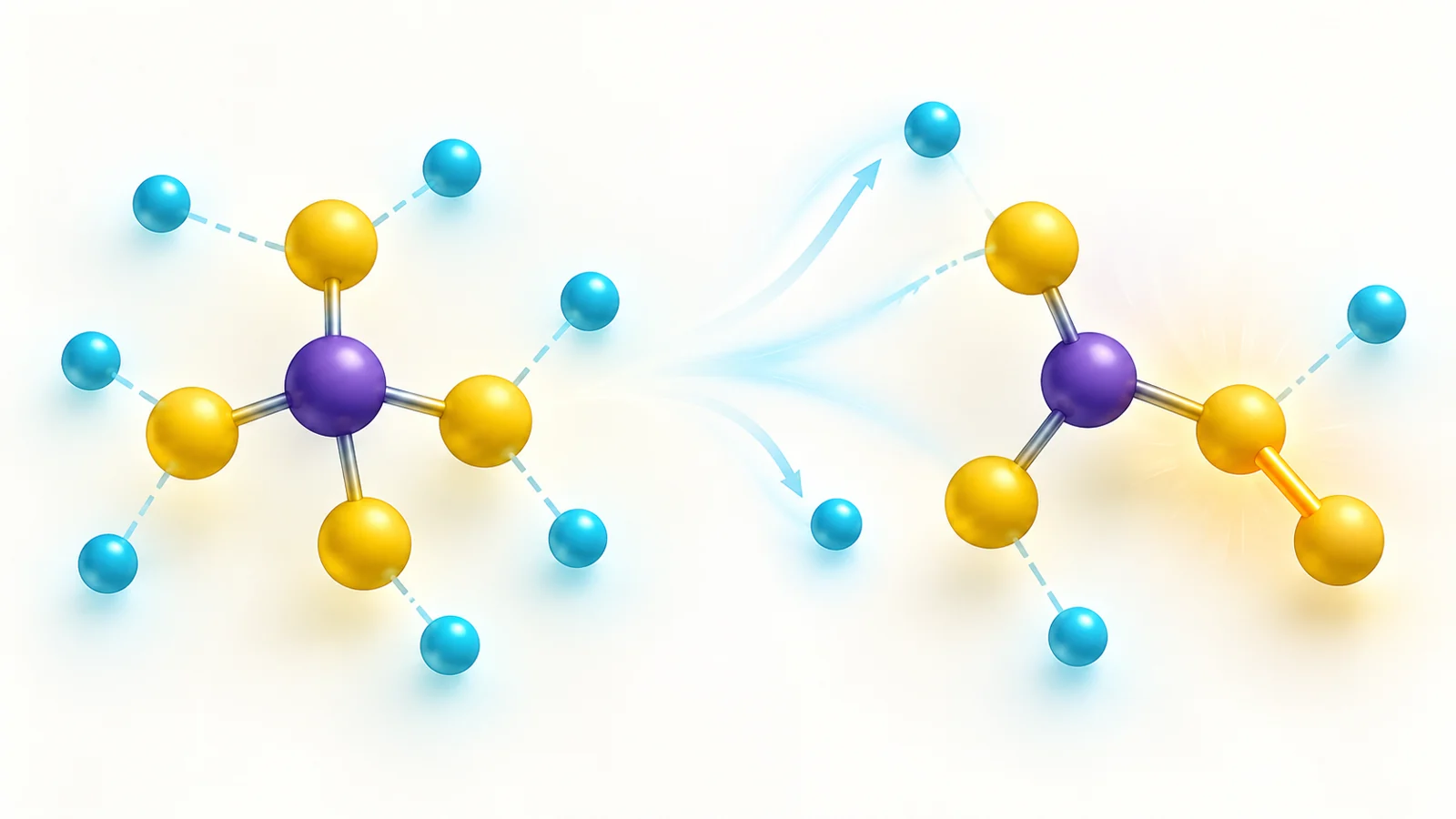
The model structure contains PS4 tetrahedra. A tetrahedron here means one phosphorus atom surrounded by four sulfur atoms, with the sulfur atoms occupying the corners of a roughly four-sided three-dimensional unit. Lithium ions sit around this network and help define the chemical environment experienced by the sulfur atoms.
The reported sequence begins when the sulfur atoms have less affinity for nearby lithium during initial delithiation. As lithium is removed, sulfur–sulfur bonds begin to form while the phosphorus-centered tetrahedra deform. The change is not simply a uniform shrinking or expansion of the whole material. It is a local rearrangement in which the original PS4 shape becomes increasingly distorted.
After the first delithiation cycle, strongly distorted PS4 motifs are present and PS3 motifs begin to appear. A PS3 motif can be understood as a changed local phosphorus–sulfur arrangement in which phosphorus is associated with three sulfur neighbors rather than retaining the original four-neighbor tetrahedral pattern. The appearance of PS3 motifs adds another local arrangement to the proposed degradation sequence.
The calculations also found delithiated structures with several intermediate lithium contents. Some fell on a shallow convex hull at zero Kelvin, meaning they were predicted to be thermodynamically stable relative to the selected reference compositions under that idealized condition. Those calculations helped supply candidate structures for the spectral analysis. They were not, by themselves, a universal operating-voltage map for a battery.
The structural changes were connected with a practical measurement. Greater distortion and destruction of PS4 tetrahedra, along with sulfur–sulfur bond formation, were correlated with increased interfacial impedance. That relationship links the local chemistry to a measurable electrical consequence, while leaving open how much each microscopic change contributes in a working cell.
How an X-ray spectrum becomes an atomic clue
X-ray absorption spectroscopy provides an indirect view of local surroundings. When the material absorbs X-rays near the characteristic absorption edge of an element, the shape and position of the resulting spectrum depend on the chemical and structural environment around the atoms being probed. The experiment therefore records a pattern, not a photograph of a PS4 tetrahedron changing shape.
To interpret that pattern, the researchers calculated phosphorus and sulfur K-edge spectra for many atomic sites in delithiated Li3PS4 structures. The databases contained 2,227 calculated phosphorus site spectra and 8,885 calculated sulfur site spectra. These numbers refer to distinct calculated site spectra in the databases, not to experimental cells, repeated batteries or independent measurements.
The calculated spectra supplied candidate fingerprints for different local arrangements. Unsupervised clustering then organized spectra with similar shapes without requiring every pattern to be assigned manually in advance. The purpose was to follow how spectral families changed as the local phosphorus–sulfur structures became more or less distorted.
Several features made the interpretation tangible. In the phosphorus K-edge measurements, the main peak broadened and shifted to higher energy by about 2.5 electronvolts during delithiation. In the sulfur K-edge measurements, a new feature appeared near 2473 electronvolts. The calculations linked these spectral changes to the evolving local structures, including the deformation of PS4 units and the beginning of PS3 formation.
This is the bridge between the measured and the atomic descriptions. A spectrum can be compared with a library of calculated possibilities, and the way its peaks broaden, shift or gain intensity can point toward a changing local environment. The conclusion is consequently an inference supported by experiment and computation together, rather than a claim that the atomic pathway was directly filmed.
A chlorine-containing material offers a comparison
The study did not stop with Li3PS4. It also examined the related argyrodite electrolyte Li6PS5Cl, a chlorine-containing sulfide material. Some sulfur sites in the argyrodite structure are replaced by halide ions, but the sulfur atoms around phosphorus remain arranged in PS4 tetrahedra.
The spectra associated with Li6PS5Cl indicated that distortion of those phosphorus–sulfur tetrahedra was greatly reduced compared with the Li3PS4 case examined in the study. The authors interpreted this as a possible local structural reason for different stability behavior: if the PS4 units resist deformation, the material may resist one part of the reaction sequence more effectively.
That comparison is useful because it turns the proposed mechanism into a design question. Instead of asking only which electrolyte conducts lithium rapidly in its initial state, researchers can also ask how its local structural units respond when lithium is removed at an interface. The spectral fingerprints provide one possible way to make that response visible.
The comparison does not show that chlorine substitution is a sufficient remedy for sulfide-electrolyte degradation in general. Li6PS5Cl is a related material with its own structure and chemistry, and the study’s result supports a possible connection between local PS4 stability and the observed spectral behavior rather than a universal rule for every sulfur-based electrolyte.
Where the interpretation needs care
The atomic picture is assembled from measurements and models that answer different parts of the question. The electrochemical experiment follows a material under a voltage-driven, kinetically evolving process. The structural calculations examine selected delithiated compositions and identify configurations that are favorable under idealized conditions, including zero Kelvin. A structure that appears on that calculated stability landscape may not be the only structure accessible at room temperature, and the experimentally reached material need not pass through every calculated equilibrium state.
The source also identifies a technical limitation in comparing calculated and measured X-ray spectra. Calculated spectra require energy alignment at the absorption edge, and different alignment procedures have limitations. The researchers benchmarked their spectral calculations against compounds with known experimental standards, but uncertainty in edge alignment can still affect how precisely a calculated peak is matched to a measured one. This matters especially when the interpretation depends on subtle shifts or on assigning a feature to a particular local motif.
The voltage calculations need similar restraint. The study’s structures indicate that Li3PS4 is fully delithiated above approximately 3.4 volts versus lithium under the modeled conditions. That value should not be converted into a universal safe operating voltage or an experimentally measured failure threshold. Practical interfaces also depend on the material state, contact arrangement and electrochemical history, while the calculation describes a specific model system.
Taken together, the evidence supports a coherent interpretation of local change: reduced lithium association around sulfur, sulfur–sulfur bonding, deformation of PS4 units and the emergence of PS3-like motifs. It does not establish that every intermediate in this sequence was independently observed, nor does it settle how the same sequence would unfold in every sulfide electrolyte or electrode combination.
What this could change
If the connection between local structure and interfacial degradation holds across a wider range of sulfur-based electrolytes, it could give materials developers a more direct way to screen candidates before relying only on long-duration cell tests. A measured spectral change could act as an early warning that the phosphorus–sulfur units responsible for the material’s initial structure are being altered during operation.
The practical payoff would not be the spectrum by itself. The larger possibility is to design electrolytes and interfaces that preserve useful local structures while lithium continues to move through the battery. If those structures remain intact under electrochemical cycling, the contact between electrode and electrolyte could retain ion-conducting pathways for longer, reducing one route to reaction-driven interface deterioration.
That outcome remains conditional. It would require the spectral fingerprints to remain reliable across realistic materials and interfaces, and it would require structural stability to translate into durable electrochemical contact in complete cells. The preprint provides a detailed chemical account of one model system and a comparison that points toward a possible design principle. Its contribution is the ability to connect an evolving X-ray pattern with a specific family of atomic changes, giving future electrolyte development a sharper way to ask what is happening at the interface.
Key Sources
- Primary source: Atomic Insights into the Oxidative Degradation Mechanisms of Sulfide Solid Electrolytes
arXiv · Preprint · 2023-10-01