
Since the previous research note · Earlier expectation not tested
Track continuity
Since the previous research note: A model follows lithium’s two ways of moving through a solid electrolyte
Previous expectation: A validated description of two ways lithium moves through a solid electrolyte could help researchers match electrolyte behavior to electrodes and operating demands in larger battery simulations.
What this study adds: This study adds experiments on lithium-rich alloy electrodes against a sulfide electrolyte and calculations of lithium migration within those alloys. It separates pressure-supported contact from internal electrode transport without establishing a test of the earlier electrolyte model.
What changed in this study
A solid-state battery electrode can remain in contact with its solid electrolyte and still fail to use all the lithium stored inside it. That distinction is central to a 2021 preprint on lithium-rich mixtures of lithium with indium or tin, two metals studied as alternatives to lithium metal in batteries that use a solid electrolyte.
The researchers report more than 1,000 hours of dendrite-free lithium cycling for two compositions, Li13In3 and Li17Sn4, at a current density of 1 mA/cm² and a capacity of 1 mAh/cm² in their laboratory experiments. The result is notable because it links long operating endurance with a carefully maintained boundary between the electrode and the sulfide electrolyte Li6PS5Cl.
But endurance is not the same as accessible capacity. Keeping the materials pressed together can preserve the route into the electrode. It cannot, by itself, make lithium move quickly through the alloy once it is inside.
Long cycling begins at the material boundary
The interface between an electrode and a solid electrolyte has to do several jobs at once. It must remain physically connected as lithium enters and leaves, and it must allow lithium ions to cross the boundary without creating a growing resistance that eventually stops the cell.
Lithium metal is attractive because it can store a large amount of charge, but its contact with sulfide electrolytes can change as lithium is removed or deposited. An alloy changes the problem by distributing lithium through a second metal. In this study, the researchers asked how that change affects both the boundary and the movement of lithium within the electrode.
Their highlighted materials were lithium-rich mixtures of metals: Li13In3, made from lithium and indium, and Li17Sn4, made from lithium and tin. The formulas describe identified intermetallic compositions rather than an unspecified blend. That matters because different proportions of lithium and the partner metal can have different structures and transport behavior.
The study compared more than one composition
To make that comparison possible, the researchers synthesized low-, medium-, and high-lithium compositions in both the lithium–indium and lithium–tin systems. The materials were prepared from stoichiometric mixtures of the constituent metals, followed by solid-state processing and high-energy ball milling. The resulting electrodes could then be studied as particular alloy phases rather than as a simple piece of indium or tin pressed against lithium.
The low- and high-lithium compositions were especially useful for showing how the systems changed across their range. The high-lithium materials received particular attention because they offer a way to retain more lithium in the electrode while avoiding the study of lithium metal alone.
That comparison also prevents a misleading shortcut. A material can look promising because it has a favorable contact with the electrolyte, while another property of its composition limits how much of its stored lithium can participate during operation. The experiments and calculations were designed to separate those possibilities.
Pressure can preserve contact while lithium is removed
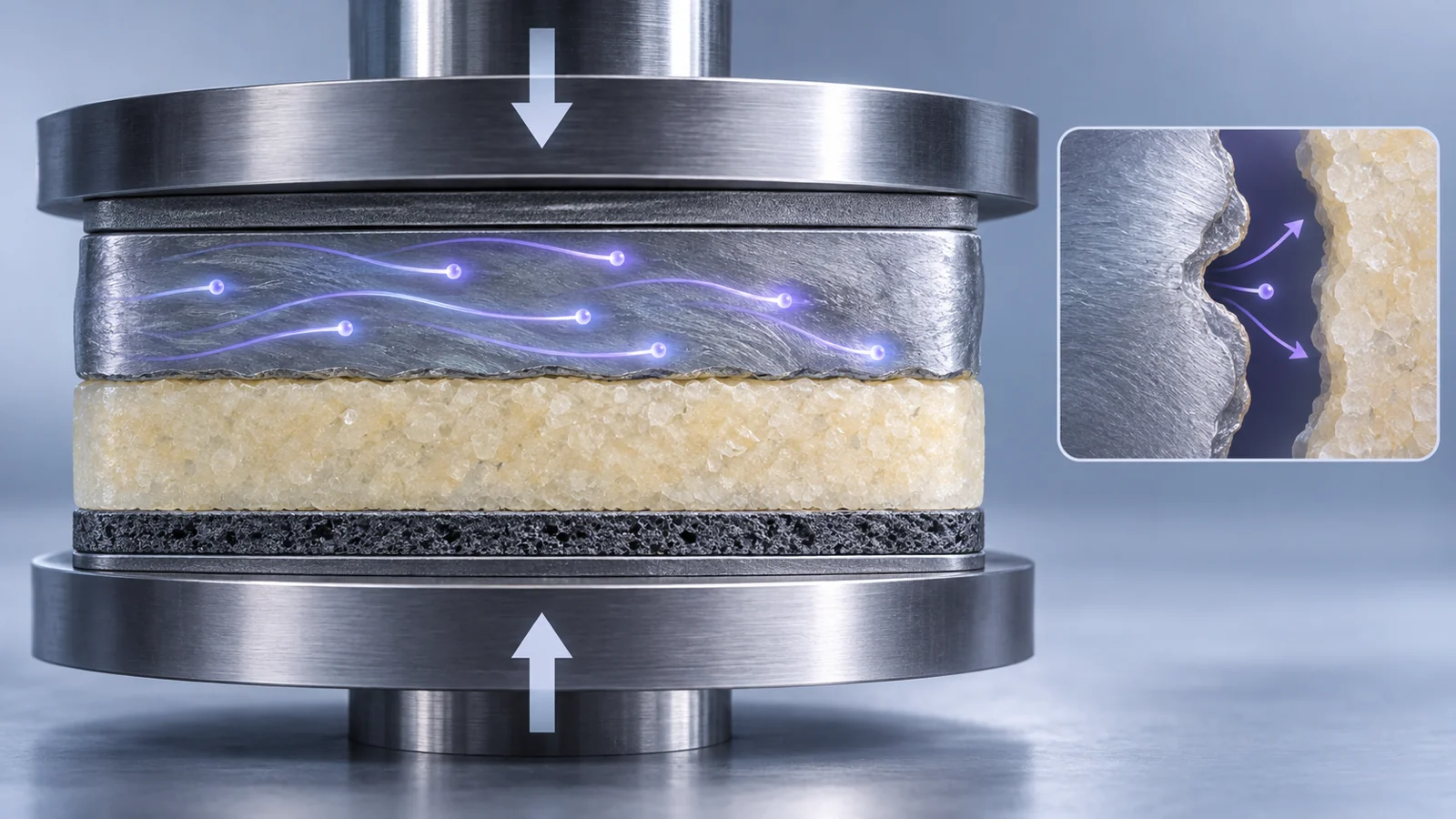
One set of experiments followed what happened as lithium was stripped from the working electrode. The researchers compared cells held at 0 MPa and 45 MPa of stack pressure, using working electrodes with approximately equal starting lithium inventories. Stack pressure here means compression maintained across the assembled cell, pressing the layers together while the electrochemical experiment proceeds.
The pressure changed the mechanical conditions at the electrode–electrolyte boundary. Under the applied pressure, the alloy electrodes maintained contact during lithium removal. Impedance measurements supported that interpretation: the reported stack resistance remained approximately 38 ohms after the stripping experiment in the highlighted case, close to the resistance attributed primarily to the solid-electrolyte pellet. The additional resistance associated with the working-electrode interface was therefore interpreted as negligibly small under those conditions.
This is an important result, but it answers a specific question. It shows that compression can help the boundary remain electrically useful as lithium is removed. It does not show that every part of the alloy remains equally easy for lithium to reach.
Capacity can be limited inside the electrode
The next question is what happens beyond the interface. Once lithium has crossed from the solid electrolyte into the alloy, it still has to migrate through the electrode material. If that internal movement is slow, some of the alloy’s nominal lithium content may remain difficult to access at the selected current and during the available cycling time.
The researchers combined electrochemical observations with calculations of lithium migration barriers. A migration barrier is an energetic obstacle that lithium must overcome as it moves along a possible path through a material. The calculations were used to examine how those obstacles vary with composition and how that variation relates to the overpotential observed during lithium cycling.
This provides a different explanation for limited capacity than loss of physical contact. In the pressure-supported experiments, the interface could remain connected while the alloy’s internal lithium transport still constrained the amount that could be removed. Pressure can help hold two materials together; it does not remove the transport barriers within the electrode.
That separation is the study’s most useful conceptual contribution. It gives researchers two places to investigate when an alloy electrode underperforms: the changing boundary between the electrode and electrolyte, and the movement of lithium through the electrode itself.
The endurance result has a defined scope
The reported cycling result for Li13In3 and Li17Sn4 shows that these materials supported dendrite-free lithium cycling for more than 1,000 hours under the stated laboratory conditions of 1 mA/cm² and 1 mAh/cm². Those values describe sustained operation in the tested electrochemical configuration. They do not represent a complete battery’s service life, usable energy, or performance in a commercial device.
The experiment also should not be read as proof that dendritic failure is impossible. The behavior can depend on pressure, current, composition, electrode construction, and cell design. The result instead shows that carefully prepared lithium-rich alloys can maintain stable cycling in contact with Li6PS5Cl over a long test period.
Nor does stable cycling mean the alloys are chemically inert toward the sulfide electrolyte. The researchers distinguish thermodynamic compatibility from kinetic stability. An interface may be capable of operating because reactions are slowed or controlled by a kinetically stable interphase, even when the materials are not thermodynamically compatible across the full stability range. Favorable operation and chemical inertness are therefore separate claims.
What this could change
If the internal transport limits identified in this study can be improved while the favorable electrode–electrolyte contact survives practical cell integration, lithium-rich indium and tin alloys could make more of their stored lithium usable during sustained solid-state battery operation. That could give battery developers additional high-capacity anode candidates to compare with lithium metal and lower-lithium alloys.
The possible benefit is conditional. It depends on translating pressure-sensitive interface behavior and composition-specific transport into complete cells with useful electrodes, electrolytes, and operating conditions. The preprint establishes a promising way to distinguish those engineering problems; it does not yet establish greater vehicle range, finished-battery cost savings, or measured system-level safety gains.
Key Sources
- Primary source: Favorable Interfacial Chemomechanics Enables Stable Cycling of High Li-Content Li-In/Sn Anodes in Sulfide Electrolyte Based Solid-State Batteries
arXiv · Preprint · 2021-07-23