
Since the previous research note · Earlier expectation not tested
Track continuity
Since the previous research note: Where lithium meets a solid electrolyte, an unfamiliar layer keeps evolving
Previous expectation: If predicted interface chemistry and ion motion were confirmed, simulations could help researchers design more durable contacts in solid-state batteries.
What this study adds: Microscopy of silicon electrodes reveals uneven initial lithium uptake and evolution toward a more uniform amorphous structure over repeated cycles. This adds a distinct electrode-interior design problem without testing the earlier interfacial-phase or transport predictions.
What changed in this study
Silicon is attractive for solid-state batteries because it can store substantial amounts of lithium and may offer an alternative to lithium metal as the battery’s negative electrode, or anode. But silicon brings a difficult mechanical problem with it. During lithiation, when lithium enters the silicon, the material can expand by roughly 300%. When lithium later leaves, that expansion and contraction can contribute to cracking.
The challenge is therefore larger than making room for a material that swells. Silicon’s internal structure also changes during its first cycles. A preprint published on July 22, 2025, investigates that transition in initially microcrystalline silicon electrodes. Although the work is motivated by solid-state battery development, the electrodes were investigated in a solid-electrolyte-free environment. Using protected specimen handling and several forms of electron microscopy and diffraction, the researchers examined how lithium was distributed inside the particles and how the balance between crystalline and amorphous material changed after cycling.
The result is a more complicated starting point for electrode design. Engineers may need to design around the structure silicon develops during use, not only the structure present when the electrode is manufactured.
The first cycle creates a mixed interior
A crystal has atoms arranged in a repeating pattern. An amorphous material lacks that long-range repeating order, even though its atoms still occupy a solid structure. Silicon in the examined electrodes began in a microcrystalline form, so its particles contained crystalline regions and grain boundaries, the borders where differently oriented crystal regions meet.
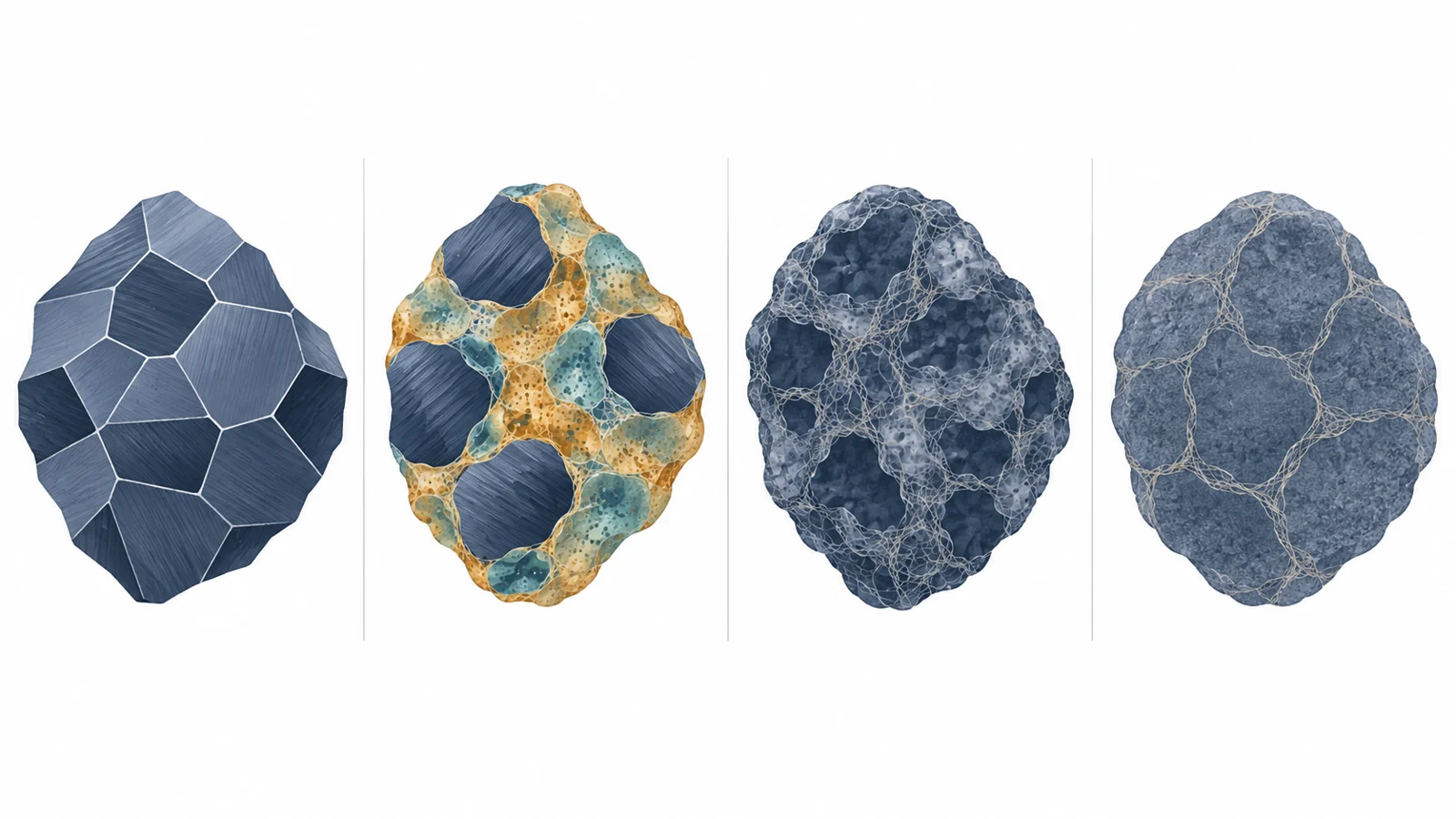
After the first lithiation, the electrode did not become one uniform material. The researchers identified a heterogeneous mixture that included crystalline Li15Si4, several amorphous lithium-silicon phases and silicon that remained crystalline. Lithium uptake was uneven across the sampled particles. Lithium-rich, dendrite-like regions appeared predominantly near grain boundaries and extended inward from those borders in some locations. Other regions contained little or no detectable lithium and often corresponded to crystalline silicon near particle cores. Additional areas showed an intermediate level of lithiation.
That spatial pattern matters because it connects chemistry with the particle’s internal geometry. The same electrode could contain a highly lithiated region beside a comparatively untouched crystalline region. A design based only on the average lithium content of the whole particle would miss that local contrast.
How the researchers preserved the evidence
The study relied on a controlled workflow intended to keep the cycled material from being altered by ambient exposure. Cryogenic scanning transmission electron microscopy allowed the researchers to examine specimens while preserving fragile structural features. High-angle annular dark-field images showed the physical texture, while chemical mapping helped locate silicon and oxygen. Electron-energy-loss measurements were used to estimate lithium-to-silicon relationships in different regions.
The researchers also used scanning nano-beam diffraction and scanning precession electron diffraction. These measurements provide information about atomic order across many small positions rather than treating an entire particle as a single uniform object. Diffraction patterns and reduced pair-distribution information helped distinguish areas with crystalline order from regions whose structure was more consistent with amorphous silicon.
The observations come from selected cycling states and locations, not from a continuous movie of one particle changing frame by frame. Their value lies in combining location, chemistry and structural order at several points in the cycling sequence while reducing the risk that handling changes the specimen before measurement.
Reading the lithiated regions carefully
The first lithiated state is best understood as a spatial snapshot. Near grain boundaries, the images and chemical measurements showed regions with higher lithium content. Some had irregular, dendrite-like shapes that extended into surrounding material. Silicon near particle cores could remain crystalline and largely unlithiated, while other regions contained intermediate amounts of lithium.
Lithium content was estimated through spectral and electron-scattering information rather than read directly from a simple visual scale. The researchers note that the available calibration for different lithium-silicon compositions affects those estimates. A region can be clearly different from its surroundings without its exact composition being known with complete confidence.
This distinction keeps the observation precise. The study identifies uneven lithium distribution at the examined state; it does not establish a universal sequence for how lithium moves through every silicon particle. The measurements show why one average composition is insufficient to describe the interior of an electrode whose regions can be at markedly different stages of lithiation.
Delithiation changes the balance
After the first delithiation, when lithium had left the silicon, the examined structure was predominantly amorphous. It contained comparatively dense areas alongside irregular, thread-like mesh regions. The remaining crystallinity was minimal in the sampled state, a marked change from the mixed crystalline and amorphous structure observed after the first lithiation.
By the tenth delithiation, the sampled microstructure appeared more uniform. Thread-like regions were still visible, but they were concentrated mainly at grain boundaries rather than distributed as broadly through the material. In the later-cycle diffraction region examined by the researchers, no crystalline silicon was detected.
The authors interpret these observations as evidence that a comparatively stationary amorphous bulk microstructure develops only after several cycles in the examined electrodes. That interpretation does not make the tenth cycle a universal stabilization threshold. Particle size, electrode architecture and operating conditions can affect how silicon transforms, and the study examines a bounded set of locations across available samples.
The sequence changes the design question. If the first cycles transform an initially crystalline material into a predominantly amorphous one, manufacturing a carefully crystalline architecture may not preserve that architecture once the cell begins operating. The structure engineers build may be only a temporary stage in the electrode’s working life.
Two ways to design for the material that emerges
The discussion in the preprint considers two broad approaches. One would begin with crystalline silicon, run a formation process that produces the amorphous phase, then use that formed material in a redesigned electrode. In principle, this separates the structural transformation from the final electrode architecture. Instead of asking a finished electrode to accommodate a disruptive first transformation, the formation step would create the material that the later design is meant to handle.
The practical difficulty is substantial. The formed amorphous material would need to be extracted and incorporated into new electrodes, and the authors leave the feasibility and scalability of that route uncertain. It also adds processing steps before the material reaches its intended cell configuration.
The other approach would begin with amorphous silicon. The authors present the possible advantage cautiously: an amorphous starting material might undergo expansion in a more uniform and predictable way than initially crystalline silicon. That is a design hypothesis, not a controlled demonstration that amorphous silicon produces a longer-lasting electrode.
Either route would still have to accommodate silicon’s large volume change. Buffer spaces, flexible composite structures or compliant layers could give the material room to expand and contract. A more uniform starting or formed structure could make those features easier to place intelligently, but only if the proposed route remains stable in a complete electrode and can be manufactured practically.
What the images cannot settle alone
A more uniform microstructure is not the same thing as proven durability. The study does not establish that initially amorphous silicon outperforms initially crystalline silicon in a controlled comparison. Nor does the observation of an amorphous bulk region by the tenth delithiation demonstrate stable capacity, repaired cracks or a longer-lasting complete battery.
There are limits inside the chemical measurements as well. Some low-energy spectral features could reflect trace residual lithium that is below detection in one measurement, or they could arise from lower material density. A missing detectable signal is therefore not equivalent to proof that all lithium has left a region. These interpretive questions matter because the distinction between chemistry and density can change how a designer understands the apparent state of the material.
The study’s contribution is narrower and more concrete than a performance claim. It shows that the interior of microcrystalline silicon can be chemically heterogeneous after the first lithiation, predominantly amorphous after the first delithiation and more uniform in the later sampled state. It then uses that sequence to argue that the material’s operating microstructure deserves a central place in electrode design.
What this could change
If future work shows that amorphous starting materials or a practical formation route can produce more predictable deformation, battery developers could design silicon electrodes around that behavior from the beginning. Buffer spaces and flexible components could be positioned to accommodate repeated expansion more effectively, rather than being added to an architecture that is itself being rearranged during the first cycles.
The potential payoff would be a silicon electrode that retains useful storage performance for longer in relevant solid-state cell designs. Reaching that point would require the structural advantage to translate into meaningful durability, and the manufacturing route would need to work at the scale and complexity of real electrodes. For now, the preprint identifies a specific bottleneck: the material engineers assemble at the start may not be the material the battery actually has after it begins cycling.
Key Sources
- Primary source: Microstructure of Silicon Anodes in Solid-State Batteries — From Crystalline to Amorphous
arXiv · Preprint · 2025-07-22