
Since the previous research note · Earlier expectation not tested
Track continuity
Since the previous research note: What graphite surface layers reveal about unrecovered charge
Previous expectation: Controlling graphite surface composition and interphase structure could reduce irreversible charge loss during initial cycling if the relationship transfers to working cells.
What this study adds: The current source examines transport through LAGP ceramic electrolyte pellets and connects the best preparation in a four-temperature comparison to inter-grain morphology and phase composition. It adds a processing-and-transport milestone without testing graphite charge recovery.
What changed in this study
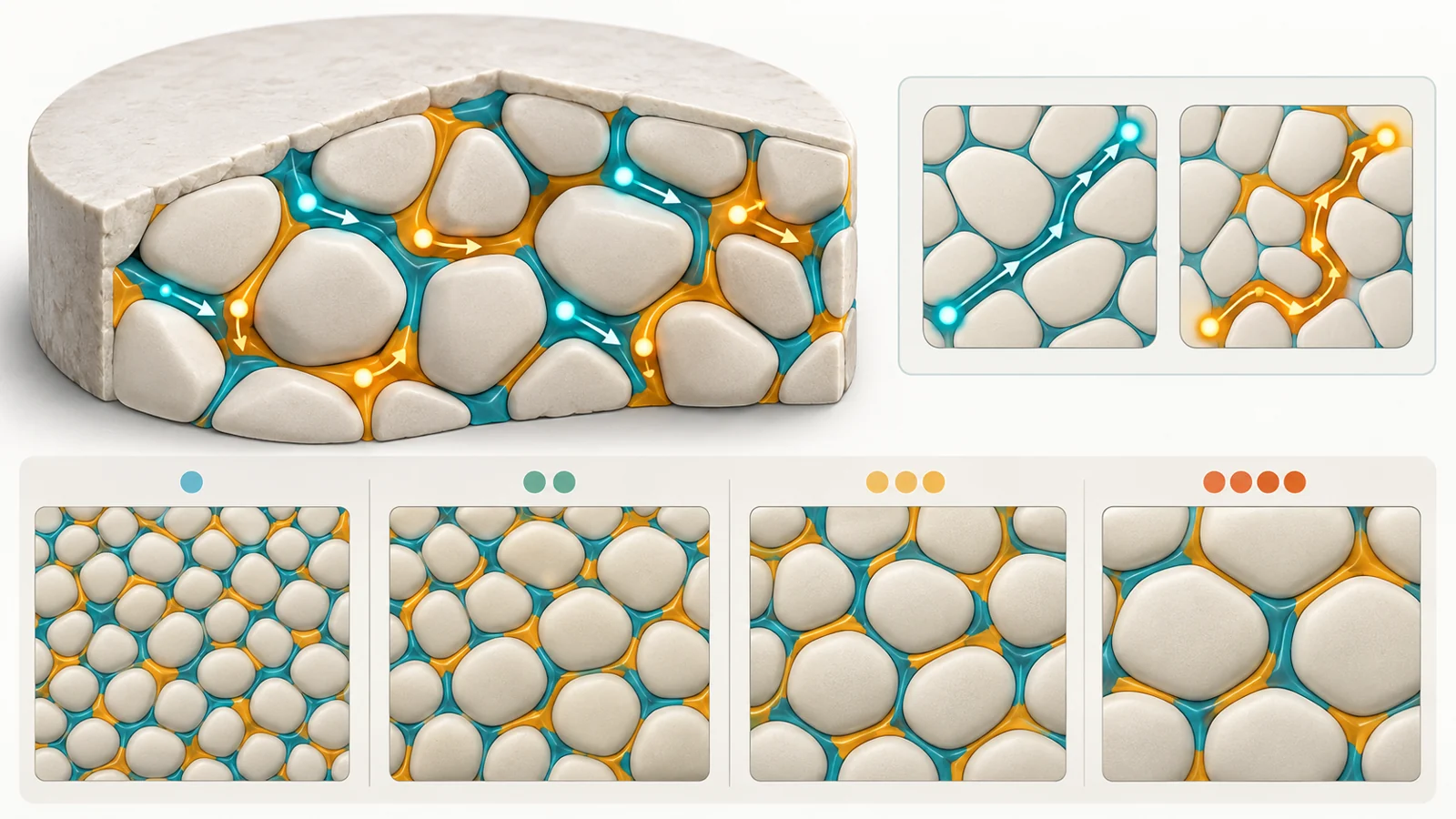
A ceramic solid electrolyte is not a single, perfectly uniform block. It is built from many grains, with material filling the spaces where neighboring grains meet. Lithium ions must move through that combined structure. A grain may conduct reasonably well on its own, yet a pellet assembled from many grains can still develop a large resistance at the connections between them.
That is the physical problem examined in a preprint posted on November 11, 2022. The study focuses on Li1.5Al0.5Ge1.5(PO4)3, usually shortened to LAGP, a lithium-containing oxide ceramic used as a solid electrolyte. The authors prepared four LAGP pellets with different spark plasma sintering temperatures, then compared their electrical behavior with structural and chemical measurements.
The central surprise is that the hottest preparation was not the best one in this set. The result points to a hidden design variable: not just how well the ceramic grains conduct, but what shape and composition the material between those grains takes.
Four preparation temperatures produced a sharp reversal
The electrical measurements were made at room temperature, while the temperatures being compared were the temperatures used to prepare the pellets. That distinction matters. A pellet sintered at 680 °C was not being tested at 680 °C.
Impedance analysis separated resistance associated with the grain interiors from resistance associated with the inter-grain regions. The grain contribution stayed comparatively stable across the preparations. The inter-grain contribution changed much more strongly:
- 650 °C preparation: 1,155.4 ohm·cm
- 665 °C preparation: 1,074.9 ohm·cm
- 680 °C preparation: 195.7 ohm·cm
- 700 °C preparation: 322.6 ohm·cm
Within these four samples, the 680 °C pellet had the lowest inter-grain resistivity and the best overall ionic-conductivity result reported by the study. Heating the preparation from 650 to 680 °C therefore coincided with a major reduction in the resistance assigned to the regions between grains. Heating it further to 700 °C did not preserve that improvement.
This is a nonmonotonic processing response rather than a simple rule that hotter sintering always makes transport better. It also shows why a measurement of the grain interiors alone would miss an important part of the pellet-level behavior. If the grains are relatively steady while the intervening network changes, the assembled ceramic can respond sharply even when its main crystalline phase remains recognizable.
A winding route explains part of the pattern
The researchers used three-dimensional focused ion beam scanning electron microscopy to reconstruct the internal structure of the pellets. One quantity they examined was tortuosity, a way of describing how indirect a path is through a material. A tortuosity value near one represents a relatively direct route; larger values indicate a more winding route between the two sides of the pellet.
That distinction turns a flat micrograph into a transport question. A connected inter-grain region may look continuous in two dimensions while forcing ions to take a longer route through the full thickness of the ceramic. The three-dimensional analysis reported inter-grain tortuosity values ranging from 6.2 to 2.2 across the preparations. The structural reconstruction therefore contributed a plausible explanation for why some pellets offered less obstructed pathways than others.
But geometry did not settle the whole result. The tortuosity analysis helped explain differences in activation energies, yet it did not by itself explain the increase in ionic conductivity associated with the 680 °C preparation. The same broad question had to be asked about the material making up those pathways.
Chemistry fills in the missing piece
The study combined diffraction, electron microscopy with elemental analysis, phosphorus and aluminum solid-state nuclear magnetic resonance, and electronic-structure calculations. Together, these measurements led the authors to identify two important types of material in the inter-grain region: ordered lithium pyrophosphate, Li4P2O7, and a disordered lithium–aluminum phosphate phase referred to in the study as OPLA.
The most prominent chemical difference separating the 680 °C sample from the other preparations was the amount of this disordered phosphate phase in the inter-grain regions. Quantitative phosphorus nuclear magnetic resonance and microscopy-based elemental analysis both contributed to that interpretation. The 680 °C preparation was associated with a stronger contribution from the disordered phase and a reduced contribution from the highly ordered lithium pyrophosphate phases.
That balance offers a way to connect the measurements. The three-dimensional structure describes how indirect the inter-grain routes are. The chemical analysis describes what occupies those routes. A region with a more favorable phase balance could help explain why the 680 °C pellet had much lower inter-grain resistance even though tortuosity alone did not account for the improvement.
The spectroscopy also came with important qualifications. The OPLA-related portion of the phosphorus spectrum contained at least five resonances across roughly 13 to 21 parts per million, rather than a single isolated peak. Some chemically distinct phosphorus environments had very similar calculated shifts, including signals near −16.1 and −16.2 parts per million. Elsewhere, overlap between low-cristobalite aluminum phosphate and LAGP around the 25-parts-per-million region reduced the accuracy of the estimate for that particular aluminum-phosphate phase. These details do not erase the compositional pattern, but they make the interpretation more careful than a one-peak identification.
The result is a linked explanation rather than a single-factor proof
The strongest conclusion is about the finished pellets as a whole. Preparation temperature changed several features at once, including the three-dimensional arrangement of inter-grain material and the phases that formed there. The four-temperature comparison shows that the 680 °C preparation performed best among the samples studied and that its performance coincided with a distinctive structural and chemical profile.
It does not isolate one inter-grain phase as an independently controlled cause, nor does it establish an intrinsic conductivity value for each phase on its own. The evidence supports an association between lower pellet resistance and a particular combination of morphology and composition. That is useful for materials design, but it is different from proving that changing only one ingredient would reproduce the same improvement under otherwise identical conditions.
The comparison also should not be read as a universal sintering optimum for every LAGP formulation, processing route, pellet geometry, or manufacturing scale. The important advance is more specific: the study makes the inter-grain region visible as a tunable part of the transport problem and links a particular preparation in this experiment to a measurable reduction in resistance.
The finding remains at the electrolyte-pellet level. It does not demonstrate faster charging, longer cycle life, higher cell energy density, improved battery safety, or commercial manufacturing readiness. A ceramic that transports lithium ions with lower internal resistance is a promising component result, but a working battery also depends on how that ceramic is integrated with its electrodes and other layers.
What this could change
If the favorable balance of inter-grain phases can be reproduced reliably and retained in battery-compatible components, electrolyte developers could make LAGP ceramics that carry lithium ions with less internal resistance. That could reduce the electrolyte’s contribution to voltage loss while a battery operates, provided the interfaces with the electrodes do not introduce a larger new bottleneck.
The preprint does not demonstrate that cell-level benefit. It identifies a conditional materials capability: controlling the hidden regions between ceramic grains may give designers another way to reduce transport losses before they assemble a complete solid-state battery.
Key Sources
- Primary source: The Impact of Inter-grain Phases on the Ionic Conductivity of LAGP Solid Electrolyte Prepared by Spark Plasma Sintering
arXiv · Preprint · 2022-11-11