
Since the previous research note · Earlier expectation not tested
Track continuity
Since the previous research note: How changing a battery ceramic's recipe shifts lithium-ion movement
Previous expectation: A selected ceramic composition could improve lithium-ion transport if its performance survives practical layer construction and operation with compatible electrodes.
What this study adds: This source introduces a different route to improving transport: heating solid-state cells through rapid alternating electrical excitation, supported by symmetric-cell experiments and pack modeling. It does not test the earlier ceramic composition or its integration forecast.
What changed in this study
Solid-state batteries replace the liquid or gel electrolyte used in many conventional designs with a solid ion-conducting material. That architecture could support high energy density and improved thermal stability, but it also creates a practical problem: at room temperature, ions can move sluggishly through some solid electrolytes. The resulting internal impedance can limit how much energy a battery delivers during a particular discharge.
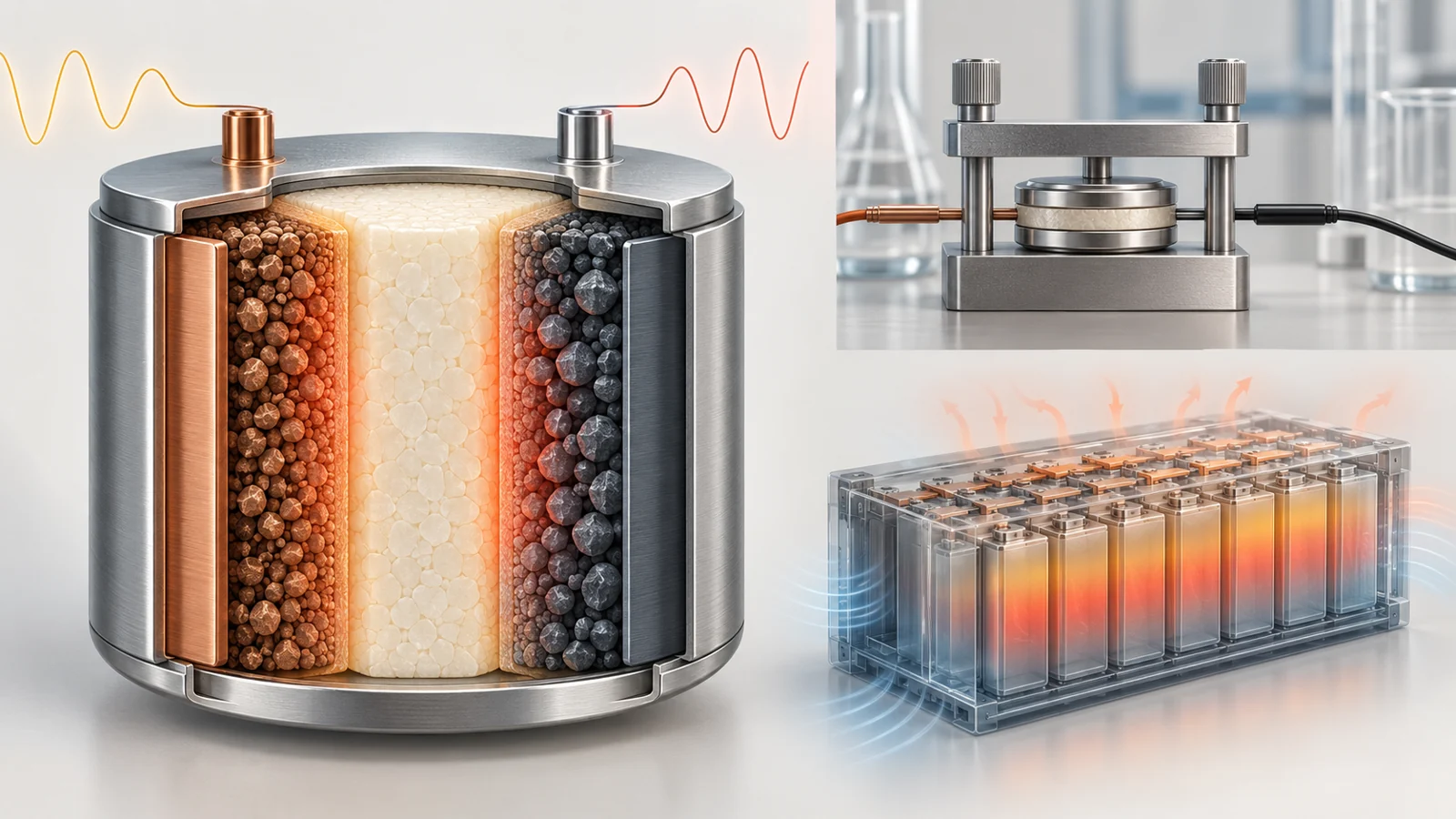
A November 15, 2024 arXiv preprint proposes tackling that bottleneck by warming the battery from within. Its method, called ultra-high-frequency self-heating, uses rapidly alternating electrical excitation to raise the cell toward an operating temperature of about 65 °C. The study combines heating experiments in symmetric solid-state cells with an electrothermal model used to project behavior at pouch-cell and pack scales.
The bottleneck is transport at room temperature
The proposal depends on a distinction that is easy to miss. A battery may contain a certain amount of stored chemical energy, yet deliver less of it under a particular operating condition if internal resistance causes voltage losses or restricts transport. Warming the solid electrolyte could improve ion movement enough to make more of that stored energy accessible during discharge.
That would not increase the battery’s intrinsic storage capacity. It would change the conditions under which the battery can release energy. The practical question is therefore not simply whether heating works, but whether the energy spent on heating is small compared with the additional useful discharge energy that becomes available.
The authors focus on temperatures because the conductivity of the solid electrolyte changes strongly with temperature. Instead of adding a heater around the battery, they investigate whether the battery’s own electrical structure can generate heat quickly, without changing its materials or internal architecture.
Frequency turns an electrical input into heat
The self-heating signal is an alternating voltage applied at frequencies above 100,000 hertz. In plain terms, the electrical direction reverses far more than 100,000 times per second. The cell’s impedance determines how that input is divided between heat-generating losses and current associated with electrode reactions.
Under the conditions described in the study, increasing frequency increased the heating rate while reducing the reaction current under a constant alternating voltage. That separation is important. The method is intended to warm the cell without using the alternating signal as an ordinary charge or discharge process. More of the input can appear as heat, while less is directed into the electrochemical reactions that would otherwise change the cell’s state.
Voltage still imposes a hard constraint. In one experiment, the researchers used a sinusoidal signal of ±2 V. The overall voltage change was kept below the maximum stable potential identified for the lithium aluminum germanium phosphate electrolyte. A higher frequency does not remove the need to stay within the cell’s electrochemical limits, and the useful operating window depends on the cell configuration.
What the small cells actually showed
The proof of concept used symmetric cells containing lithium aluminum germanium phosphate, or LAGP, as the solid electrolyte. A symmetric cell is useful for studying electrical and thermal behavior without presenting it as a complete commercial battery with its full electrode pair, packaging and control system. Here, the cells were first stabilized at room temperature for 10 minutes and then exposed to the alternating signal.
For a single-layer configuration, the researchers swept the frequency from 0.5 to 7 megahertz. Under the ±2 V sinusoidal excitation, the measured temperature rise after two minutes increased from 0.45 °C at 0.5 MHz to 0.8 °C at 7 MHz. The rise became roughly stable at about 0.85 °C once the frequency moved beyond 2 MHz in that configuration.
The study also examined stacked double-layer cells and other configurations. Their thermal behavior depends not only on the electrical signal but also on how much surface area is exposed, how much material must be warmed and how readily heat escapes. Those measurements establish a frequency-dependent heating response in the tested cells. They do not show that a complete battery pack reached the later pack-level performance projected by the model.
The experiment is best understood as a demonstration of controllable self-heating. It answers whether this electrical approach can produce a measurable temperature response in a solid-state cell. It does not, by itself, answer how much additional discharge energy a finished battery would deliver after the heating energy has been deducted.
Scaling changes both the heat and the bill
The authors use an experimentally validated electrothermal model to explore larger systems. The model combines cell impedance with thermal properties such as heat capacity and thermal conductivity. Some properties were measured, while others came from the literature, and the cell or pack was represented with effective thermal approximations rather than every microscopic feature.
That distinction matters when moving from a small test cell to a pack. A small cell can warm relatively quickly because the distance for heat to travel is short. A larger assembly has more material to heat, more interfaces and more surfaces through which heat can be lost. Insulation, cell spacing, electrolyte thickness, pack geometry and the assumed heat-transfer conditions all influence the result.
The simulations extend across pouch-cell and pack scenarios, including a modeled 62-kWh pack. In the modeled setup, the predicted heating rate reaches about 50 K per minute, while the energy used for heating remains below 4% of the energy stored in the battery. Those figures are outputs of the pack model, not measurements from a physical 62-kWh pack.
The percentage is also not a universal property of solid-state batteries. It depends on what temperature increase is required, how long the battery must remain warm, how much heat leaves the system and how the alternating excitation is applied. A pack that warms rapidly but loses heat quickly could face a different energy tradeoff from a well-insulated system. Conversely, reducing heat loss may affect packaging, cooling and control requirements.
The useful-energy claim needs a complete system
The preprint’s abstract claims more than twice the discharge energy in a 25 °C ambient environment. That is a claim about energy delivered during discharge, not a doubling of intrinsic storage capacity. Whether the approach gives a useful net gain depends on the comparison conditions and on how much energy heating and temperature maintenance consume.
That boundary does not make the proposal uninteresting. It identifies where the evidence changes character. The symmetric-cell work measures a temperature response. The electrothermal model uses measured and literature-based parameters to estimate how heat could move through larger systems. A discharge comparison adds another layer, because it depends on the complete cell, the discharge conditions and the energy consumed before and during operation.
The model’s experimental grounding therefore supports confidence in the particular behavior it was built to represent, not automatic validation of every downstream pack prediction. A reduced reaction current during high-frequency excitation also does not establish long-term durability, freedom from degradation or complete-system safety. Those questions become especially important when the method is integrated with electrodes, packaging, power electronics and battery controls.
The central test for the idea is consequently economic and operational as much as thermal. After the alternating signal has warmed the battery, how much extra energy can the complete system deliver, and under what conditions? The answer must include the heating input, stable operation and repeated use rather than treating temperature rise alone as the final benefit.
What this could change
If the modeled gains survive complete-cell and pack integration, rapid internal warming could give solid-state batteries a practical way to deliver more of their stored energy in room-temperature surroundings. A vehicle, grid battery or other system would not necessarily need a separate external heater or a redesigned solid electrolyte. Instead, its control system could briefly apply a high-frequency alternating signal, bring the cells into a more favorable operating range and then use the warmed battery for discharge.
For a battery limited by sluggish ion transport at room temperature, that could mean supplying a load for longer from the same stored energy. The benefit would be conditional, however. The heating route would need to remain within stable voltage limits, consume only a small share of the energy it unlocks, preserve the battery through repeated operation and work across the complete pack rather than only in a symmetric test cell. The November 2024 results make fast electrical self-heating a credible system concept to investigate; they do not yet turn a modeled pack advantage into demonstrated commercial performance.
Key Sources
- Primary source: Solid-state batteries enabled by ultra-high-frequency self-heating
arXiv · Preprint · 2024-11-15