
Since the previous research note · Earlier expectation not tested
Track continuity
Since the previous research note: How rapid alternating current could warm a solid-state battery
Previous expectation: Rapid internal electrical warming could let solid-state batteries deliver more of their stored energy if the modeled gains survive cell and pack integration.
What this study adds: The current source addresses a separate manufacturing obstacle by reporting molecular protection of a sulfide electrolyte during controlled humidity exposure and retained function in a specified battery configuration. It provides no test of the earlier heating forecast.
What changed in this study
Sulfide solid electrolytes are attractive for all-solid-state batteries because they can carry lithium ions efficiently and can be processed as relatively ductile solids. Their weakness appears when manufacturing moves outside a carefully controlled dry environment. Moisture can react with the sulfide material, changing its structure and reducing the conductivity that makes it useful in the first place.
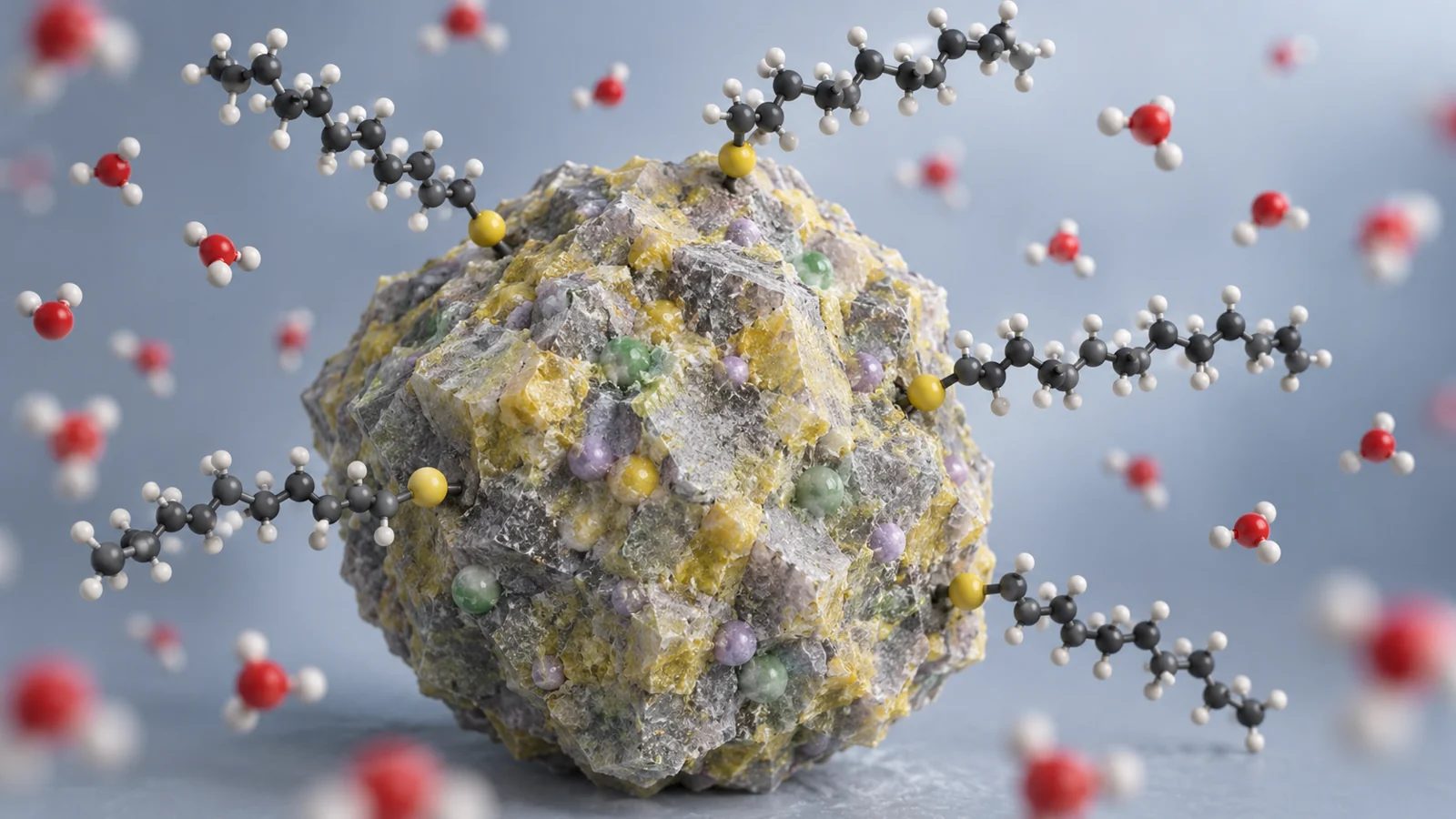
A December 5, 2024 arXiv preprint reports a way to give one such electrolyte a temporary molecular shield. The researchers modified Li₆PS₅Cl with undecanethiol, a long-chain molecule also known as UDSH. The reported milestone is about material handling: whether a moisture-sensitive powder can remain usable for longer during exposure to humid air. It is not a claim that a finished battery becomes waterproof or that ordinary factory conditions are already safe.
Why moisture is a manufacturing problem
A solid electrolyte has to perform more than one job in a battery. It must transport lithium ions, but it also has to survive mixing, shaping, contact with electrodes and other handling steps without losing the structure that supports that transport. For sulfide electrolytes, the need to limit moisture can force processing into environments that are unlike the infrastructure used for conventional lithium-ion battery production.
That creates a practical bottleneck. A material may have the right electrochemical properties on paper while being difficult to move, blend or assemble without strict humidity control. Extending the time available for those operations could therefore matter even if the treatment does not improve the electrolyte’s intrinsic conductivity.
The preprint focuses on Li₆PS₅Cl and asks whether its surface can be altered without sacrificing the property manufacturers need most from it: the ability to conduct lithium ions. The authors describe the modification as reversible and report a negligible effect on ionic conductivity before the humidity exposure test.
A molecular layer with two jobs
UDSH has two parts that serve different purposes. Its thiol group is reported to anchor to the electrolyte surface. Its long hydrocarbon tail is hydrophobic, meaning that it tends to repel water and reduce the ease with which water reaches the underlying material.
The proposed arrangement is less like a permanent waterproof shell than a surface treatment built from molecular interactions. The sulfur-containing end provides the attachment point, while the hydrocarbon portion forms the water-avoiding side of the treatment. That division of labor helps explain why the researchers chose a long-chain alkyl thiol rather than treating the electrolyte with an unspecified barrier coating.
The surface evidence supports the presence of the treatment. Energy-dispersive X-ray measurements report a uniform carbon-rich layer on the Li₆PS₅Cl. Experimental and computational results also support the interpretation that the thiol binds at the surface and that the hydrocarbon tail contributes hydrophobic protection.
A carbon-rich layer, however, is not the same thing as a complete picture of every molecule’s orientation or packing. Powder particles are irregular and difficult to inspect in the same way as a flat surface. The useful conclusion is that UDSH is associated with the electrolyte surface and that its chemical parts fit the proposed protective mechanism, not that the experiment proves a perfectly ordered coating around every grain.
What two days at 33% humidity measures
The central exposure result is specific. Modified Li₆PS₅Cl reportedly retained ionic conductivity above 1 mS/cm for up to two days in air at 33% relative humidity, while showing limited structural degradation. The untreated and treated materials were evaluated as a function of exposure time, and the comparison indicates a substantially longer period of usable conductivity for the treated powder.
The authors describe this as more than a 100-fold improvement in protection time over the approaches included in their comparison. That is an important result, but the number needs to be read with the test designs in view. The comparison includes powder samples measured in closed systems and a pellet measured in an open system. Exposure duration, sample form and the way air reaches the material all affect how quickly degradation can appear.
So the two-day figure is best understood as a condition-specific handling window. It says that, under the reported humidity and test arrangement, the modified electrolyte stayed above the selected conductivity threshold for that period. It does not establish unrestricted tolerance across higher or lower humidity, moving air, repeated handling, different particle structures or an entire manufacturing line.
The conductivity threshold also answers a narrower question than battery performance. It shows that the treated powder continues to transport lithium ions at a useful measured level under the stated test conditions. By itself, it does not show higher energy density, faster charging or longer service life.
The battery test changes the question
A powder conductivity measurement isolates the material. A battery test asks whether that material can still take part in an electrochemical assembly after it has experienced the proposed handling challenge.
The abstract reports that humidity-exposed UDSH-treated Li₆PS₅Cl maintained its function in an all-solid-state battery configuration using a lithium–indium anode and a nickel-rich layered oxide cathode. This provides a bridge from surface treatment to device construction: the exposure did not prevent the treated electrolyte from functioning in the reported assembly.
That bridge is useful precisely because it is limited. The result concerns the specified battery configuration and the reported exposure history. It does not supply a general performance claim for commercial cells, other electrode combinations or long-term cycling. The battery experiment supports compatibility with the demonstrated assembly; it does not turn a humidity test into a complete manufacturing validation.
The practical gap is larger than the humidity chamber
Whether this idea can help manufacturing depends on details that a single relative-humidity value cannot settle. A process may expose powder to changing humidity, air movement, temperature, pressure, contact with other materials and mechanical handling. The relevant question is not only whether the molecular treatment slows water access, but whether it continues to do so throughout the steps that matter for a particular production route.
The treatment’s reversibility introduces another practical question. If UDSH is meant to protect the electrolyte during handling, manufacturers would need a way to manage the treatment before or during battery assembly while preserving the final cell’s function. The reported result establishes the protection concept and a battery demonstration, but it does not by itself establish an industrial treatment-and-removal workflow or measured cost and energy savings.
This is also why the comparison with earlier approaches should not be read as a universal ranking. The reported advantage is striking within the compared tests, yet different sample forms and exposure configurations make matched conditions important. A longer protection time in one arrangement may not translate directly to the same advantage in another.
What this could change
If the surface treatment remains effective through realistic handling, and if its use or removal can be integrated without harming the assembled battery, manufacturers could gain a longer window for working with sulfide electrolytes outside the driest environments. Some processing steps might then need less stringent moisture exclusion, potentially reducing the infrastructure burden of making sulfide-based all-solid-state batteries.
The possible benefit is therefore operational rather than magical. The molecule would not make the battery waterproof. It could make a vulnerable material easier to handle for a defined period, giving process engineers more flexibility while they move, mix or assemble it. That could support lower-cost and lower-energy manufacturing if later process validation shows that the treatment fits the required sequence and preserves battery function.
The December 2024 preprint establishes a promising material-level route toward that goal: attach a water-repelling molecular layer to the electrolyte surface, preserve ion transport, and demonstrate function after controlled humid-air exposure. The remaining challenge is to connect that laboratory handling window to the varied, continuous and tightly specified conditions of real battery production.
Key Sources
- Primary source: Surface molecular engineering to enable processing of sulfide solid electrolytes in humid ambient air
arXiv · Preprint · 2024-12-05