
Since the previous research note · Earlier expectation not tested
Track continuity
Since the previous research note: What turbine coatings could teach us about tougher battery electrolytes
Previous expectation: A ceramic electrolyte with suitably mobile twin boundaries could preserve its integrity and electrode contact during repeated charging if ion transport and manufacturing requirements were also met.
What this study adds: This source introduces a separate-surface computational screen for coating adhesion and compatibility, identifying candidates for oxide and sulfide electrolyte systems. It addresses coating selection without testing the earlier twin-boundary mechanism.
What changed in this study
A solid-state battery still depends on intimate contact between different materials. Its electrolyte must carry lithium ions, while the electrodes must exchange them during operation. A thin coating can help protect those materials from unwanted chemical reactions, but protection alone is not enough. If the coating does not remain attached, or if the interfaces resist lithium movement, the layer can become another obstacle inside the battery.
A March 28, 2023 preprint proposes a way to search for coatings that address both problems. Rather than calculating every possible atomic arrangement where an electrolyte, coating and electrode meet, the authors estimate how strongly separate materials may adhere and then combine that estimate with other filters. The result is a computational shortlist, not a demonstrated working battery, but it offers a way to make an enormous materials search more manageable.
A protective layer has two jobs
The first job of a coating is chemical. It must remain stable across the voltage range relevant to the electrode and avoid harmful bulk reactions with neighboring materials. Two solids can therefore look compatible on a chemical stability chart and still make a poor interface if they do not maintain enough physical contact.
That second job is adhesion: how well the surfaces stick together. A weakly attached layer may leave gaps or delaminate as the materials are assembled and used. Even without a visible gap, an interface with poor contact can add resistance to lithium transport. The preprint treats adhesion as a distinct design requirement rather than assuming that chemical non-reactivity guarantees a useful junction.
This distinction matters especially in solid-state batteries, where the materials are not joined by a liquid that can easily fill small spaces. A coating has to sit between solids while remaining compatible with both sides. It is a connector as much as a shield.
Replacing every interface calculation with a faster screen
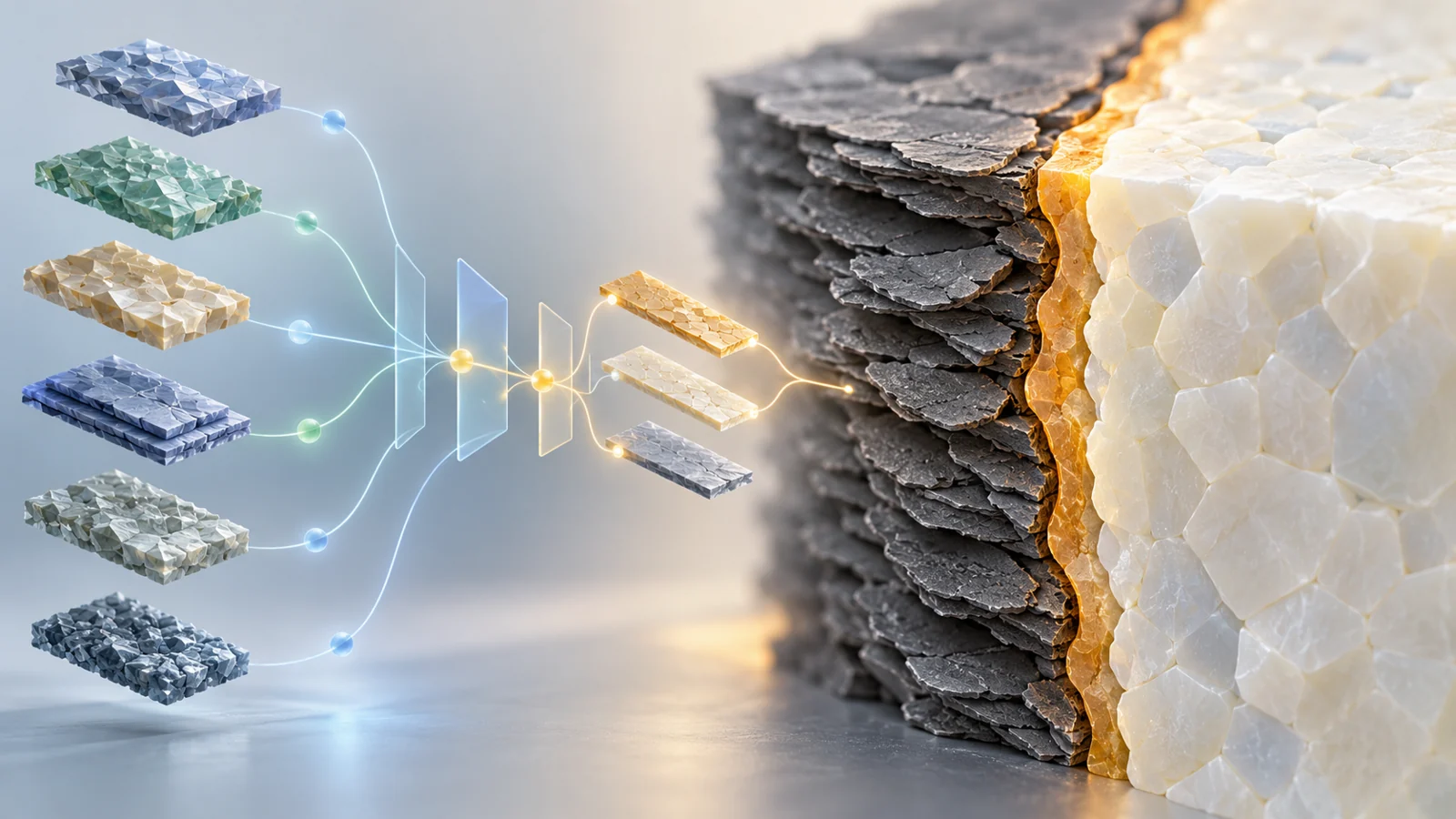
The direct way to study a material junction would be to construct many combined interfaces, varying the atomic arrangement and orientation each time. The number of possibilities quickly becomes unwieldy. The authors instead calculate individual slabs made from one material at a time.
A slab is a model of a crystal surface. By calculating the energy needed to cleave a crystal and expose that surface, the researchers estimate its surface energy. They then place those separate-surface estimates into an adapted contact-angle relationship, producing an adhesion parameter for a pair of materials. In this study, a value below zero is treated as favorable adhesion.
The shortcut does not reproduce every atom at a real boundary. Its value is that it can rank many possible combinations without explicitly constructing all of them. The continuous parameter also lets the researchers compare candidates rather than treating adhesion as a simple yes-or-no property.
The calculation is deliberately framed as an approximation. Surface energies depend on which atomic termination is exposed, and the selected surfaces may not match every interface formed during manufacturing. That dependence becomes part of the interpretation rather than a detail that can be ignored.
The coating must pass more than one test
Adhesion is only one gate. The screen also considers electrochemical stability, abundance, bulk reactivity and material stability. A coating that adheres well but breaks down over the battery’s operating voltage would not solve the underlying interface problem.
The authors apply the filters across electrolyte systems and then examine compatibility with lithium metal and with selected cathode materials. This two-sided check is important. Passing a test against an electrolyte does not establish that the same coating will work against an electrode. The coating must remain acceptable at both interfaces that surround it.
The anode side exposes a particular tension. The discussion identifies electrolyte–coating adhesion as a limiting factor for anode coatings. The authors suggest that coatings stable against lithium may also have more stable surfaces, and that such surfaces may bond less strongly with the electrolyte. In other words, improving chemical stability can coincide with a surface that is less ready to adhere. The screen is designed to find candidates within that trade-off rather than optimize only one property.
The shortlist changes with the electrolyte
The results are not a universal ranking of solid electrolytes or coatings. Candidate families differ between the oxide and sulfide systems examined. Across the systems, sulfides show candidates with more negative, or more favorable, adhesion parameters under the study’s approximation. The authors also note that the surface assumptions used in the calculation influence that comparison.
Oxides and silicates perform well across the compounds considered, a result that makes them visible candidates for further attention. Some anion families are less useful for particular electrolyte groups because they cannot meet the combined requirements. For example, the screen finds very few candidates in some families for the oxide systems, while those families appear among candidates for sulfide electrolytes.
Two named examples are LiAlSiO4 and Li5AlO8. The abstract highlights them as promising coating candidates for the lithium-containing oxide and sulfide electrolyte systems examined, and notes that they had also been investigated as electrode coatings. Their appearance in this screen is useful because it connects the adhesion calculation to recognizable materials. It does not make either compound a universally best coating or establish every electrode–electrolyte combination in which it would work.
Surface assumptions shape the result
A crystal can expose different atomic terminations and orientations. The authors therefore compare more than one way of choosing the surfaces that enter the adhesion estimate. A highly unstable exposed surface can make an electrolyte appear to adhere poorly to many coatings, even though that surface may be unlikely to occur naturally. A very stable termination produces a more favorable picture.
The reported discussion proceeds with a moderate case based on the 50 percent most stable terminations. This choice attempts to represent surfaces that are more likely to occur without relying only on the single most stable termination. It also explains why a candidate can move into or out of the shortlist when the surface-selection rule changes.
That sensitivity gives the result a practical meaning. A coating rejected under one assumed surface condition has not been shown to be incapable of adhering in every real interface. Conversely, a favorable calculated parameter does not show that a manufactured layer will keep the same contact. The calculation narrows the search by identifying combinations worth considering under stated surface assumptions.
From a calculated candidate to a working interface
The preprint includes 945 slab terminations across the materials analyzed, and 15 materials did not converge in the reported calculations. Those details show both the scale of the screening task and the limits of treating a large computational catalog as complete. The authors present a focused set of viable candidates rather than claiming to have evaluated every possible coating.
The main output is a way to prioritize materials that satisfy several conditions at once. A calculated screening parameter is not itself a measurement of adhesion strength, and a favorable value alone does not establish how a manufactured interface will behave. Nor does selection as a candidate, by itself, demonstrate sustained lithium transport through the coating, manufacturing readiness or improved performance in an operating cell.
Those questions belong to a later stage of evidence. A coating would need to retain contact, remain chemically and electrochemically compatible, and allow sufficient lithium movement when it is actually placed between battery materials. The computational screen helps define which combinations deserve that attention; it does not substitute for the behavior of the assembled device.
What this could change
If coatings identified through this kind of screen retain adhesion, chemical compatibility and adequate lithium transport in working cells, they could provide a physical bridge between solid electrolytes and demanding electrodes. That could make it more practical to pair solid electrolytes with lithium-metal anodes or higher-voltage cathodes while keeping the neighboring solids in useful contact.
The potential payoff is therefore not simply a longer list of coating materials. It is a more systematic route toward interfaces that are stable enough to protect battery components and connected enough to let lithium move across them. Whether that capability emerges depends on the unresolved transition from calculated surface relationships to durable, operating-cell interfaces.
Key Sources
- Primary source: Electrolyte Coatings for High Adhesion Interfaces in Solid-state Batteries from First Principles
arXiv · Preprint · 2023-03-28