
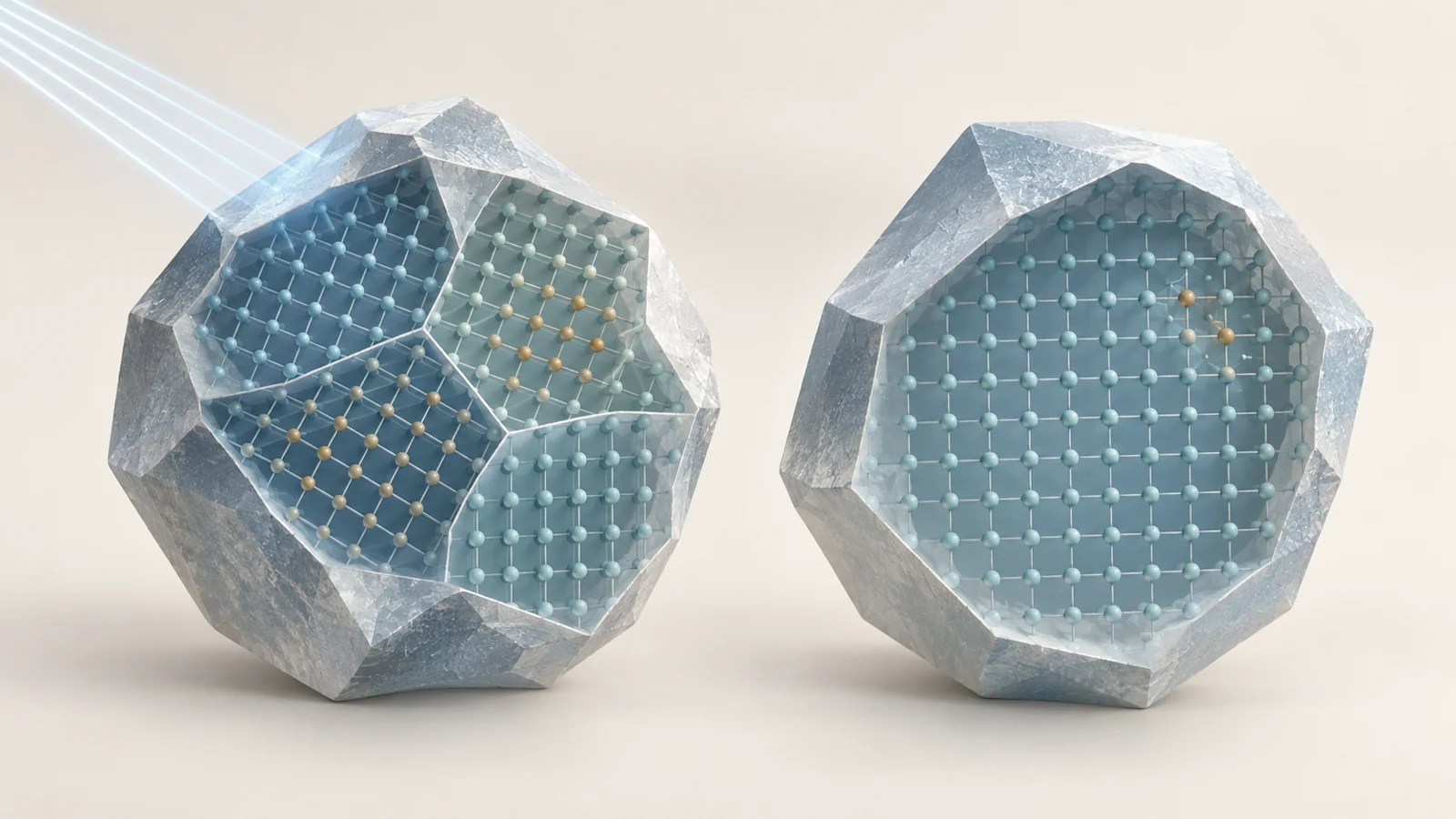
Adding aluminum helps a promising solid battery electrolyte adopt a crystal structure favorable for lithium-ion movement. What happens inside the resulting crystals deserves a closer look. A material can have the desired crystal phase while containing regions that differ in orientation, lattice spacing and local distortion.
In an arXiv v1 preprint dated January 24, 2021, researchers examine individual grains of aluminum-doped lithium lanthanum zirconium oxide, usually shortened to LLZO. Using Bragg Coherent Diffractive Imaging, they investigate atomic displacements within grains representing tetragonal, cubic and mixed cubic-tetragonal structures. Their observations reveal differently oriented domains, dislocations and a phase boundary, along with contrasting strain patterns.
The work provides a close view of the material from which an electrolyte might be made. Its contribution is a structural reference point for understanding how preparation choices could eventually affect mechanical behavior in a battery.
Why aluminum changes lithium movement
A solid electrolyte must allow lithium ions to move through it. In LLZO, that movement depends on the arrangement of the crystal and the distribution of lithium within it. The same broad chemical family can therefore behave differently depending on its crystal phase—the repeating arrangement of atoms in the solid.
The preprint describes tetragonal LLZO as stable at room temperature, with ionic conductivity roughly two orders of magnitude lower than that reported for cubic LLZO. That contrast comes from the background literature discussed by the authors. Strong lithium ordering in the tetragonal structure restricts the available ionic pathways and makes the movements needed for transport less readily accessible.
Aluminum substitution changes this arrangement. In the composition studied, one aluminum ion with a charge of three positive units substitutes for three singly charged lithium ions. The accompanying reduction in lithium occupancy introduces vacancies, or unoccupied lithium sites. Those vacancies are part of the structural change associated with stabilizing the cubic phase and increasing ionic conductivity.
The useful physical idea is that lithium transport depends on more than how much lithium a material contains. Occupancy and ordering matter too. Adding aluminum alters both the composition and the conditions that favor one crystal arrangement over another, giving researchers a way to influence the electrolyte’s behavior.
Looking within a single grain
A grain is an individual crystalline region within a material. Its outer boundary does not necessarily enclose one perfectly uniform arrangement. Smaller regions inside it can have different crystallographic orientations; these are domains. Distinguishing a domain from a grain matters here because the researchers are investigating variation within individual grains.
Bragg Coherent Diffractive Imaging uses X-ray diffraction to reconstruct information about the crystal interior. In this study, it gives the researchers access to atomic displacements—departures of the lattice from a reference arrangement. Spatial changes in those displacements reveal local strain, meaning distortion within the crystal.
For tetragonal LLZO, the team observes coexisting domains with different crystallographic orientations. A single grain thus contains internal organization that its phase name alone does not describe. The orientation of one region differs from that of another even though both belong to the grain being examined.
In their examination of mixed- and cubic-phase grains, the authors also report dislocations and a phase boundary, and connect the observed defects with aluminum doping. A dislocation is a disruption in the regular arrangement of a crystal lattice. A phase boundary separates regions with different crystal structures. Neither term, by itself, means an open crack: these observations concern how the crystalline solid is arranged internally.
The images therefore distinguish several kinds of structure that would be easy to blur together in a general description of “defects.” Orientation changes, changes of phase and disruptions of lattice order are different features, with potentially different consequences.
The mixed and cubic particles store different strain energy
The mixed-phase grains exhibit large strain gradients. In physical terms, the amount of lattice distortion changes substantially from one location to another. The authors suggest that an uneven distribution of crystal phases within a grain could explain this behavior. That is an interpretation of the observed pattern, rather than a separately demonstrated cause.
At increased aluminum doping, the study describes the formation of large strain-free crystalline domains of stable cubic LLZO. These broad regions contrast with the more strongly varying mixed-phase interior. Yet the cubic grains also show slight differences in lattice spacing. The authors propose local variation in aluminum composition as a likely explanation for those differences.
There is no contradiction between a large strain-free domain and residual variation elsewhere. The first description applies to a region within the reconstructed structure. It does not establish that the entire grain is uniform, much less that every grain in a ceramic electrolyte would share that condition.
The researchers also compare the strain energy of a reconstructed mixed-phase particle with that of a cubic particle. Strain energy describes the elastic energy associated with deformation of the lattice. In this comparison, the mixed-phase particle has approximately twice the reported strain energy of the cubic particle. This agrees with the more pronounced strain and domain structures described in its reconstruction.
That ratio belongs to the particles compared. It does not establish a rule that mixed-phase LLZO always stores twice as much strain energy, or that progressively adding aluminum will always reduce strain. The result supplies a concrete local comparison, without identifying an optimal doping recipe.
Where the connection to durability remains open
The mechanical question arises because an electrolyte must remain useful through repeated battery operation. The preprint discusses prior work linking fracture behavior to microstructural features such as grain size, impurities and pre-existing cracks. It also cites modeling in which greater fracture toughness helps prevent crack formation and propagation, supporting stable performance.
Against that background, residual strain around the observed defects is a plausible subject for further investigation. But the imaging does not establish which features initiate cracks, whether every dislocation is detrimental, or how the measured structures respond during cycling. A lattice disruption and a fracture are distinct observations; demonstrating a causal connection requires evidence that follows the material’s mechanical behavior.
The electrical connection also remains unresolved at this scale. The study does not establish a conductivity gain in the particular grains imaged or directly trace lithium transport through their defects. The conductivity advantage discussed for cubic LLZO comes from the source’s account of earlier research, while this experiment contributes local structural observations.
These distinctions define the strength of the January 2021 preprint. It offers experimental evidence about grain interiors and interpretations of why their strain varies. It does not demonstrate longer battery life, improved cell safety or greater energy density. This preprint version has not been peer reviewed.
What this could change
If particular internal strain patterns can be linked to fracture behavior, and material preparation can control those patterns while retaining useful ionic conductivity, LLZO developers could gain a route to electrolytes that are less prone to cracking during cycling. The path would run from identifying mechanically consequential structures, to controlling their formation, to demonstrating that the resulting ceramic withstands repeated use.
Such control could help solid electrolytes keep functioning for longer and potentially support longer-lasting solid-state cells. From the January 2021 perspective, the opportunity is to make the interior of an electrolyte grain an actionable part of durability design. These X-ray observations provide an early structural basis for pursuing that possibility.
Key Sources
- Primary source: X-ray nanoimaging of crystal defects in single grains of solid-state electrolyte AlxLi7-3xLa3Zr2O12
arXiv · Preprint · 2021-01-24