
Since the previous research note · Earlier expectation not tested
Track continuity
Since the previous research note: How contact layout and pressure shape charge flow in a solid battery interface
Previous expectation: Durable contact arrangements could reduce interface resistance and preserve more of a solid-state battery's working voltage.
What this study adds: The current preprint follows crystal structure during operation, reporting an orientation-dependent cathode reaction, a lithium-rich insulating interface limiting lithium removal, and evolving lithium orientation on titanium. It supplies a distinct view of processes inside an operating cell without testing the earlier contact-layout forecast.
What changed in this study
A battery’s voltage trace can show that charging is becoming difficult, but it cannot by itself reveal where the difficulty begins. In a compact all-solid-state battery, the obstruction might develop inside the cathode, at an interface, or in the lithium being deposited at the other electrode. Those possibilities matter because a dense electrode has less open space than a porous one, while a solid electrolyte carries lithium ions through a rigid set of materials rather than a flowing liquid.
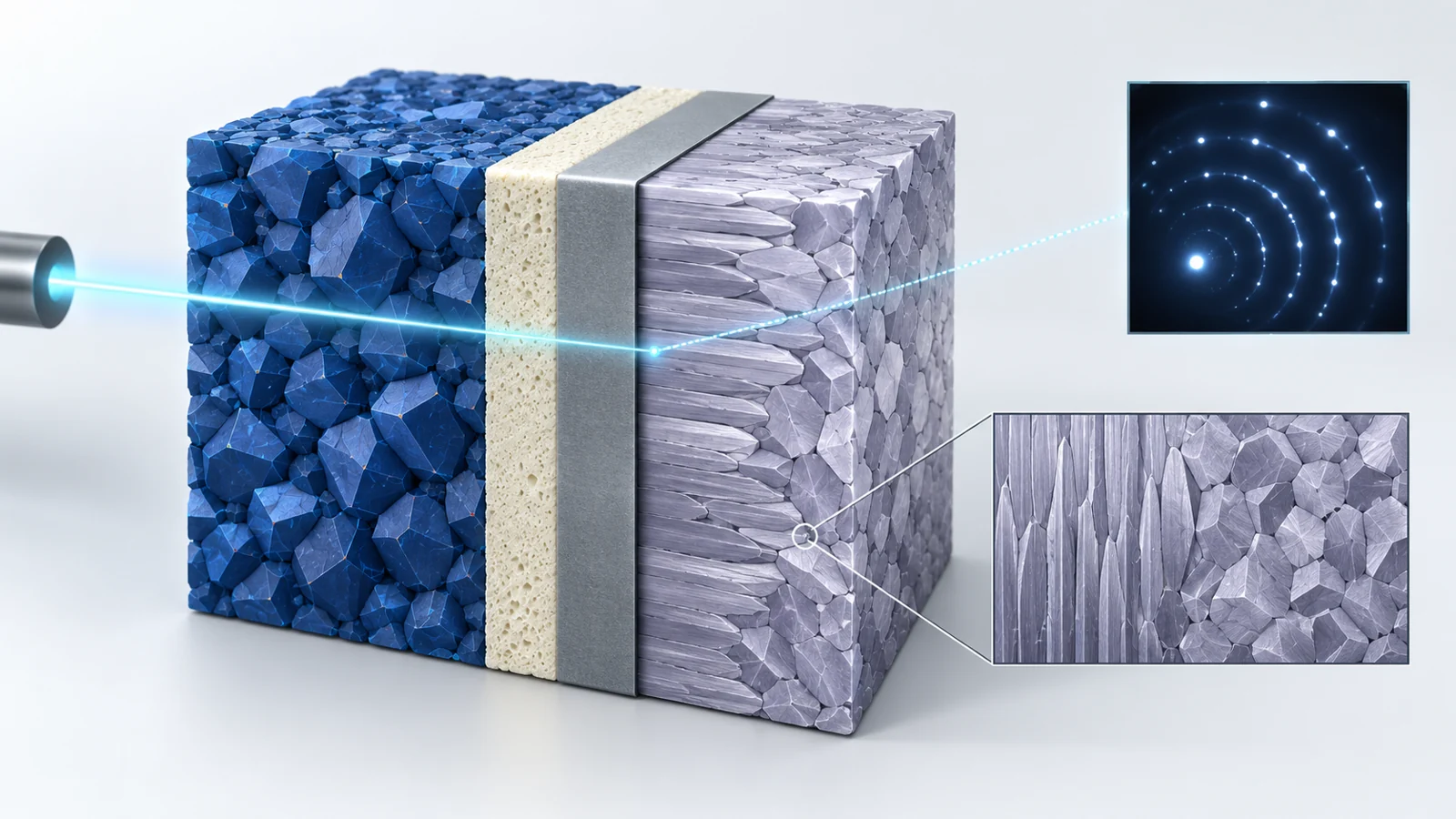
A preprint published on February 5, 2025, follows these changes while the cell operates. The researchers use synchrotron X-ray micro-diffraction imaging to watch a dense lithium cobalt oxide cathode, a titanium current collector, and electrodeposited lithium. The measurements connect two kinds of structural information with electrochemical behavior: how the spacing of atoms changes and how individual crystal regions are aligned.
Following three crystalline parts as the cell runs
“Operando” means that the measurement is made during operation rather than after the battery has been stopped and taken apart. Here, a focused X-ray beam scans across the compact cell. At each position, the detector records a diffraction image, allowing the researchers to follow crystalline regions over time.
Lattice parameters describe the repeating distances within a crystal. Crystal orientation describes how that repeating structure is aligned relative to the surrounding material and the measurement. The distinction is important. Two regions can contain the same material while presenting different orientations, and those orientations can affect how structural changes appear as lithium moves in or out.
The experiment brings several parts of the working cell into the same view. It follows the dense lithium cobalt oxide cathode as lithium is removed, the titanium current collector that supports the metal electrode, and lithium deposited during plating. That combination gives the structural changes a shared timeline. It does not amount to equivalent crystallographic coverage of every material in the cell: the supplied evidence concerns these named crystalline components, not a complete structural image of the electrolyte and packaging.
The researchers also compare normalized electrochemical profiles from the imaging cell with a cell tested under controlled laboratory conditions. The profiles match closely enough that the imaging setup shows no evident interference attributable to its test environment. That supports interpreting the structural sequence as a response of the operating cell, while leaving the broader question of how widely the behavior applies open.
The cathode’s alignment changes the charging story
The cathode is not structurally uniform simply because all of it is lithium cobalt oxide. Different crystal regions have different orientations, and the preprint reports different reaction behavior for those orientations. During charging, lithium is removed from the cathode. The way that removal progresses therefore depends partly on how the crystal is aligned.
That observation changes the usual picture of a dense electrode as a single block through which lithium must diffuse. The interior contains differently oriented crystalline regions, and the preprint reports that their reaction behavior differs with orientation. The paper discusses mechanical effects as a possible reason for the orientation-dependent behavior, but the supplied evidence does not settle the cause. The orientation link is an experimental observation; the explanation remains a hypothesis.
The more specific charging constraint concerns what happens as lithium leaves the dense cathode. The authors attribute the limited delithiation of this dense electrode to the formation of a lithium-rich insulating interface. In this account, the difficulty is not simply that lithium has a long distance to travel through the electrode. A lithium-rich region develops where it can interrupt the electrochemical process and restrict further removal.
That interpretation also gives the result a useful contrast with porous electrodes. Pores change the paths and available interfaces inside an electrode, while the dense electrode studied here presents a different arrangement of material and contact. The preprint’s finding is therefore not a universal rule for every cathode. It identifies a specific structural and interfacial behavior that can make lithium removal difficult in a dense configuration.
Lithium does not keep the same crystal arrangement
The other half of the experiment follows lithium metal as it is plated and stripped. At the beginning of plating, the orientation of the deposited lithium is influenced by the texture of the titanium current collector. Texture means a preferred distribution of crystal orientations across a material, rather than a completely random arrangement.
The initial relationship then changes within minutes. Some lithium grains remain observable through much of plating, while others rotate or move out of the diffraction conditions needed for detection. During stripping, the observed grain population changes as well. The important sequence is not a single fixed orientation, but an evolving metal structure that responds as lithium is added and removed.
The discussion suggests that lithium may initially grow in an epitaxial relationship with titanium, meaning that the crystal arrangement of the new material is guided by the underlying surface. That possibility is not established as an exact orientation relationship by the supplied evidence. It is a useful clue about how the collector may influence early growth, followed by a measured change in the orientations visible during cycling.
This matters because the metal electrode is not merely a featureless reservoir of lithium. Its grains have orientations, some persist, some disappear from the measurement, and the balance shifts on the timescale of battery operation. The cathode result and the lithium result describe different processes, but together they show why a voltage trace alone leaves out important information about a working solid-state cell.
A detailed view with a narrow window
The X-ray method provides unusually rich information, but it does not see every grain at every moment. Without rotating the sample, the experiment samples only part of the available reciprocal space, the crystallographic range represented by the diffraction geometry. A grain appears when its orientation meets the conditions for producing a detectable spot. A grain that is still physically present may therefore become invisible after rotating or moving away from those conditions.
That restriction is why the reported counts of total and newly visible lithium grains should be read as diffraction populations, not as a complete census of the metal. The rapid increase in visible grains early in plating and the later changes in that population reveal how the observable structure evolves, but they do not by themselves determine the fate of every grain in the electrode.
The electrochemical comparison has a similarly defined scope. Matching normalized profiles between the operando cell and a laboratory-tested cell indicate that the measurement environment did not produce an evident distortion in those profiles. They do not demonstrate faster charging, greater usable capacity, longer cycle life, improved safety, or performance across other battery designs and operating conditions.
Taken together, the results offer a way to connect structural events with battery behavior while preserving the limits of the view. Crystal alignment helps distinguish cathode reactions that would otherwise be grouped together. The lithium observations show a changing orientation population rather than a static deposit. The interface interpretation identifies a plausible reason for restricted lithium removal in the dense cathode, while the origin of the orientation-dependent reaction remains unresolved.
What this could change
If the lithium-rich insulating interface can be reduced without creating a new bottleneck, a dense cathode could release more of its lithium during charging instead of leaving part of its working capacity inaccessible. If the early influence of the titanium collector and the later evolution of lithium orientations can also be controlled in ways that improve plating and stripping reversibility, compact solid-state batteries could make more of their stored energy usable over repeated operation.
That conditional path would matter especially for batteries designed for portable electronics and microdevices, where compact construction makes each active region important. The value of this preprint is the ability to see the cathode reaction and lithium growth as changing crystal processes inside the same operating cell. Turning that view into a practical gain would depend on proving that the identified constraints can be changed reliably, not simply observed.
Key Sources
- Primary source: Operando imaging of crystal structure and orientation in all components of all-solid-state-batteries
arXiv · Preprint · 2025-02-05