
Since the previous research note · Earlier expectation not tested
Track continuity
Since the previous research note: Why the middle recipe mattered in a ceramic battery electrolyte
Previous expectation: A particular ion-conducting ceramic could become easier to fabricate and integrate into a solid-state cell if its properties survived handling, processing and joining to electrodes.
What this study adds: This preprint introduces a computational framework connecting particle–electrolyte separation to lithium-transfer degradation and demonstrates how neighboring particles can intensify interface fracture. It adds a way to investigate a mechanical integration problem without testing the earlier ceramic or its forecast.
What changed in this study
A solid-state battery replaces the liquid electrolyte found in many conventional designs with a solid ion-conducting material. That change can make the physical boundary between an electrode particle and its surrounding electrolyte central to how the cell operates. Lithium must move through the electrolyte and exchange with the particle, while the particle itself changes shape as lithium is inserted or removed.
A September 2023 arXiv preprint studies what happens when those processes interact. Its computational framework follows electrochemistry and nonlinear mechanics at the scale of individual particles. The model allows an active particle—the electrode material that stores lithium—to separate from the surrounding solid electrolyte when intercalation stresses become large enough to drive interface fracture. Once contact is lost locally, the model reduces the charge transfer available across that part of the boundary.
This is a modeling milestone about interface mechanics. It does not demonstrate a new battery or establish a measured change in capacity, cycle life or charging speed. Its value is that it gives researchers a way to examine how particle shape, stress and contact can influence lithium transfer before those questions are reduced to a whole-cell performance claim.
When contact becomes part of the battery problem
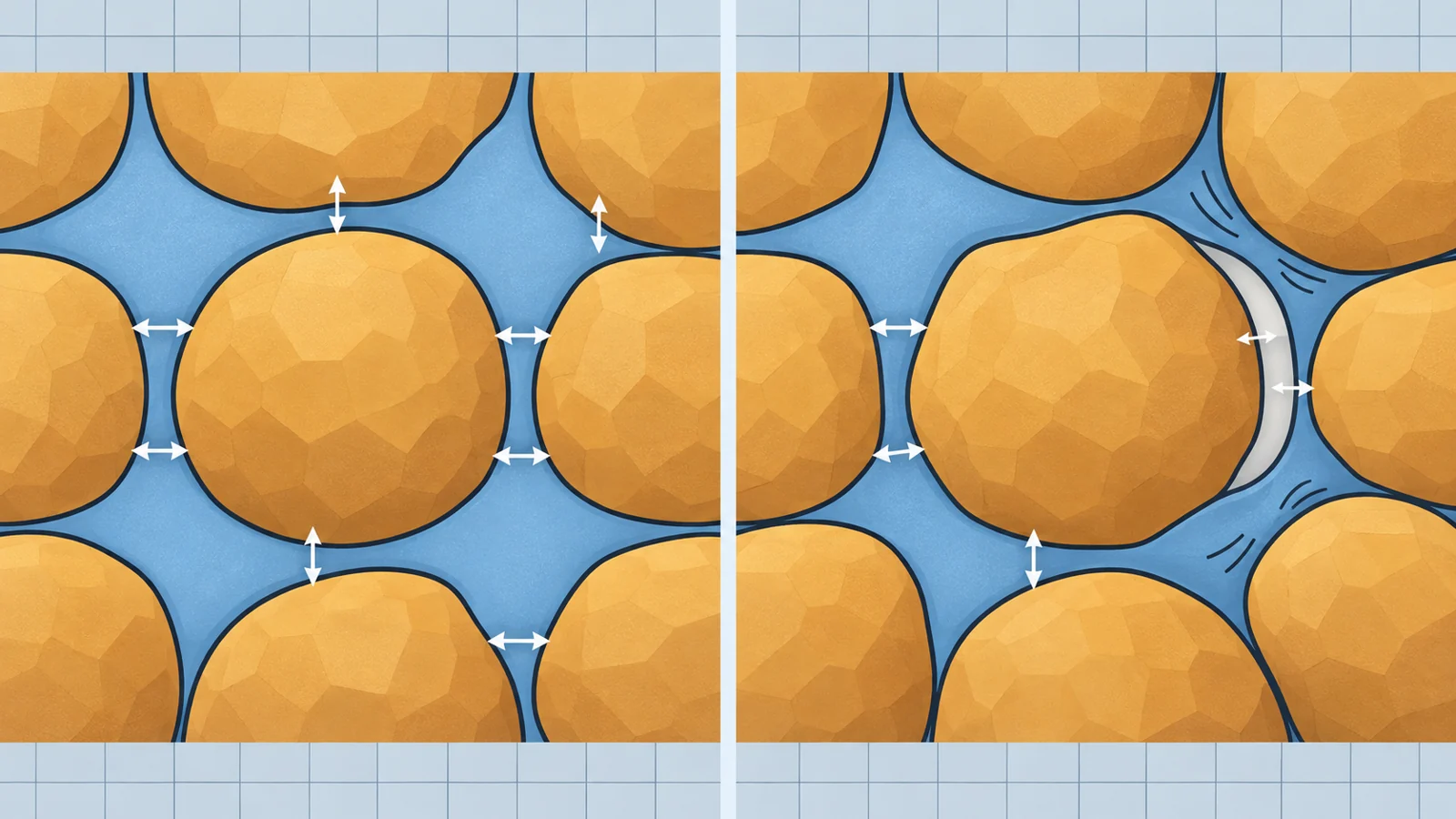
The preprint treats the particle–electrolyte boundary as an active part of the calculation rather than as a perfectly intact line that stays fixed throughout operation. Lithium insertion changes the particle’s deformation state. That deformation creates stresses at the interface, and the interface may open in some locations while remaining connected in others.
The same boundary carries several kinds of information at once. Lithium concentration can differ across it. Lithium flux can change as the local transfer conditions change. Electric fields can also be discontinuous, and displacement must be allowed to jump when a crack or gap opens. Representing those differences matters because a fractured interface is not simply an intact interface with a smaller number attached to it. Its mechanical separation changes the conditions under which electrochemical transfer can occur.
The framework therefore links two effects that are often easier to discuss separately. Mechanical loading can create damage, while damage can alter charge transfer and, in turn, the later distribution of lithium. That feedback is the physical problem the calculation is designed to expose.
A grid that can let boundaries move
The numerical method extends discontinuous finite element techniques so that the fields on opposite sides of a sharp material boundary do not have to share the same value. It also allows displacement discontinuities associated with particle–electrolyte fracture. In practical terms, the calculation can represent a boundary that has opened without requiring every field to remain smooth across it.
The mesh has another important role. It can remain Cartesian and independent of the outlines of the particles. The particle geometry does not have to conform exactly to the computational grid, so the framework can accommodate arbitrary designed shapes or geometries obtained from microscopy images. That does not mean the examples shown are themselves measurements of a particular electrode microstructure. It means the method is built to handle more varied shapes than a grid whose elements must be redrawn around every particle.
This separation between geometry and mesh is useful for a problem in which the geometry can change the answer. A narrow contact region, a curved boundary or a nearby particle may produce a different local stress pattern from a simple idealized shape. Keeping the grid independent gives the calculation room to represent those configurations while retaining a common numerical structure.
Stress changes lithium even before a crack
The preprint first separates stress effects from fracture. In a single-particle example, the baseline calculation uses stress-independent kinetics. Other comparisons then allow stress to affect lithium diffusion, the interface reaction, or both. The question is not merely whether stress exists, but which part of the electrochemical process responds to it.
The comparison shows that the lithium concentration field changes when either diffusion or reaction is made stress-dependent. When both effects are included, their combined influence produces additional lithium near the interface close to the current collector relative to the separate-effect cases described in the study. These are spatial differences within the simulated particle at the end of the first discharge, not direct measurements of lithium in a working cell.
That distinction helps clarify what the model contributes. A change in the concentration pattern can arise from stress-sensitive transport or interfacial charge transfer even when the particle–electrolyte boundary is kept intact. Fracture is therefore not the only route by which mechanics can reshape the modeled electrochemical state. It is a further change in the boundary condition, layered onto an already coupled problem.
Fracture makes the comparison visible
The fracture-enabled calculation adds cracked elements at the particle–electrolyte interface. The study compares this case with a fracture-suppressed calculation and examines the difference in lithium concentration inside the cathode particle. In the fracture-suppressed reference, the reported deviation is zero by definition. The fracture-enabled result then shows where the concentration field departs from that selected baseline.
This comparison is useful because it keeps the question local and explicit. It does not turn a damaged interface into a single cell-wide performance number. Instead, it shows how the modeled lithium distribution changes when the calculation permits the boundary to open and the associated charge-transfer degradation to take effect.
The same logic applies to the figures showing fractured elements. White regions identify elements that have cracked in the displayed simulations, while the concentration comparison indicates how the fracture case differs from the intact-contact reference. Together, the views connect mechanical damage with an electrochemical consequence inside the modeled particle. They do not, by themselves, state how much energy a complete battery would lose or what fraction of capacity would remain available.
Why neighboring particles matter
The multiple-particle example adds another source of mechanical interaction. A particle does not deform in isolation when other active particles occupy the surrounding electrolyte. Deformation of neighboring particles increases tensile stresses at particle interfaces in the demonstrated configuration, and the calculation produces more fracture than in the corresponding single-particle setting.
That result changes the interpretation of interface damage. A particle’s risk of separation is not determined only by its own lithium-driven deformation. The arrangement around it can contribute to the stress state that develops at the boundary. The modeled concentration differences between fracture-enabled and fracture-suppressed cases then show how that additional damage can be associated with reduced lithium transfer across fractured interfaces.
The finding is specific to the demonstrated examples and settings. It does not establish a universal rule that denser packing, a particular particle arrangement or any neighboring particle will always increase fracture across all materials and operating conditions. It shows why the surroundings belong in the calculation when the goal is to understand a real electrode architecture rather than an isolated particle.
Reading the result at the right scale
The preprint’s outputs are concentration fields, interface states and stress-coupled comparisons inside simulated particle structures. They can reveal where the calculation predicts altered lithium distribution and where mechanical separation appears. They can also help distinguish a transport effect from a reaction effect in a controlled numerical comparison.
Those outputs sit several steps away from a validated prediction of battery service life. A difference from a chosen simulation baseline is not an observed improvement or decline in a manufactured cell. The displayed concentration changes do not quantify whole-cell energy loss, retained capacity or charging speed. Nor does the ability to use microscopy-derived geometry show that a particular measured microstructure was used in the examples described here.
The useful claim is narrower and more practical: the framework provides a way to test how electrochemical behavior and interface mechanics interact under specified particle arrangements. Whether those predictions are reliable for a given material system depends on their agreement with relevant physical behavior and their usefulness for electrode structures beyond the demonstrations.
What this could change
If this coupled approach holds up against the physical behavior of real solid-state electrode interfaces, it could give designers a better way to search for particle arrangements that retain contact while lithium moves in and out. Instead of treating mechanical separation as a late-stage failure that appears only after a cell has been built, they could use particle-scale calculations to identify geometries and local stress patterns that are less likely to interrupt active material participation.
The potential payoff is not a guarantee of longer-lived batteries from the simulation alone. It is a design capability: compare realistic particle shapes and neighboring configurations, identify where contact is most vulnerable, and favor structures that keep more of the electrode connected to the ion-conducting solid. That path remains conditional on the model matching relevant physical behavior and remaining useful for practical electrode architectures, but it addresses a bottleneck that a purely chemical description would leave out.
Key Sources
- Primary source: A treatment of particle-electrolyte sharp interface fracture in solid-state batteries with multi-field discontinuities
arXiv · Preprint · 2023-09-23