
Since the previous research note · Earlier expectation not tested
Track continuity
Since the previous research note: Lithium can move faster without changing its route through a solid
Previous expectation: Controlling strain in Li3YCl6 while maintaining stable interfaces could help preserve lithium transport as a solid-state battery operates.
What this study adds: The current source examines a different material and a different transport question, calculating rapid intrinsic lithium transfer at a lithium/Ga-doped LLZO interface and distinguishing it from practical contact-related resistance. It provides neither a test nor validation of the earlier strain forecast.
What changed in this study
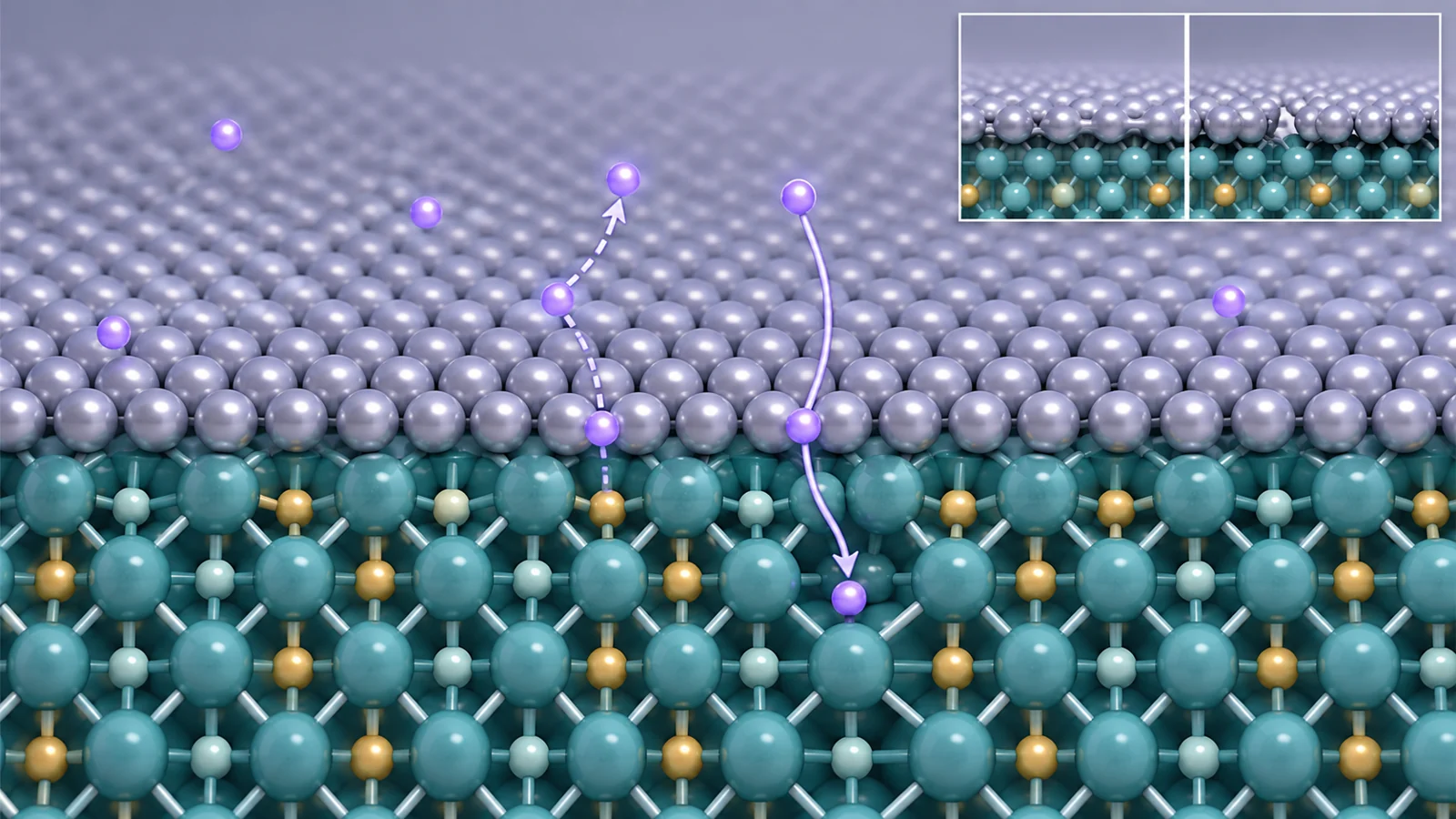
A solid-state battery can have a lithium-conducting ceramic that appears capable of moving lithium quickly, yet still show substantial resistance where the metal touches the ceramic. That apparent contradiction is the starting point for a new computational preprint on lithium metal and gallium-doped LLZO, a garnet-type solid electrolyte.
The study calculates a charge-transfer activation energy of 167 meV at the lithium/Ga-LLZO interface. For comparison, lithium migration within Ga-LLZO has a reported barrier of 200 meV. An activation energy is the energetic hurdle for a process to occur. It is not a charging time, a battery-efficiency percentage or a direct measurement of how quickly a complete cell can charge.
The result points to a particular conclusion about the modeled interface: the intrinsic step in which lithium crosses between metal and ceramic may be fast enough that it is not the main source of resistance. That conclusion becomes more useful once the simulation separates a genuine transfer event from nearby atomic motion and distinguishes an ideal contact from the imperfect area available in a real interface.
A boundary can be active without every nearby ion crossing
At an atomistic interface, lithium does not move in a perfectly straight stream. An ion can shift toward the boundary, move back and forth, or rattle around a local environment without completing a transfer from one side to the other. Simply observing motion near the interface would therefore overcount the events that matter for charge transport.
The researchers introduce a residence-time window to filter out this local rattling. The method asks whether an ion remains on the new side long enough to count as a transfer, rather than treating every boundary crossing or short excursion as a completed event.
That distinction also separates two kinds of atomistic question. A static migration calculation traces an energetically favorable pathway between positions. Molecular dynamics follows atoms as they move at finite temperature. The first can show whether a proposed route is energetically plausible; the second can reveal how often ions actually make lasting transitions in a fluctuating structure. For charge transfer, following the event itself can answer a different question from drawing the lowest-energy path.
Using the event-counting method, the study estimates a resistance on the order of 10^-5 Ω cm² for the modeled lithium/Ga-LLZO interface. In the authors’ interpretation, that low intrinsic value means the transfer step at this clean, simulated boundary is not rate-limiting. It does not mean every lithium/LLZO contact will behave the same way.
Larger simulations still need an electronic-structure anchor
The calculation combines several levels of modeling. Electronic-structure and ab initio molecular-dynamics calculations provide configurations for training moment tensor potentials, or MTPs. These learned interatomic potentials approximate the atomic interactions at much lower computational cost, allowing molecular-dynamics simulations over larger collections of atoms and longer trajectories than direct electronic-structure calculations would normally permit.
A learned potential is useful only if it preserves the behavior that matters for the question being asked. In selected migration-pathway tests, MTP-based nudged elastic band calculations reproduced low-energy lithium pathways in tetragonal LLZO and in a lithium/tetragonal-LLZO supercell. The reported mean absolute error in the specified activation-energy benchmarks was 15 meV.
That comparison supports the use of the learned model for those benchmarked pathways. It is not an uncertainty interval for the final 167 meV interfacial activation energy, and it does not turn every result from the larger molecular-dynamics calculations into a directly measured quantity. The validation is strongest where the learned and electronic-structure calculations were explicitly compared.
This layered approach matters because the central result depends on dynamics, not only on a single frozen structure. The model must describe enough of the surrounding atomic environment for ions to move, rearrange and occasionally complete a transfer. The larger simulations make that type of sampling practical, while the electronic-structure calculations provide the physical reference for selected cases.
Crystal choice and temperature can change the story
The identity of the simulated LLZO structure is not a minor modeling detail. The study compares tetragonal LLZO, cubic LLZO and Ga-LLZO, and uses a vacancy-containing tetragonal structure as a possible computational reference. That shortcut does not work reliably for the transport comparison presented.
The vacancy-containing tetragonal model has a calculated activation energy of 136 meV and a vacancy diffusion coefficient of 2.8 × 10^-8 cm²/s. The authors use these results to show that it is not a suitable surrogate for cubic LLZO. A convenient crystal model can therefore produce a plausible-looking transport number while representing a different mechanism or structure from the one a researcher intended to study.
Temperature creates a related problem. Ab initio molecular dynamics is often run at elevated temperatures to make diffusion events easier to observe. But a high-temperature trajectory can enter a different dynamical regime from the one relevant at room temperature. In the Ga-LLZO comparison, extrapolation from the high-temperature regime gives a 300 K diffusion coefficient three times lower than the value inferred from low-temperature data.
The lesson is not simply that hotter simulations are wrong. It is that the regime being sampled has to be connected carefully to the regime being interpreted. For interface calculations, both the material structure and the temperature-dependent mechanism can affect the barrier, the diffusion rate and the apparent relationship between bulk transport and interfacial transfer.
A small intrinsic resistance can coexist with a difficult contact
The calculated resistance belongs to an idealized atomistic boundary. A practical interface is judged over a nominal geometric area, but current may pass through only part of that area if contact is incomplete. The area-normalized resistance can then look large even when the locally active patches have relatively favorable transfer kinetics.
This distinction helps reconcile a low calculated intrinsic resistance with appreciable resistance measured at a practical interface. Poor physical contact and the formation of an interphase can add losses that are not the same as the elementary lithium-transfer barrier at a clean metal/ceramic boundary. The study’s discussion treats these extrinsic features as important explanations for why interface resistance can change substantially with processing.
Atomistic calculations can estimate intrinsic area-normalized resistance and exchange-current-related quantities for a modeled contact. They cannot, by themselves, determine how much of a manufactured interface is electrically and ionically active during operation. That missing connection between nominal area and conducting contact area is one reason a favorable microscopic result does not automatically become a full-cell performance improvement.
The practical implication is specific rather than universal. For lithium and Ga-LLZO, the modeled transfer step looks sufficiently facile that engineers may need to focus on preserving effective contact and controlling interphase formation rather than assuming the elementary boundary crossing is inevitably the dominant bottleneck. Other solid electrolytes, compositions or interface conditions require their own assessment.
The electrical boundary of the calculation
The study also identifies a limit in the way the learned models are used. The interatomic potentials are trained from electronic-structure and molecular-dynamics data under constant-charge conditions. Within that setup, the calculations can reproduce the modeled potential alignment and evaluate the reported exchange-current behavior for the selected condition.
They do not establish how the exchange current changes across different applied potentials. That matters because an operating battery does not remain at one abstract electrical condition throughout every stage of use. A constant-charge result can describe the modeled interface under its chosen conditions without providing a complete current–voltage picture.
This boundary keeps the interpretation appropriately narrow. The preprint supports a computational mechanism result for lithium/Ga-LLZO: genuine transfer events have a low calculated barrier, and the associated intrinsic resistance is estimated to be on the order of 10^-5 Ω cm². It does not establish faster charging, higher power, longer cycle life or improved safety for a complete battery.
What this could change
If the modeled transfer kinetics remain favorable under relevant operating conditions, and if manufacturers can maintain clean, effective contact across the lithium/Ga-LLZO boundary, that interface could carry useful current with less loss at the metal–ceramic step. Battery developers could then spend less effort treating intrinsic transfer across this particular boundary as an unavoidable bottleneck and more effort preserving the portion of the interface that actually conducts.
That is a conditional capability, not a demonstrated battery outcome. Its value lies in separating a potentially fast microscopic event from the practical conditions that determine whether enough of those events can occur across a working interface. The result offers a way to ask a sharper engineering question: not only whether lithium can cross the boundary, but how much of the boundary remains able to support that crossing.
Key Sources
- Primary source: Machine learning assisted molecular dynamics of charge-transfer mechanisms at Li/Ga-doped Li$_7$La$_3$Zr$_2$O$_{12}$ (LLZO) interfaces
arXiv · Preprint · 2026-06-05