
Since the previous research note · Earlier expectation not tested
Track continuity
Since the previous research note: Why a battery can look stable while its interface keeps changing
Previous expectation: Joint control of lithium contact and accumulating interface chemistry could help future solid-state cells sustain delivered performance under repeated demanding use.
What this study adds: The current preprint adds a bulk-electrolyte mechanism, predicting that lattice strain changes lithium diffusion in Li3YCl6 without shifting the crossover between its two transport regimes. That result does not test the earlier coupled interface forecast.
What changed in this study
A solid-state battery electrolyte is not mechanically isolated once a cell is assembled. Stack pressure can compress its lattice, thermal cycling can expand and contract it, and a mismatch between neighboring materials can distort its structure. Each change can affect how lithium ions travel through the solid. The key question is whether deformation changes the transport process itself or mainly changes how efficiently that process operates.
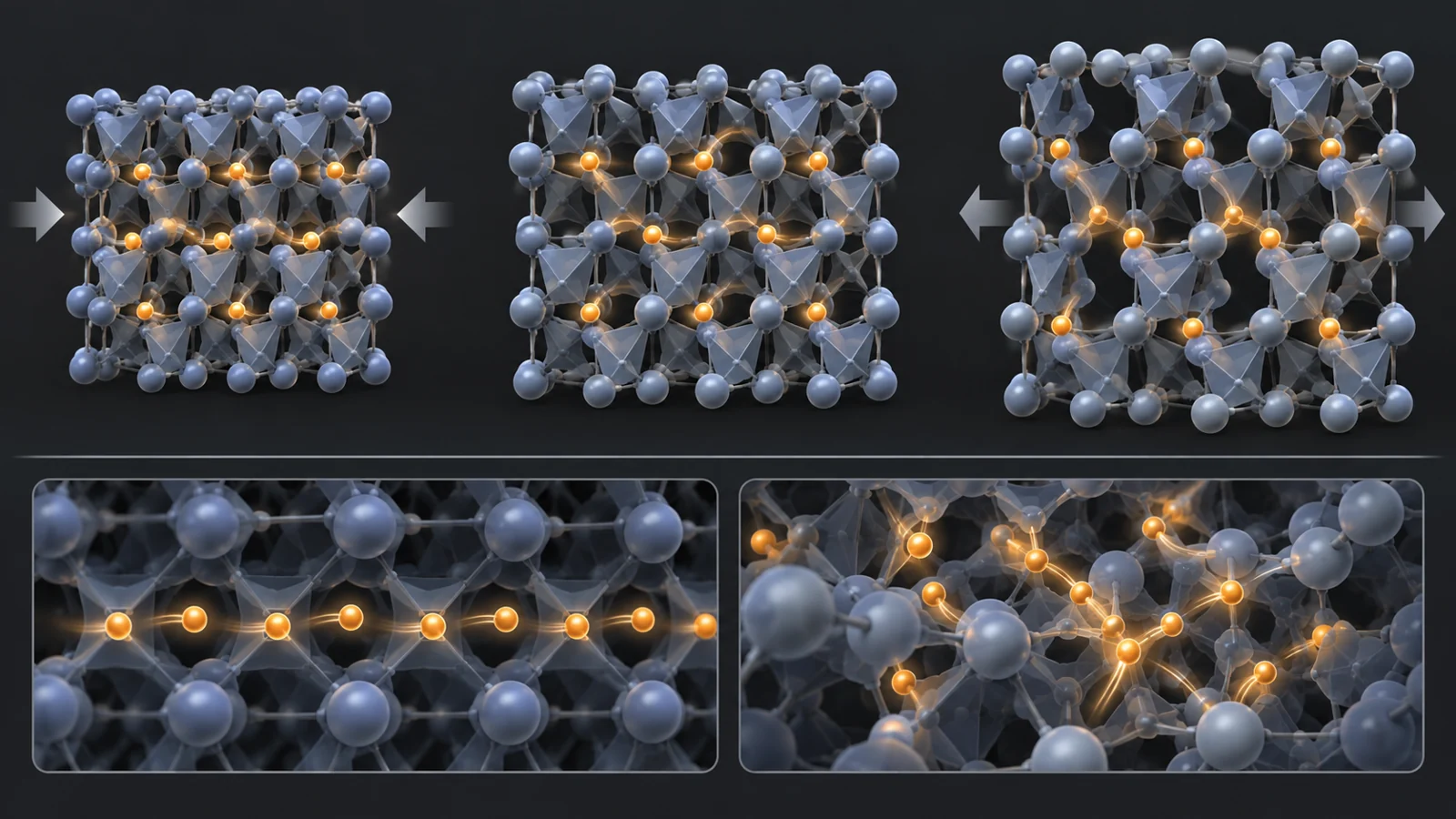
A computational preprint published on May 7, 2026, examines that question in Li3YCl6, a lithium-conducting halide solid electrolyte. The researchers used large-scale molecular dynamics with isotropic lattice strain. In the reported simulations, expansion increased lithium diffusivity and compression decreased it, while the temperature at which the material changed transport regime remained unchanged.
That result separates transport rate from transport pattern. The lattice can make lithium movement easier or harder without necessarily replacing one microscopic mode of movement with another.
When the lattice itself is under strain
Lithium does not move through Li3YCl6 as if it were traveling across an empty space. Its motion responds to the arrangement of atoms and to the energy landscape created by that arrangement. Changing the lattice dimensions can therefore alter the difficulty of individual hops and the conditions under which broader cooperative motion develops.
Li3YCl6 is a useful setting for examining the distinction because its calculated transport already has two temperature regimes. At lower temperatures, lithium motion is predominantly one-dimensional hopping. At higher temperatures, it becomes three-dimensional and cooperative. The study asks whether isotropic expansion or compression shifts the boundary between those regimes, rather than simply changing the rate within each one.
A model built to follow ions
The calculations use an Atomic Cluster Expansion, or ACE, interatomic potential. This machine-learning model approximates the forces between atoms from patterns learned from first-principles energies and forces. Once trained, it lets molecular dynamics follow atomic motion across large simulations without recalculating every interaction directly from first principles at every step.
The model was trained with separate training, validation and test subsets. On the test set, it reported mean absolute errors of 0.52 meV per atom for energy and 14.09 meV per angstrom for forces. The calculated lattice parameters for the reported Li3YCl6 phases agreed with the referenced calculations and experiments within 0.5%.
Those checks give the transport calculation a specific foundation. The potential was assessed against energetic, force and structural quantities before it was used to examine how strain affects diffusion. The study also compared structural, mechanical and transport properties with experimental and first-principles results.
Temperature changes the transport pattern
The main model produces a two-regime Arrhenius relationship for lithium diffusion. In the lower-temperature regime, lithium primarily advances through one-dimensional hopping. At higher temperature, the motion becomes three-dimensional and cooperative, involving a broader connected pattern of movement.
A single temperature trend would blur that change in mechanism. The rate of diffusion might still be summarized by one curve, but the microscopic process behind the curve would be treated as continuous when the simulation instead identifies a crossover between two forms of transport.
This distinction matters for interpreting strain. If expansion or compression affected only a single unchanging mechanism, its influence could be described as a straightforward rate adjustment. Here, the same material has different transport descriptions on either side of the crossover, so the study examines the strain response separately in both regimes.
Strain changes the rate within each regime
The simulated response is consistent in direction. Tensile strain increases lithium diffusivity, while compressive strain reduces it. The two-regime structure persists under both types of strain, and the crossover temperature remains invariant in the reported calculations.
The mechanism behind the rate change differs with temperature. At lower temperature, strain mainly changes the activation barriers that lithium must overcome during hopping. At higher temperature, changes in the pre-exponential factor become important. In an Arrhenius description, that factor captures rate contributions beyond the activation energy, including how the available atomic motions contribute to diffusion.
So the calculation does not describe strain as creating a new high-temperature pathway or eliminating the low-temperature one. It describes deformation as changing the efficiency of transport while leaving the reported temperature-defined pattern in place.
A different reference model gives a different trend
The study’s interpretation depends strongly on how the atomic interactions are represented. The principal ACE model was trained on first-principles data using a description that includes van der Waals interactions. A comparison model trained on PBEsol data instead produced a single linear Arrhenius relationship across the temperature range, with no corresponding transition between the two transport regimes.
The authors connect this contrast to the treatment of van der Waals interactions and to temperature-dependent lattice rigidity. In this comparison, the training reference does more than shift a predicted numerical value. It changes the qualitative temperature dependence of diffusion.
That makes model selection part of the scientific result. A machine-learning potential can reproduce the behavior encoded by its reference calculations, but the resulting transport story still depends on whether that reference captures the material properties relevant to the mechanism under study.
From a bulk lattice to a working cell
The simulations isolate isotropic lattice strain in bulk Li3YCl6. That controlled setup helps identify how deformation relates to lithium transport, but the mechanical environment of a functioning battery is more complicated. An electrolyte must remain in contact with neighboring layers while conditions change during operation, and strain may not be uniform or isotropic throughout a cell.
The result therefore does not identify an optimal stack pressure, a universal strain target or a net performance benefit for a complete battery. It also does not show that the same response applies to other solid electrolytes or to every deformation geometry. The study provides a material-specific computational result, not a demonstrated charging-time, cycle-life, energy-density or power improvement.
If the predicted response is confirmed experimentally, the useful design question would be how to maintain a favorable lattice state while preserving stable interfaces and the rest of the cell’s structure. Mechanical conditions would then become part of the transport problem rather than merely an external constraint.
What this could change
If Li3YCl6’s strain response survives experimental testing and can be controlled alongside stable interfaces, engineers could design the electrolyte structure and its mechanical environment together. The goal would be to preserve efficient lithium transport as a solid-state cell operates, reducing the chance that the electrolyte becomes a transport bottleneck when the battery is delivering power.
That prospective capability is narrower than a claim that stretching a cell automatically improves its performance. It follows from the specific result that deformation can tune the efficiency of an existing transport network without shifting the simulated crossover between one-dimensional hopping and three-dimensional cooperative diffusion.
Key Sources
- Primary source: Strain-Dependent Ionic Transport in Li3YCl6 Solid Electrolytes
arXiv · Preprint · 2026-05-07