
Since the previous research note · Earlier expectation not tested
Track continuity
Since the previous research note: What adding one lithium atom reveals about a solid battery interface
Previous expectation: Li3OCl could become a useful solid-electrolyte partner for lithium-metal anodes if it resists unwanted lithium incorporation while preserving ion movement and stable contact during operation.
What this study adds: The current preprint supplies a dynamic modeling framework that separates cycling-scale contact changes from accumulated chemical decomposition and predicts rate-dependent performance reversals. Its representative sulfide pressure comparison does not test that Li3OCl-specific expectation.
What changed in this study
A solid-state battery uses solid material to carry ions instead of a liquid electrolyte. That design can improve safety and enable new cell architectures, but it also makes the contact between materials unusually important. If lithium loses contact with part of a solid electrolyte, resistance can rise even when the bulk material itself still conducts ions.
A new modeling preprint, published on April 27, 2026, examines a more complicated possibility. The contact may open and partly recover during cycling, while chemical decomposition continues to accumulate in the background. In that picture, a battery can appear comparatively steady from one cycle to the next while a slower process is gradually changing the interface.
The study also raises a practical puzzle. An architecture that appears to have the best energy density during slow discharge may not keep that lead when the battery is asked to deliver energy faster. The authors present this ranking reversal as a prediction from their model, not as an experimentally observed comparison between commercial batteries.
The quiet battery problem starts at its interfaces
The preprint separates two coupled forms of degradation.
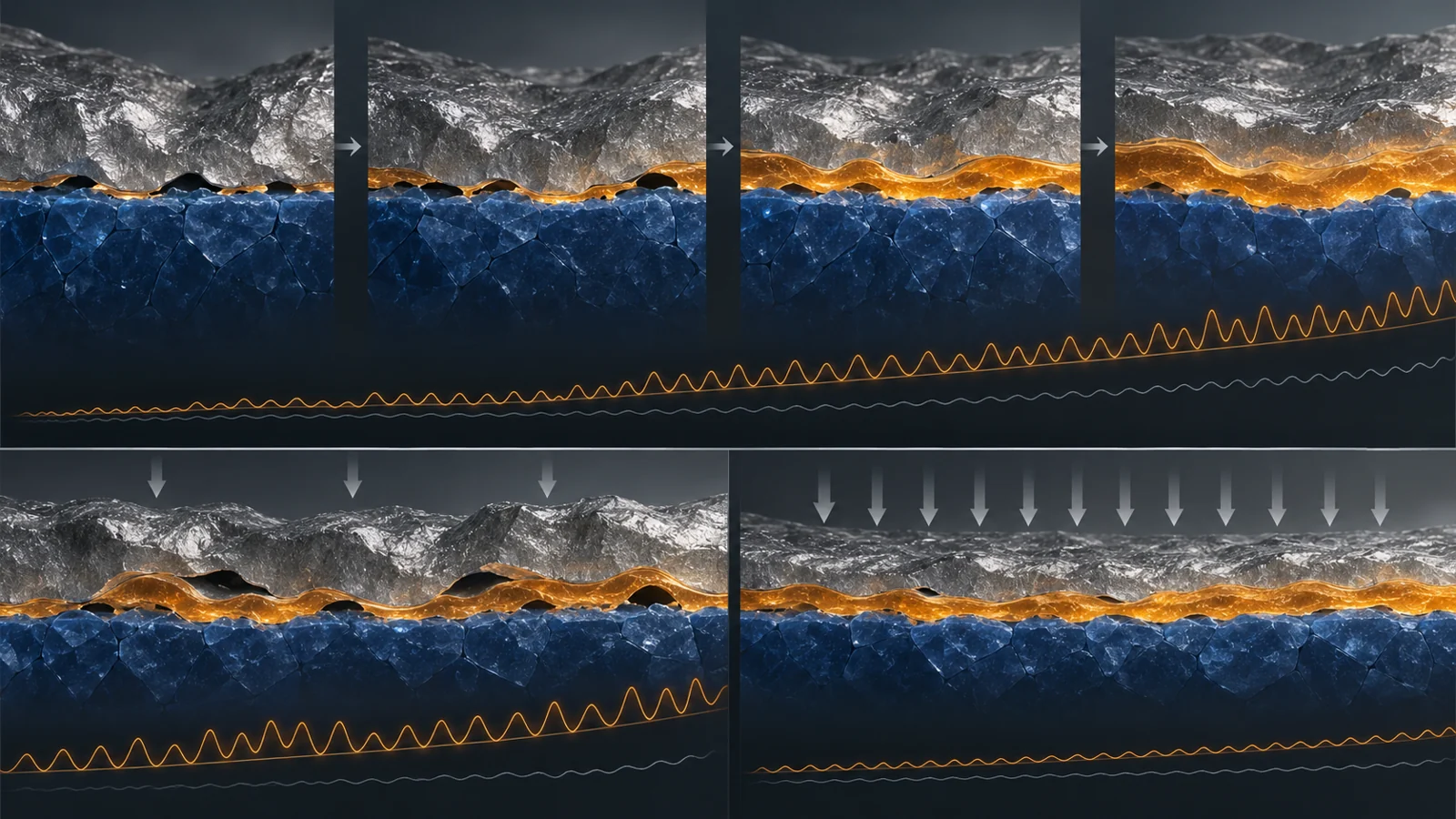
The first is what it calls interfacial breathing. Lithium contact is not treated as a permanently fixed boundary. During a cycle, small gaps and contact regions can change as the cell’s internal fields and stresses evolve. The result is a cycle-scale oscillation in how much of the interface is effectively available for current to pass through.
The second is reactive memory. Electrolyte decomposition products accumulate over many cycles, leaving a chemical record that does not disappear when contact improves during the next cycle. This slower process changes the condition of the interface on a different timescale.
That distinction matters because a single average resistance or a single end-of-cycle voltage can hide the relationship between the two. The study describes breathing with four descriptors: the amplitude of the void field, changes in the interphase, changes in resistance, and a stress signature. It adds a memory measure based on the thickness of decomposed interphase material.
The timing also matters. Contact, stress and resistance can change out of step during a cycle; this offset is a phase lag. The study examines these timing relationships alongside the four breathing signatures, while reactive memory tracks slower decomposition accumulation.
The result is a two-clock view of failure. Fast contact fluctuations ride on top of a slower chemical envelope. A cell can therefore look calm for a while, then become vulnerable when accumulated decomposition has shifted the baseline far enough for ordinary contact fluctuations to cross a damaging threshold.
The benchmark shifts attention from conductivity to resistance
Before studying the dynamic interface, the authors use a reduced electrochemical benchmark to establish a static comparison. In this model, changing ionic conductivity from 0.3 to 1.2 S m⁻¹ changes the mean discharge voltage by only 2.1 mV. Adding a cathode-electrolyte interphase resistance produces a much larger effect within the same calculation.
The benchmark is designed to show sensitivity, not to rank every battery design in the real world. Its interphase term is set to 2.0 Ω, roughly two hundred times the base ohmic term. That deliberately exposes how strongly an interfacial resistance can dominate the modeled voltage response. The most extreme voltage collapse in the benchmark is explicitly unrealistic as a forecast for an operating solid-state cell.
The useful lesson is narrower and more concrete. Improvements to bulk ion transport may not be the only, or even the most influential, lever in a model where the interface has accumulated substantial resistance. A material with good conductivity can still be limited by what happens where lithium, electrolyte and interphase meet.
That does not make conductivity unimportant in every chemistry or operating condition. It means that a conductivity comparison alone cannot describe a cell whose contact area and interphase resistance are changing during use. The dynamic model asks what happens when the interface is not a passive boundary between otherwise stable materials.
Pressure quiets contact changes without erasing chemical memory
The phase-field part of the study reconstructs a representative sulfide-based all-solid-state cell under different stack pressures. In practical terms, stack pressure is the compressive force per unit area applied to keep the cell’s layers pressed together. The modeled comparison asks whether more pressure changes both parts of the proposed failure law or mainly the mechanical one.
The answer is strongly asymmetric. Raising pressure from 5 to 200 MPa reduces all four breathing signatures, but not by the same amount. Across that modeled range, the void-field amplitude falls by a factor of 4.4, interphase breathing by 16.4, resistance breathing by 3.4, and the stress signature by 32.
At the same time, the reactive-memory measure changes little. The model therefore separates two effects that can easily be conflated. In this reconstruction, higher pressure suppresses contact fluctuations within each cycle while leaving the decomposition-based memory measure nearly unchanged.
This is why a quieter voltage or resistance waveform would not necessarily mean that the interface has stopped changing chemically. Mechanical stabilization can reduce the visible oscillation without removing the slower process that sets the long-term baseline.
The pressure result is a property of the modeled sulfide reconstruction, not a general prescription to compress every solid-state battery to a particular value. Different materials, interfaces and cell structures could respond differently, and the study does not turn its pressure comparison into a safety or manufacturing rule.
The authors use the combined descriptors to distinguish three modeled regimes. In a void-growth-dominant region, loss of contact is the main dynamic concern. In a healing-dominant region, contact recovery plays the larger role. In an interphase-memory-dominant region, accumulated decomposition controls the longer-term behavior. These are ways of organizing the model’s responses, rather than labels already established for commercial cells.
Faster discharge can reverse the early energy ranking
Discharge rate is simply how quickly a battery is asked to deliver its stored charge. At a slow rate, the cell operates closer to its open-circuit behavior and current-related voltage losses are smaller. Under those conditions, an architecture with a higher theoretical energy density can appear to lead clearly.
As demand rises, the comparison changes. Resistance losses become more important, and the breathing descriptors can grow or interact with the slower interphase memory. A design that begins with a theoretical energy advantage may then deliver less usable energy than a competing design whose static advantage was smaller but whose interface responds more favorably under load.
The preprint calls this a rate-dependent energy-density rank inversion. It is a prediction produced by the coupled model. It is not evidence that a named commercial battery has already lost its lead at a measured discharge rate.
This distinction changes how a battery comparison should be read. A single low-rate energy number describes one operating condition. It does not reveal how the ranking will behave when the same cell is asked to deliver power quickly or repeat that demand over many cycles. The discharge rate at which a crossover appears could also indicate which part of the interfacial dynamics is becoming dominant.
The point is not that every battery will show the same crossover. It is that static energy density and delivered energy under demanding conditions are different questions. A material or architecture can win the first comparison and lose the second if its interface becomes more unstable as current rises.
A model prediction still needs synchronized measurements
The computational results have a reproducibility strength, but it is not the same as physical validation. The authors report regenerating 40 numerical summary entries exactly across four pressures and ten fields, with a maximum absolute discrepancy of 0.000e+00 against an archived summary dataset. That shows that the reported numerical outputs can be reproduced from the model workflow.
It does not by itself show that an operating cell follows the proposed timing relationships, or that the decomposition-based memory measure has the predicted connection to later resistance growth. Those questions require measurements taken on the same cell while its mechanical, structural, electrical and chemical states are observed together.
The authors propose such a synchronized package. A high-precision load cell would track the changing pressure state. Operando X-ray tomography or laminography would observe the evolving void field. Impedance measurements and current-interrupt pulses would provide electrical views at relevant points in the cycle. After cycling, cross-sectional XPS or TOF-SIMS depth profiling could assess the accumulated interphase chemistry used to represent reactive memory.
The value of combining these measurements is that each one addresses a different part of the proposed sequence. Contact imaging can be compared with stress, resistance can be aligned with cycle position, and post-cycling chemistry can be related to the slower drift. Agreement across those observations would give the mechanism more support than a smooth voltage trace or a reproduced simulation alone.
Until that kind of test is carried out, the pressure response and rate crossover remain modeled expectations. They are useful because they make the theory testable, but they should not be read as quantified promises about lifetime, vehicle range or manufacturability.
What this could change
If the coupled mechanism holds up under operating-cell measurements, solid-state battery development could move beyond treating contact pressure, bulk conductivity and interphase chemistry as interchangeable fixes. Engineers could design around two separate requirements: keeping lithium contact sufficiently stable during each cycle and slowing the chemical changes that accumulate across cycles.
That combination could help future cells retain more of their usable energy when they are asked to deliver power quickly and repeatedly. The benefit for battery users would be more sustained delivered performance under demanding conditions, rather than a headline energy number that applies only to gentle discharge. The result would still depend on finding materials, interfaces and manufacturing methods that make both controls practical; this preprint does not establish a specific lifetime or driving range.
Key Sources
- Primary source: Interfacial breathing as a dynamic failure law in all-solid-state batteries: amplitude, phase lag and dual-timescale memory as design principles
arXiv · Preprint · 2026-04-27