
Since the previous research note · Earlier expectation not tested
Track continuity
Since the previous research note: How sodium removal can break contact in a solid-state battery
Previous expectation: Suitable sodium-conducting interlayers could help sodium solid-state batteries sustain higher discharge currents with more reliable contact and less demanding compression.
What this study adds: The current source examines a different metal–electrolyte pair through calculations of lithium insertion and migration at a lithium-metal/Li3OCl contact. It adds an atomic-scale chemical compatibility milestone without testing the earlier sodium-interlayer forecast.
What changed in this study
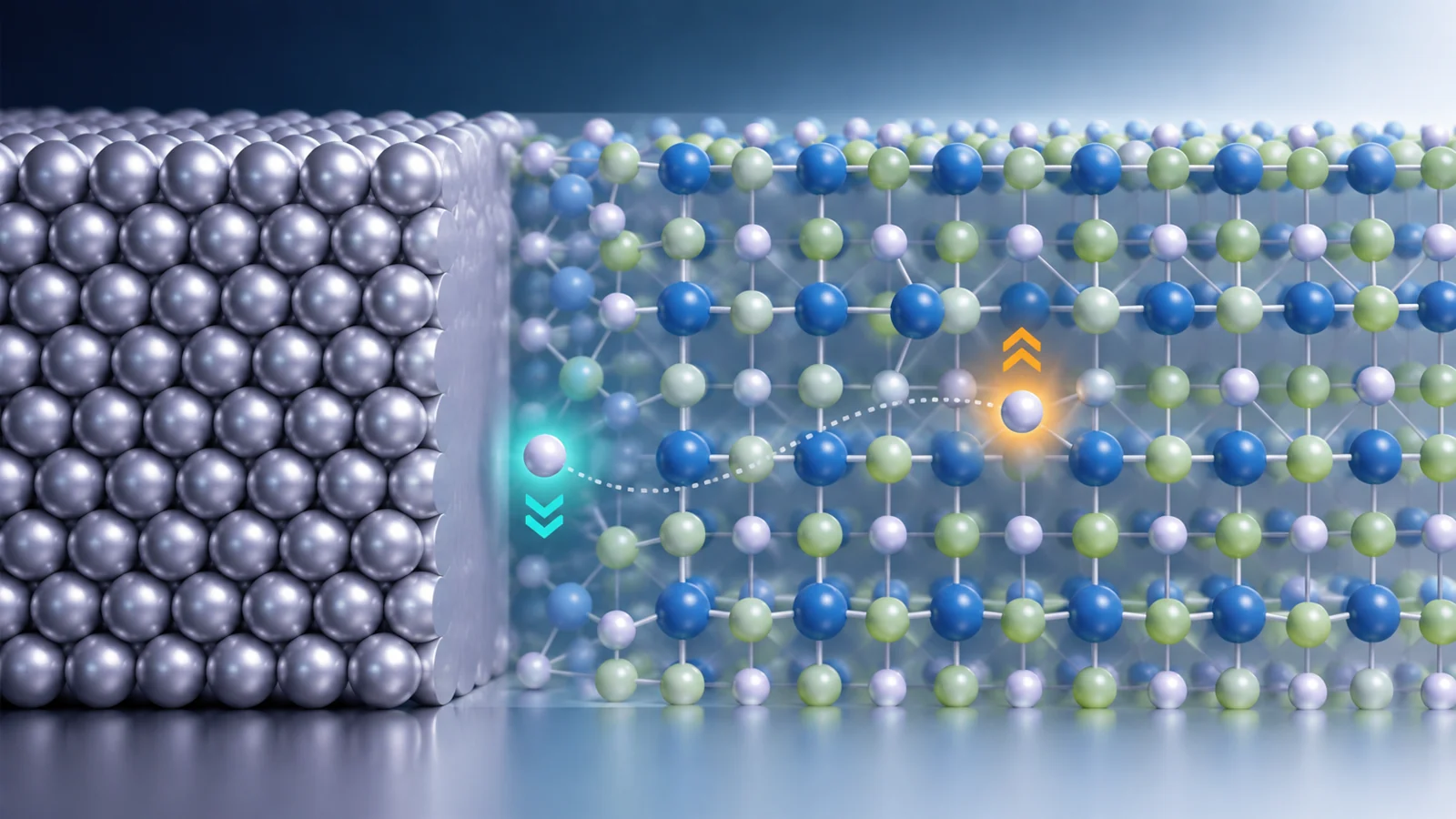
In the modeled battery system, lithium metal is in direct contact with a solid electrolyte. That boundary is more than a meeting point between two materials. It is a region where the local atomic arrangement can change how easily lithium enters, moves through, or settles into the electrolyte.
Li3OCl is a solid electrolyte that carries lithium ions. In a preprint dated April 12, 2026, researchers used first-principles density functional theory calculations to examine what happens at a Li|Li3OCl interface. Their question was narrow but important: if an additional lithium atom is placed at different positions, which parts of the modeled electrolyte energetically resist it, and which parts can accommodate it?
The result is spatially uneven. Most of the modeled Li3OCl layers have positive insertion energies, which means that adding lithium there is energetically unfavorable. Near the contact with lithium metal, however, the interface contains a localized region of reduced electrochemical stability. The material can therefore look resistant across most of its depth while remaining more permissive at the boundary.
The contact is part of the question
The interface model depends on how lithium metal and Li3OCl are arranged against each other. They constructed four candidate arrangements for lithium metal beside Li3OCl and compared their interfacial energies. After relaxing the atomic coordinates and lattice parameters, structure A was identified as the most stable configuration among those examined. Structure B was described as comparable to it.
That distinction matters. A lowest-energy arrangement within a set of four is a preferred model for the calculation, not proof that it is the only possible structure or the universally best interface. Atomic positions near a boundary can adjust on both sides, and the resulting arrangement determines which neighboring atoms an added lithium atom encounters.
The calculations also examined how electronic charge changes around the relaxed contact. The charge redistribution was localized near the interface, with the analysis indicating electron transfer from the lithium metal toward the electrolyte side. This gives the contact a specific electronic character rather than treating the two materials as unchanged blocks placed next to each other.
Those structural and electronic checks set the stage for the insertion calculation. Before asking whether lithium can enter, the researchers first established which candidate contact was energetically favorable in the models and how the atoms and charge responded near that contact.
Positive energy changes what stable means
Insertion energy is a way to ask whether an additional lithium atom is energetically welcome at a chosen position. A positive value means that incorporation is unfavorable. A negative value means that incorporation is favorable and may point to local reduction or structural instability. The sign is therefore not a score for the entire electrolyte. It describes the particular layer and local configuration being tested.
This is why the interface result is not contradictory. The modeled contact region includes positions where extra lithium is less costly than it is deeper in the electrolyte. At the same time, the majority of Li3OCl layers show positive insertion energies. Resistance to lithium incorporation is consequently a layer-dependent property, not a single label that applies equally from the metal surface through the full electrolyte.
The local atomic environment helps explain why different positions can behave differently. In some layers, the inserted lithium atom can occupy more than one stable candidate configuration. In layers containing lithium and oxygen, the coordination environment permits only one stable insertion configuration in the calculation. These are small geometric differences, but they change the energetic options available to the added atom.
The paper’s central spatial finding is therefore more precise than saying that Li3OCl either accepts or rejects lithium. Most modeled layers resist incorporation, while the interface contains a localized weak spot relative to those deeper layers. That pattern is the answer to the opening tension: contact behavior and bulk-layer behavior need not match.
A destination is not a transport rate
The study also reports a migration energy profile, but that test answers a different question from insertion energy. In the reported path, the barrier is 0.89 eV. The final configuration, with lithium on the lithium-metal side, is about 0.56 eV lower in energy than the initial configuration in the electrolyte.
A useful way to read those numbers is to separate the hill from the valley. The barrier describes the energetic obstacle along the modeled route. The lower final energy describes where that particular route ends relative to where it began. A destination can be energetically preferred even when reaching it requires crossing a substantial barrier.
This path-specific result adds kinetic context to the layer-by-layer insertion picture. It suggests that a lithium atom placed in the modeled electrolyte region has a calculated route toward the lithium-metal side, while also showing that the route is not barrier-free. The calculation does not turn that profile into a travel time or a current-carrying rate. It addresses one modeled pathway and its energy landscape.
That distinction is important for readers accustomed to treating a material as simply permeable or impermeable. A positive insertion energy, a preferred final state, and a migration barrier describe different parts of the same atomic story. They should not be collapsed into one general claim about how quickly lithium ions move through the electrolyte.
What the calculation can and cannot carry forward
The results give three related but separate pieces of information. Structural relaxation identifies a preferred contact arrangement among the candidates examined. Insertion energies show how favorable an additional lithium atom is at selected layers and local configurations. The migration profile describes the energetic shape of one route between modeled positions.
Together, they provide atomic-scale evidence that the Li|Li3OCl interface can be structurally well behaved in the chosen models and that most modeled electrolyte layers resist lithium incorporation. They do not by themselves establish how the interface behaves through repeated charging and discharging, how long it remains intact, or how a complete battery performs under operating conditions.
Positive insertion energies across most layers also address only the tested incorporation question. They do not establish resistance to every possible reaction or to every form of chemical and mechanical change. Likewise, the reported 0.89 eV barrier does not establish bulk ionic conductivity, a transport rate, or a charging capability.
The choice of structure A has a similarly bounded meaning. It is the lowest-energy candidate in the comparison reported here, not a guarantee of a globally optimal or readily manufacturable interface. The value of the calculation is its sharper picture of how contact structure, local coordination, insertion energetics, and one migration path fit together. Turning that picture into a working-cell conclusion requires evidence at the level of operation, durability, and performance.
What this could change
If Li3OCl can preserve its resistance to unwanted lithium incorporation across most of its electrolyte layers while maintaining useful lithium-ion movement and a stable contact with lithium metal during operation, it could become a workable solid-electrolyte partner for lithium-metal anodes. That combination would support the broader pursuit of solid-state batteries with more energy stored in a practical cell. The present calculation does not deliver that battery capability, but it identifies a specific atomic condition that a future material and interface would need to satisfy.
Key Sources
- Primary source: Electrochemical stability and lithium insertion at the Li|Li3OCl solid electrolyte interface
arXiv · Preprint · 2026-04-12