
Since the previous research note · Earlier expectation not tested
Track continuity
Since the previous research note: How a layered ceramic changes cycling in a battery with a solid electrolyte
Previous expectation: A layered ceramic electrolyte could help solid-state cells retain usable capacity if its structural advantage survives longer cycling and practical integration.
What this study adds: Sodium model-cell experiments distinguish a discharge-side vacancy-transport limitation and show that a tin–sodium interlayer changes the measured activation barrier and critical current. This adds a mechanism-focused milestone rather than testing the earlier layered-ceramic forecast.
What changed in this study
A solid-state battery uses a solid electrolyte instead of a liquid one to carry ions between its electrodes. That design can create a difficult mechanical problem at the point where sodium metal meets the ceramic electrolyte. The battery may still be delivering current, yet the metal can gradually lose working contact with the ceramic.
A March 24, 2026 preprint investigates why this happens in sodium-metal model cells. Its central question is whether the limiting step lies inside the sodium metal or at the boundary between sodium and ceramic. The distinction matters because changing the metal’s structure would be a very different remedy from changing the boundary itself.
The contact problem starts at the boundary
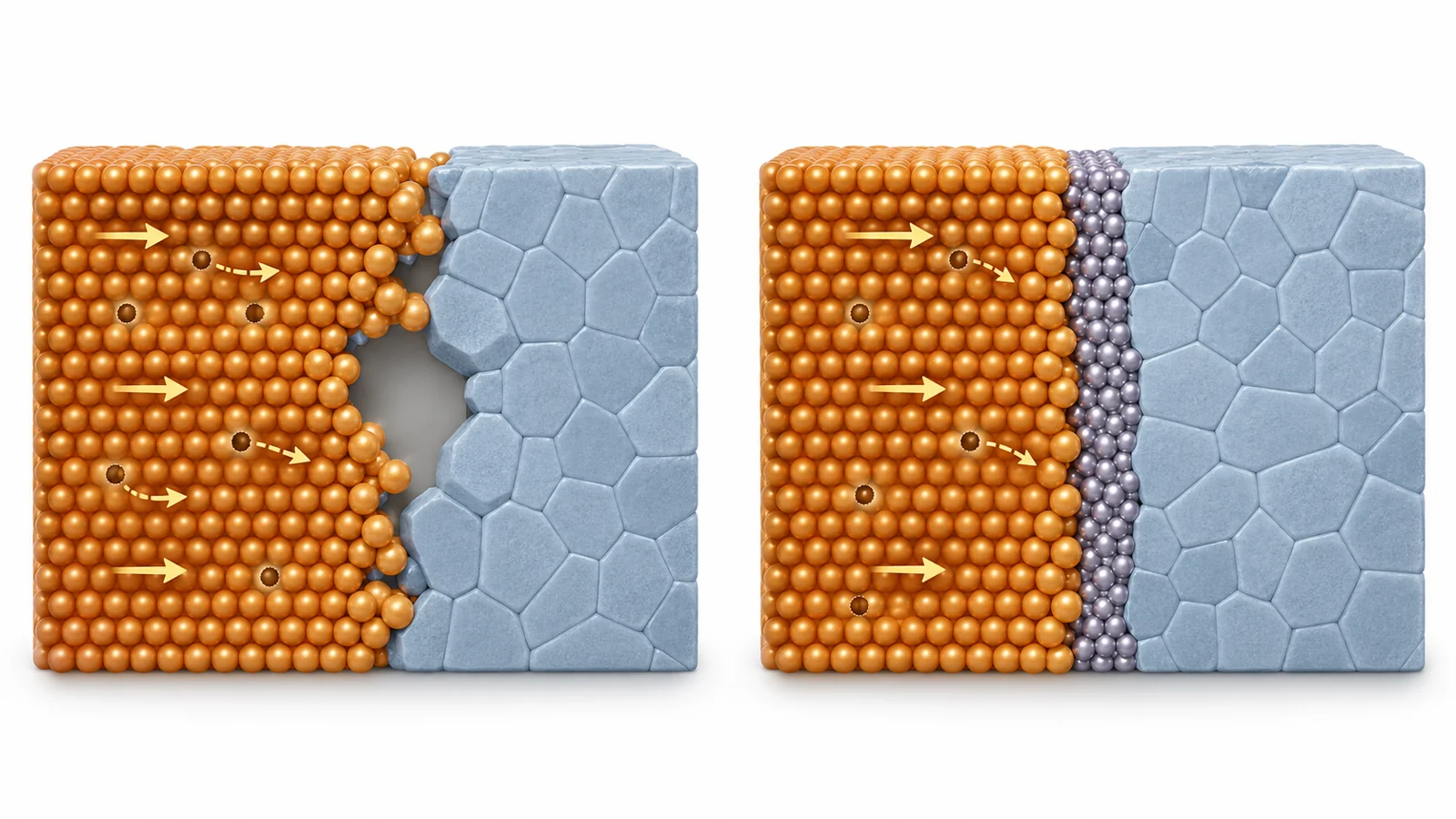
During discharge, sodium atoms at the metal electrode are oxidized. Sodium ions move through the ceramic electrolyte, while the metal side is left with missing-atom sites called vacancies. A vacancy is an atomic-scale absence inside the metal. It is not the same as a void, which is a larger empty region formed when many vacancies accumulate or when contact separates over a broader area.
If vacancies cannot be transported away from the sodium–ceramic boundary quickly enough, empty space can develop there. The metal then touches less of the ceramic, concentrating current through the remaining contact. That loss of contact can raise the local electrical burden and promote further deterioration, eventually appearing as delamination or a sharp increase in resistance.
The study focuses on this discharge-side process. It should not be confused with charging failure caused by sodium metal penetrating through the ceramic as dendrites. Both problems can affect a working cell, but they arise from different directions of sodium movement and are not interchangeable explanations.
A rising current makes the failure visible
The researchers used model cells with sodium metal on both sides of a ceramic solid electrolyte and included a sodium reference electrode. Rather than applying one fixed current, they increased the current in a controlled ramp. This progressively stressed the sodium-oxidation side of the cell and made it possible to observe when the electrical response changed character.
At lower current densities, the anode voltage increased approximately linearly with the applied current. Above a critical current density, written as jcrit, the voltage began to rise exponentially instead. In this experiment, that transition serves as an indicator that vacancy accumulation and contact loss have entered a rapidly worsening regime.
That threshold is useful for comparing conditions, but it is not a universal operating-current limit for every sodium solid-state battery. Its value can depend on the measurement geometry, temperature, mechanical conditions, ramp protocol, and details of how local damage becomes visible in the cell voltage.
Temperature separates possible bottlenecks
The researchers then examined how jcrit changed with temperature. From that temperature dependence, they inferred an activation energy, an energy scale that describes how strongly the threshold responds to thermal assistance. The measured values were 0.13 to 0.15 electronvolts across three ceramic electrolyte compositions.
The preprint compares those values with 0.053 electronvolts for diffusive vacancy migration in bulk sodium. The larger measured barrier suggests that ordinary vacancy diffusion through the interior of the metal is not the slowest step controlling the observed threshold.
A second observation strengthens that interpretation. The researchers varied the sodium anode microstructure, yet the measured activation energy remained essentially insensitive to those changes. If transport through bulk sodium were the decisive bottleneck, substantial changes in the metal’s microstructure would be expected to alter the temperature dependence more directly. Taken together, the energy comparison and the microstructure result support the authors’ conclusion that the limiting process lies elsewhere under these conditions.
This is a mechanism comparison rather than a claim that every resistance in a practical cell comes from one location. It identifies which explanation best fits the threshold behavior in the tested model-cell regime.
A thin alloy layer changes the experiment
To test whether the boundary itself could control the result, the researchers introduced a thin tin–sodium alloy interlayer between the sodium metal and the ceramic. This intervention changes the contact region without simply changing the bulk sodium microstructure.
With the interlayer, the reported activation energy fell to 0.10 ± 0.01 electronvolts, and the critical current increased. The combination is important: the cell tolerated a higher current before entering the rapid voltage-rise regime, while the temperature dependence indicated a lower apparent barrier.
The authors interpret that response as evidence that interfacial thermodynamics limits vacancy transport. Their proposed explanation is that the tin-containing boundary has lower interfacial tension than a direct sodium–ceramic contact, making it easier for the interface to accommodate the conditions created during sodium removal.
That explanation is plausible within the study’s transport model, but the interlayer response is not itself a direct measurement of interfacial tension. The experiment shows that changing the boundary changes the threshold behavior. It does not independently measure every thermodynamic quantity responsible for that change.
Geometry shapes what the threshold means
The interpretation also depends on how microscopic damage becomes an electrical signal. A tiny local void can create current focusing, but it may need to grow or be joined by enough neighboring voids before its effect becomes detectable across the measured interface. The observed threshold therefore reflects both the local physics and the spatial scale over which vacancy accumulation becomes electrically significant.
The study uses a one-dimensional model to distinguish candidate transport mechanisms. That model is useful for comparing activation energies, but it cannot capture every three-dimensional pattern of local current focusing and void growth. The researchers account for this by considering a regime in which void accumulation is sufficiently reproducible across a meaningful portion of the interface, rather than allowing one isolated microscopic defect to dominate the result.
Mechanical conditions matter as well. The measurements were made in a regime where stress-driven sodium creep was treated as negligible. That helps isolate vacancy transport, but it also means the measured threshold should not be transferred directly to a different pressure range or to a complete battery stack without further testing.
The most defensible reading is therefore specific. In these sodium–ceramic model cells, temperature-dependent current ramps distinguish a boundary-limited transport process from simple bulk vacancy diffusion, and a tin–sodium interlayer shifts the measured behavior. Whether the same advantage persists through long cycling, manufacturing variation, and practical cell integration remains a separate question.
What this could change
If suitable sodium-conducting, sodiophilic interlayers preserve their function in practical cells, engineers could have a route to sodium solid-state batteries that sustain higher discharge currents while maintaining metal–ceramic contact more reliably. The causal chain is conditional: a boundary that transports or accommodates vacancies more effectively could delay the contact loss that causes the rapid voltage rise, which could in turn reduce the need for extremely demanding external compression.
That possibility would matter beyond one interface measurement. Less reliance on very high stack pressure could make the mechanical design of sodium solid-state battery assemblies easier to manage. But the benefit depends on the interlayer remaining stable and well integrated over useful operation, and it would address the discharge-side contact problem rather than automatically solving charging-side dendrite penetration. The preprint establishes a mechanism-focused direction for investigation, not demonstrated long-term practical-cell durability.
Key Sources
- Primary source: Experimental Insights into the Limiting Mechanism of Vacancy Transport in Sodium Metal Anodes for Solid State Batteries
arXiv · Preprint · 2026-03-24