
Since the previous research note · Earlier expectation not tested
Track continuity
Since the previous research note: Why electrical flow and cracking can open a ceramic battery barrier
Previous expectation: Controlling crack-tip behavior could eventually help ceramic battery barriers tolerate higher charging currents and resist metal penetration more consistently.
What this study adds: The current preprint adds a full-cell comparison of dense and three-layer ceramic electrolytes, linking a 25-cycle capacity advantage with impedance behavior and lithium depth profiles. It does not establish a test of the earlier crack-growth forecast.
What changed in this study
A battery’s ceramic electrolyte is meant to let lithium ions move between electrodes while keeping the cell’s internal materials separated. In practice, the interfaces where that ceramic meets the electrodes can become a major obstacle. A March 23, 2026 preprint asks whether changing the ceramic’s internal structure can make that passage more stable during repeated cycling.
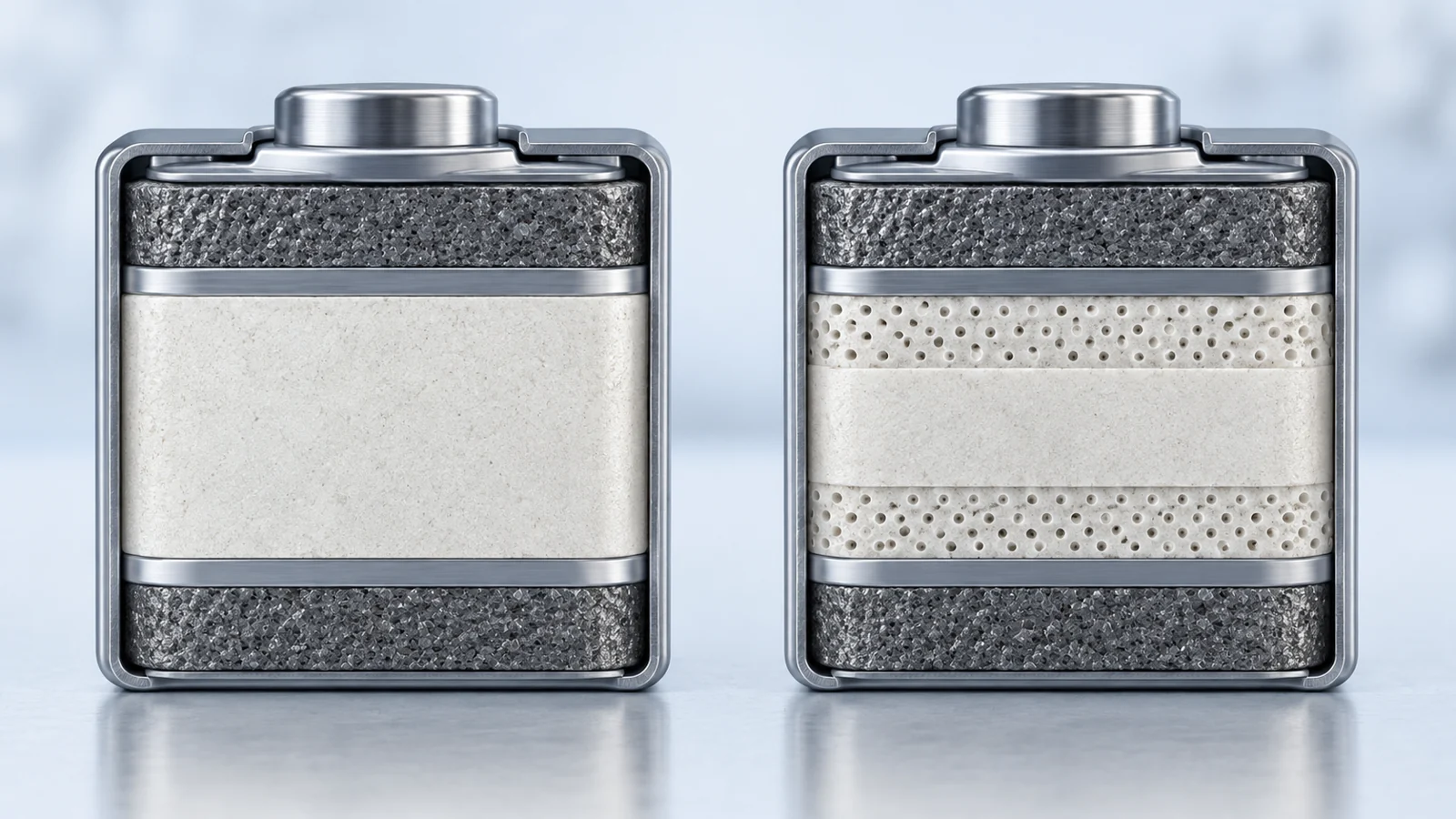
The study compares two versions of an aluminum-containing garnet ceramic called Al-LLZO in lithium-metal/NMC(111) full cells. One electrolyte is dense throughout. The other is built as a graded three-layer structure with porous outer regions and a dense middle region. After 25 cycles, the three-layer cell delivered about 55 mAh/g of discharge capacity, compared with about 27 mAh/g for the dense-cell comparison.
That is a large difference within this laboratory test. It is also a more specific result than saying that solid-state batteries generally doubled their capacity. The comparison concerns two ceramic architectures tested in the reported full-cell setup, and the number describes discharge capacity per gram under that experiment. It does not translate directly into doubled energy density, longer vehicle range or the service life of a commercial battery.
A ceramic that is dense in the middle and porous at its faces
Microscopy identified the three-layer sample as porous–dense–porous. A useful way to picture it is as a compact ceramic core bordered by more open structures at the two surfaces. The dense region can provide a continuous solid body, while the porous regions change how the electrode-facing interfaces are formed. The dense comparator, by contrast, does not have that same layered arrangement.
The authors connect this architecture with easier lithium-ion transport across the interfaces. They also propose that a multilayer structure may accommodate mechanical stresses more effectively and reduce interfacial degradation during cycling. Those are interpretations of why the arrangement might help. The microscopy establishes the physical structure; it does not by itself demonstrate that stress accommodation caused the higher capacity or prevented damage.
The capacity result gives the architecture an important practical context. A material can look well designed in isolation yet perform poorly when it has to exchange lithium repeatedly with electrodes. Here, the layered ceramic was evaluated inside a complete cell, so the reported difference captures the combined behavior of the electrolyte, its interfaces and the other cell components under the study’s cycling test. That makes the result more informative than a structural description alone, while still keeping it tied to the 25-cycle comparison.
The resistance improved comparatively while still rising
Electrochemical impedance spectroscopy, or EIS, provides a different view of the same experiment. Rather than measuring how much capacity the cell delivers during discharge, it measures how strongly the cell resists the movement of charge. A lower interfacial resistance generally means that lithium-ion transfer encounters less opposition at the boundaries between materials.
The three-layer Al-LLZO cell began with a reported impedance of 372.8 ohms. After 25 cycles, that value had risen to 457.6 ohms. The increase matters: even the more stable architecture did not keep its measured impedance perfectly unchanged. At the same time, its resistance remained lower overall and behaved more favorably than the dense Al-LLZO comparison, whose interfacial resistance was higher and changed more substantially during the test.
This combination helps explain the capacity result without turning impedance into a complete diagnosis. The layered cell appears to preserve a comparatively easier route for ionic transport as cycling proceeds, but its own interface still changes. The measurements therefore point to improved relative stability, not to an interface that is unaffected by use.
That distinction is useful for interpreting the phrase “improved cycling stability.” In this study, it refers to the three-layer cell retaining a stronger combination of capacity and impedance behavior over the reported 25 cycles. It does not mean that every degradation process has been removed or that the same performance would automatically persist through years of operation.
Lithium profiles show where the difference appears
The study adds a spatial measurement through nuclear reaction analysis, or NRA. Instead of producing another capacity value, NRA examines how lithium is distributed beneath the surface. The resulting profile can show whether the two ceramic designs have similar lithium concentrations near the interface and deeper in the material.
For the three-layer Al-LLZO, the reported lithium value was about 75% in the top roughly 0.59 micrometers. It decreased progressively toward about 30% deeper in the material, across a total analyzed thickness of roughly 4.5 micrometers. The dense sample showed about 48% in its surface layer, around 0.35 micrometers, falling to about 16% in the bulk across a total thickness of roughly 2.57 micrometers.
These percentages describe the fitted depth profiles for the analyzed ceramic regions. They are not the percentage of the battery’s original lithium inventory that remained, the fraction of lithium that was electrochemically usable, or a measure of coulombic efficiency. The important comparison is spatial: after cycling, the three-layer sample showed higher reported lithium values both near its surface and farther into the measured profile.
That observation is consistent with the electrochemical results. If lithium is distributed more favorably through the relevant near-surface and deeper regions, the architecture may be helping the cell maintain a more workable path during repeated charge and discharge. But consistency is not the same as a demonstrated causal chain. The profile does not independently prove that the layered geometry created the capacity advantage, nor does it identify every process responsible for the impedance change.
What 25 cycles can and cannot tell us
Taken together, the measurements tell a coherent laboratory story. The three-layer ceramic had a porous–dense–porous structure, delivered about twice the dense comparator’s discharge capacity after 25 cycles, retained a comparatively favorable impedance despite an increase of its own, and showed a different lithium depth profile. Each measurement addresses a different part of the comparison: delivered charge, electrical resistance, visible structure and lithium distribution.
The same results leave important questions open. A 25-cycle test cannot by itself establish practical battery lifetime, fast-charging capability or pack-level performance. It also does not show that the ceramic resists lithium-metal penetration or that the proposed mechanical-stress explanation caused the observed difference. Those questions require evidence from tests designed to examine them directly and over substantially longer operation.
The capacity numbers should therefore be read as an architecture result, not as a finished battery claim. A cell that delivers 55 mAh/g in this comparison has demonstrated more discharge capacity than the dense-cell counterpart under the reported test. That is meaningful progress, but it does not specify how the result would translate to a commercial design, different operating conditions or a complete battery pack.
What this could change
If the layered advantage persists through much longer cycling and can be integrated into practical cells, battery developers could use ceramic electrolytes that continue delivering more usable charge instead of losing performance as their interfaces evolve. The possible payoff is not simply a better number at cycle 25. It is a solid-electrolyte cell that remains more productive over repeated use, making dependable energy storage easier to build.
That future depends on two conditions the present comparison does not settle: the structural benefit must endure, and manufacturers must be able to incorporate the graded ceramic into useful cell designs. If both hold, controlling the architecture of a ceramic electrolyte could become one route toward solid-state batteries that retain their working capacity more reliably in real applications.
Key Sources
- Primary source: Improved cycling stability and lithium utilization in trilayer Al-LLZO revealed by Electrochemical cycling performance
arXiv · Preprint · 2026-03-23