
Since the previous research note · Earlier expectation not tested
Track continuity
Since the previous research note: Lithium and sodium share growth rules, but sodium leaves a changed interface
Previous expectation: If observed metal growth and removal behavior translated to realistic cells, interface design could preserve contact and improve durability through repeated cycling.
What this study adds: This preprint introduces an analytical account of crack-mediated metal penetration, including a slower growth pathway and predicted variation between samples. It does not test the earlier contact-preservation or cycling forecast.
What changed in this study
A ceramic solid electrolyte is meant to conduct ions between a battery’s electrodes while helping keep the metal electrodes apart. Yet metal can still penetrate this hard barrier through dendrites, narrow growths that advance from an electrode into the ceramic.
A preprint published on March 20, 2026, develops an analytical explanation for that process. Its central idea is that metal penetration can be understood as a competition between the energy needed to open a crack and the electrical energy lost when current has to detour around an existing metal intrusion. The model also extends the picture beyond sudden onset, proposing a slower route for growth below the usual critical current.
The result is not a complete-cell performance forecast. It is a way to connect penetration behavior with the defects and material properties that may make one ceramic barrier more vulnerable than another.
The current and crack compete at the interface
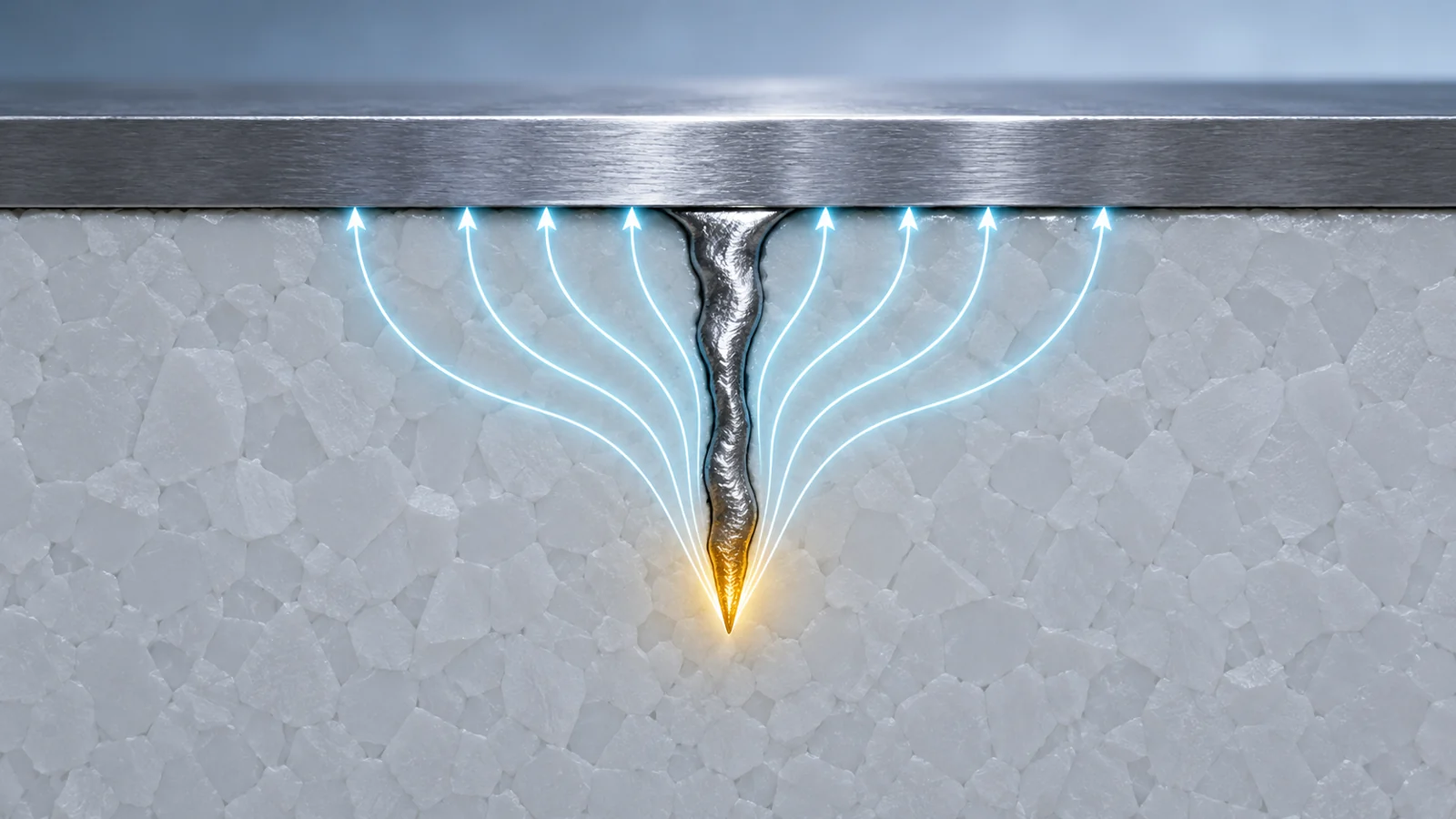
The model begins with a pre-existing defect at the metal–ceramic interface. The length of a sufficiently thin interfacial defect helps determine the modeled current required for a metal intrusion to advance into the ceramic. The ceramic is treated as a solid that must be cracked open as the intrusion grows.
Two outcomes are then compared. In one, electrical current takes a longer route around the metal-filled defect before reaching the flat electrode surface. That detour dissipates electrical energy as heat. In the other, metal deposits at the tip of the defect and pushes the crack forward. The proposed propagation condition is reached when the electrical dissipation associated with the detour is energetically more costly than opening the ceramic crack.
This gives the model’s critical current density a specific meaning. It is the current per electrode area at the modeled onset of crack-assisted propagation, not a universal safe-current number for every battery. A sample with a different interfacial defect can therefore reach that modeled onset under different conditions.
The length of the most consequential pre-existing defect is especially important in the model. Long, thin interfacial flaws are treated as particularly effective starting points for penetration, so a ceramic’s apparent resistance to dendrites depends on more than its nominal hardness. Ionic conductivity and fracture toughness also enter the design picture. Fracture toughness describes how resistant the ceramic is to the advance of a crack, although the value relevant at a metal-filled crack tip may not be the same as a simple bulk-material constant.
A threshold is not the whole story
A critical current can suggest an abrupt boundary: below it, penetration should stop; above it, a dendrite can advance. The preprint adds a more gradual possibility.
Ceramic solid electrolytes can retain some electron conduction. At the tip of a metal intrusion, that residual conduction is proposed to contribute to electrochemical stress-corrosion cracking. In plain terms, the crack tip may undergo a chemically assisted weakening process even when the current is below the level associated with the initial fracture-and-dissipation criterion.
This is called subcritical growth. It does not mean that a dendrite suddenly crosses the ceramic at a lower threshold under the same mechanism. It refers to a slower pathway in which crack-tip processes can let metal advance under conditions that would not trigger the model’s main critical-growth criterion.
That distinction changes how a single threshold should be interpreted. A measurement near or below the critical current may still describe the onset of rapid propagation without ruling out more gradual penetration over time. The two pathways belong to the same broader crack-mediated picture, but they represent different routes for the intrusion to keep moving.
Why nominally similar samples may behave differently
The model moves from one crack to a population of ceramic samples by treating the relevant defects as variable. If the longest sufficiently thin interfacial flaw differs from sample to sample, the predicted penetration threshold should vary as well.
The preprint connects that variation to a Weibull distribution. This is a statistical way to describe how failure thresholds spread across nominally similar specimens, rather than assuming that every specimen fails at one identical value. The predicted distribution is presented as a consequence of defect-controlled crack growth, with greater scatter than would be expected from a perfectly uniform population.
For experiments, the implication is practical but limited. A measured critical current from a small set of samples may identify behavior for that set without representing the full spread of possible thresholds. A higher average threshold could coexist with occasional more vulnerable specimens if the defect population is broad. Conversely, improving the consistency of interfaces could matter as much as shifting a central measurement upward.
The Weibull prediction is a statistical expectation of the analytical theory. It does not provide a failure probability, lifetime estimate, or validated fit for a particular ceramic from the information available here. Those quantities would require measurements tied to defined materials, interfaces, and test populations.
Where the calculation leaves reality out
The analytical result gains its clarity by narrowing the material system. The electrolyte is treated as homogeneous and isotropic. Bulk microstructural defects, including pores and grain boundaries, are left out, while the model is motivated by observations in which dendrites nucleate at the interface and then propagate in a stable manner after the critical current is exceeded.
That choice makes the interface the center of the calculation. It does not show that pores or grain boundaries are irrelevant in every ceramic electrolyte. Real materials may contain several defect populations, and the importance of each would depend on how those structures interact with the metal and the applied current.
The model also neglects additional power dissipation from electrochemical reaction kinetics under the stated conditions of clean, stable oxide ceramic interfaces and alkali metal electrodes. That simplification is presented as appropriate for the conditions considered, not as a general rule for all interfaces. A reaction-resistant contact and a damaged or chemically unstable contact would not necessarily contribute the same losses.
Fracture toughness is another unresolved part of the picture. The calculation treats it as a material constant, but the behavior of the ceramic immediately around a metal-filled crack tip remains disputed. Some proposed mechanisms would strengthen the tip region, while others would weaken it. Because this local property directly affects crack advance, the model’s numerical predictions should not be detached from that uncertainty.
Together, these assumptions define what the preprint contributes. It supplies a compact physical account of how electrical dissipation, defect geometry, ionic conductivity, and crack resistance could interact. It does not by itself establish how the proposed scaling behaves across complete cells, operating conditions, or manufacturing routes.
What this could change
If the crack-growth picture survives direct testing and the behavior of the crack tip can be controlled, battery developers could aim for ceramic barriers that sustain higher charging currents while resisting metal penetration more consistently from cell to cell. The benefit would not be a single magic threshold. It would be a more reliable operating window, with fewer vulnerable interfaces hidden inside an apparently uniform batch.
That capability could support more dependable charging in solid-state cells, where the ceramic barrier must perform as both an ion conductor and a mechanical boundary. Reaching that outcome would require the modeled interface behavior to translate into complete-cell operation, including the other materials and stresses present there. The preprint’s value at this stage is to make the failure mechanism and the population-level uncertainty precise enough to test.
Key Sources
- Primary source: An Analytical Model of Critical and Subcritical Alkali Metal Dendrite Growth in Ceramic Solid Electrolytes
arXiv · Preprint · 2026-03-20