
Since the previous research note · Earlier expectation not tested
Track continuity
Since the previous research note: Tracing lithium through chloride–bromide solids that carry ions in batteries
Previous expectation: Experimentally validated simulations could help researchers prioritize chloride–bromide electrolyte candidates before synthesis.
What this study adds: This preprint reports a separate nitrogen-driven route to disordered chloride electrolytes, including structural evidence and conductivity and cycling results for a hafnium-based composition. These findings add a materials-synthesis milestone without validating the earlier simulation-based screening forecast.
What changed in this study
Why would a battery material benefit from becoming less orderly? A version 1 preprint dated October 11, 2025, investigates that question by adding nitrogen to metal chlorides and turning several of them into amorphous solid-state electrolytes. A solid-state electrolyte is the ion-carrying material inside a battery. In an all-solid-state battery, it must allow lithium ions to move between the electrodes while remaining a solid.
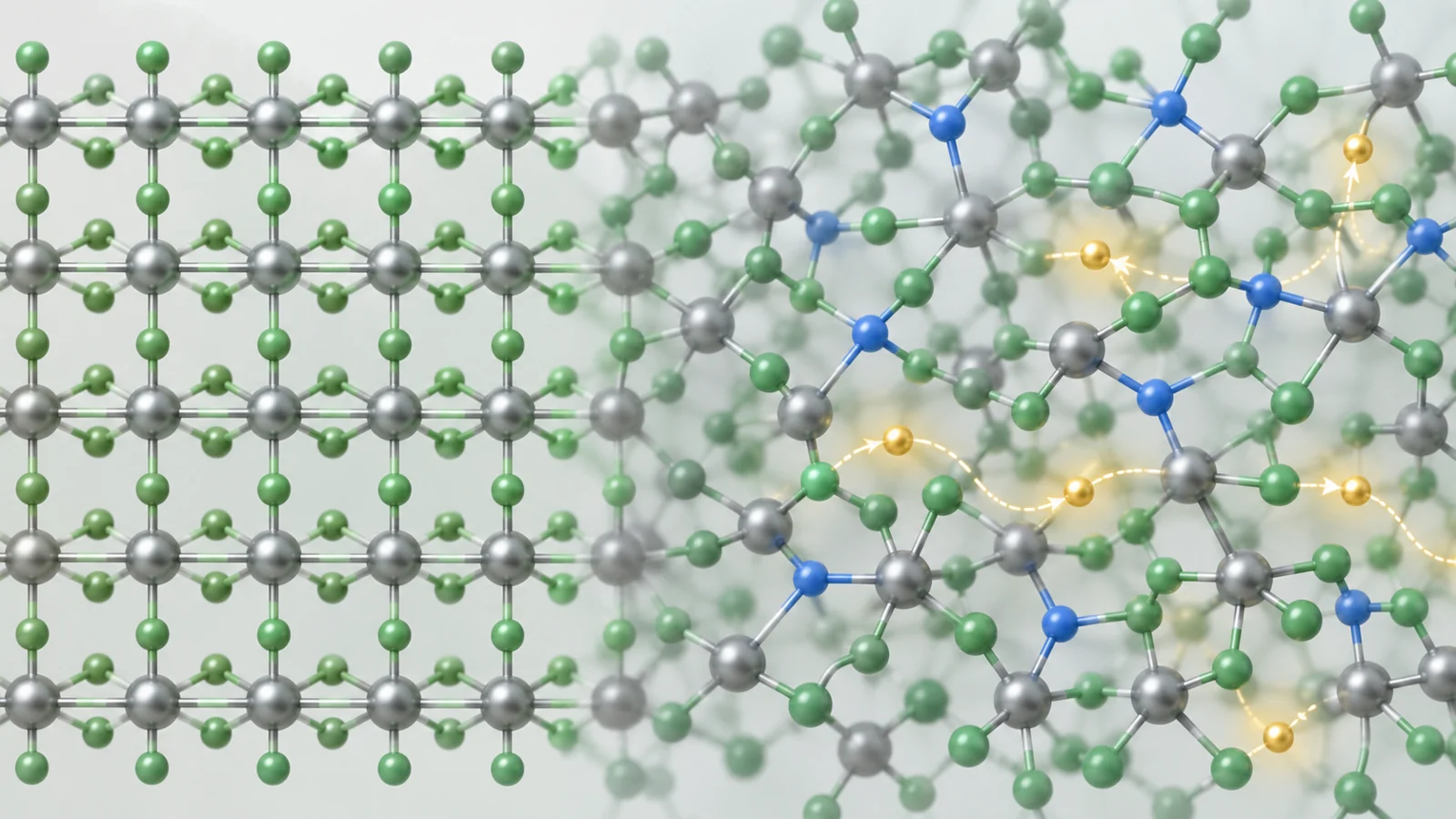
The study focuses on a tension that is easy to miss. Crystals have long-range atomic order, which can create well-defined structures but also makes transport sensitive to interfaces between grains. An amorphous material lacks that long-range order. Its atoms are not arranged in one repeating pattern across the whole solid, even though nearby atoms can still form connected local structures. The researchers ask whether nitrogen can use that less rigid arrangement to create useful pathways for lithium ions.
Why lose a crystal’s order
Amorphization is not the same as breaking a material apart. It means that the repeating arrangement seen over long distances in a crystal is lost. At shorter distances, metal atoms can still be surrounded by coordinating atoms, and those local connections can form a continuous network through the material.
That distinction matters for ion transport. A lithium ion does not need the entire solid to behave like a single perfect crystal. It needs a connected set of sites and pathways through which it can move. In the authors’ account, removing long-range order can make those pathways more isotropic, avoiding some of the directional constraints associated with a crystalline grain structure.
The proposed intervention is nitrogen-containing lithium nitride, introduced alongside metal chlorides. Rather than treating amorphization as an accidental consequence of processing, the study presents nitrogen as a structural ingredient that can help create the disordered state.
Nitrogen changes the local connections
The authors connect nitrogen’s role to two related changes. First, nitrogen distorts the coordination environments around metal atoms. A coordination environment is simply the set of atoms immediately surrounding a metal atom and the geometry they form around it. Distorting those local polyhedra makes it harder for the material to maintain one repeating crystalline arrangement.
Second, nitrogen can bridge parts of the metal-containing network. The study associates the high charge density and bridging capability of N3− with greater network disorder, shorter distances between coordinating atoms, and better-connected routes for lithium-ion movement. The proposed picture is therefore more specific than nitrogen merely adding a conducting ingredient. It changes how the surrounding atoms connect.
The researchers also describe dynamic bond reorganization as part of the transport mechanism. Bonds and local coordination relationships can rearrange as lithium ions move, helping the disordered network accommodate ion migration. This is an author-proposed structural explanation for the measured behavior, not a claim that every amorphous solid will transport ions in the same way.
The chemistry decides how far the strategy travels
A central contribution of the work is the attempt to make nitrogen-driven amorphization a materials strategy rather than a single successful recipe. The paper reports amorphized metal-chloride examples such as TaCl5 and HfCl4. Its supplementary material also identifies theoretically compatible candidates including AlCl3 and FeCl3.
Those categories should not be treated as interchangeable. An experimentally amorphized composition has demonstrated a structural outcome in the study. A theoretically compatible candidate is a proposal about where the approach might work, not evidence that the candidate has been synthesized into an equivalent amorphous electrolyte or tested in a battery.
The magnesium composition illustrates why the chemistry matters. In 0.1Li3N–MgCl2, diffraction evidence shows residual crystallinity rather than complete loss of crystalline order. The authors associate this result with the stability of MgCl2, which can limit its interaction with Li3N and create barriers to full amorphization. Nitrogen therefore does not make every chloride respond identically. The local chemistry still controls whether the intended network transformation occurs.
This exception strengthens the practical meaning of the proposal. A useful design principle must explain both successful conversions and incomplete ones. Here, the relevant question is not simply whether nitrogen is present, but whether its charge and bridging behavior can reorganize a particular metal-chloride network sufficiently to produce the desired structure.
Two measurements answer different questions
The clearest performance result comes from 0.533Li3N–HfCl4. At 25 °C, the material reaches a reported ionic conductivity of 2.02 mS cm−1. Ionic conductivity is a material-level measure of how readily charged ions move through the electrolyte under the measurement conditions. The room-temperature value indicates that the hafnium-based amorphous composition can transport lithium ions at a useful rate in that test.
It is not the same as the amount of energy a complete battery stores. Conductivity describes transport through the electrolyte; battery capacity describes charge delivered by a cell during cycling. Keeping those measurements separate prevents a strong material result from being mistaken for a complete battery specification.
The study also reports a battery result for cells using 0.533Li3N–HfCl4. They retain 81.87% of their capacity after 2,000 cycles at 1,000 mA g−1, with a reported cathode loading of 6.24 mg cm−2. The current is given relative to mass, while the loading states how much cathode material was used per unit area. Together, these conditions identify the cycling result more precisely than the percentage alone.
Capacity retention at the end of repeated cycling is a cell-level durability measurement under that reported test setup. It supports prolonged charge and discharge operation in the tested cells, with 81.87% capacity retained at the reported endpoint. It does not turn the conductivity value into a guarantee of the same behavior in every cell design.
What the numbers leave open
The conductivity and cycling results establish particular properties of one hafnium-based composition under stated conditions. They do not by themselves determine a complete cell’s energy density, charging time, vehicle range, safety, calendar life, or manufacturing cost. Nor do they show that every candidate in the proposed material family can be produced with the same structure or performance.
The reported figures also are not enough to rank this electrolyte against competing materials. A comparison would require matched measurement conditions and the relevant details for each material. The evidence here supports a narrower conclusion: nitrogen is associated with a route to amorphous chloride electrolytes, and the hafnium composition combines measured room-temperature ion transport with a reported long cycling test.
That combination is scientifically important because it joins structure and operation in the same study. The structural evidence addresses whether the material has lost long-range crystalline order. The conductivity measurement addresses lithium-ion movement through the electrolyte. The cycling result asks whether a battery using the material can retain capacity over repeated operation. Each result adds a different piece of evidence, and none should be used as a substitute for the others.
What this could change
If nitrogen-driven structural conversion proves reliable across a wider range of chloride chemistries, and if the demonstrated transport and cycling behavior survive practical cell integration and scalable production, battery developers could gain a broader family of solid ion-conducting components. That would give materials designers more flexibility than relying on a small set of crystalline electrolyte structures.
The conditional payoff is a route toward all-solid-state batteries that can combine repeated charge and discharge with greater freedom in choosing and tuning the electrolyte network. The preprint does not establish that downstream outcome. It identifies a possible design lever: use nitrogen to reshape local atomic connections, then test whether the resulting amorphous solid delivers both ion transport and durable cell operation.
Key Sources
- Primary source: Nitrogen-Triggered Amorphization Enables High-Performance Solid-State Electrolytes
arXiv · Preprint · 2025-10-11