
Since the previous research note · Earlier expectation not tested
Track continuity
Since the previous research note: Inside a ceramic battery where crystal seams shape transport and fracture
Previous expectation: Better control of ceramic contacts, leakage, and fracture could eventually let lithium-metal cells operate at useful rates with less external compression.
What this study adds: Targeted model training enables stable simulations of chloride–bromide electrolytes and investigation of composition-dependent lithium transport. This adds a computational materials-development capability without testing the earlier cell-mechanics expectation.
What changed in this study
A solid-state battery needs more than an electrode that stores lithium. It also needs a solid electrolyte, the material through which lithium ions travel between the electrodes. That movement depends on the arrangement of atoms, the flexibility of the crystal, and the conditions used to represent it in a computer simulation.
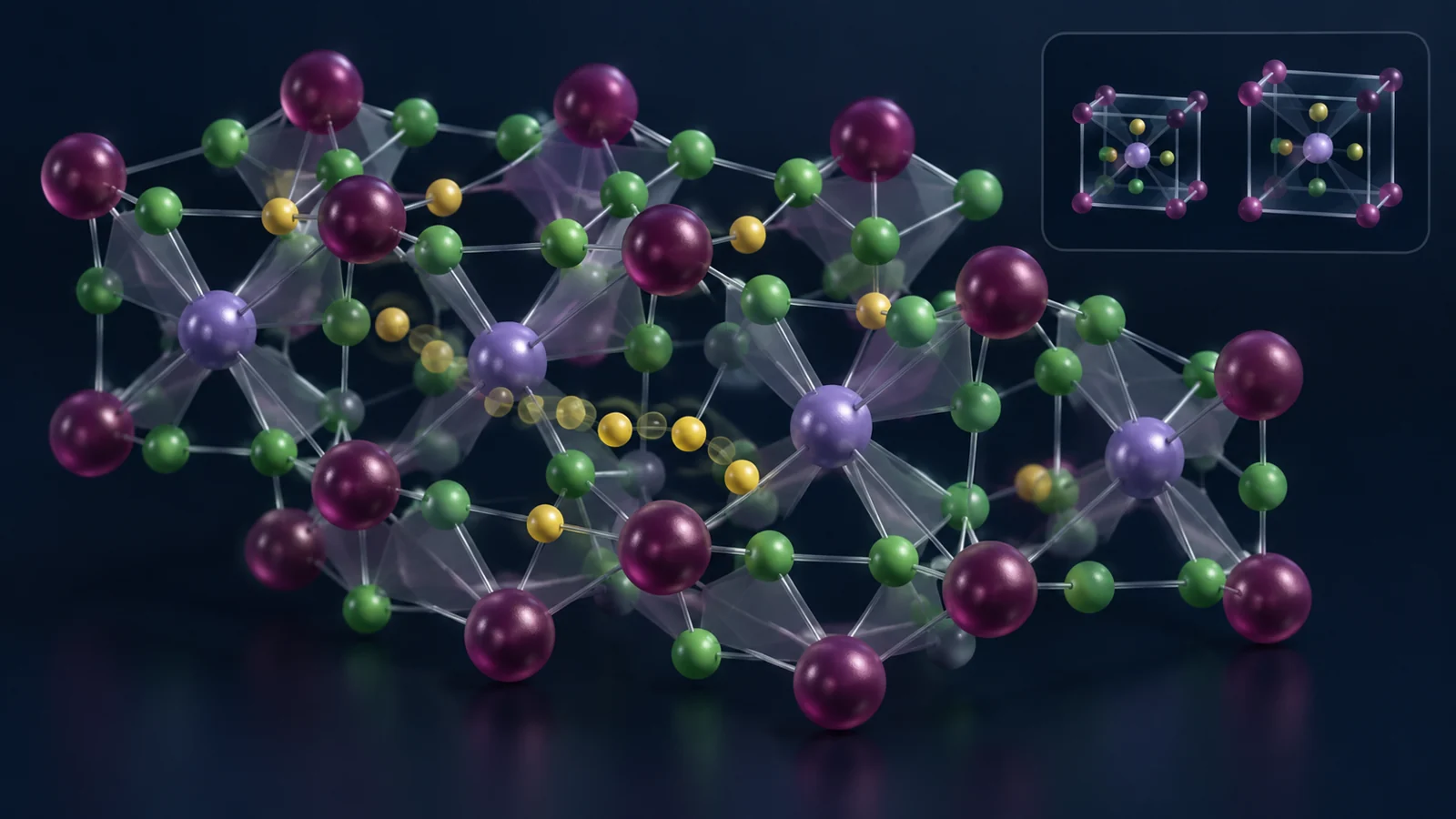
A new computational study asks how efficiently researchers can investigate those details in the mixed halide family Li₃YCl₆₋ₓBrₓ, abbreviated LYCB. The October 10, 2025 arXiv preprint tests a fine-tuned machine-learning model against density-functional-theory calculations and first-principles molecular-dynamics results. Its contribution is a way to explore crystal arrangements and lithium transport across chloride-rich, bromide-rich, and mixed compositions at a scale that would be difficult to reach with repeated first-principles simulations alone.
The result is useful as a materials-development capability. It is not evidence that a battery made from one particular LYCB composition would charge faster, last longer, or be ready for practical use.
The difficult starting point is an imperfect crystal picture
The researchers began with experimentally refined structures for Li₃YCl₆ and Li₃YBr₆. Those structures describe disorder in the material rather than one single, fully specified placement of every atom. That distinction matters because a simulation needs actual atomic coordinates. To follow lithium motion, the calculation must start from a concrete arrangement that can be relaxed and then evolved over time.
The team therefore generated ordered candidates from the experimentally refined models. They used 1 × 1 × 2 supercells and systematically enumerated symmetrically distinct arrangements. An initial machine-learning potential ranked the candidates by predicted total energy. The 20 lowest-energy configurations then received additional density-functional-theory relaxations, giving the researchers a reference-based check on which arrangements were plausible starting points.
This procedure does not claim that one ordered snapshot is the complete physical description of a disordered solid. It creates a set of realistic, low-energy models from which the later simulations can begin. In practical terms, the structural preparation is part of the scientific result. A fast dynamical calculation would still be misleading if it started from an arbitrary crystal arrangement.
Training the model around the structures it must handle
Machine-learning interatomic potentials are designed to approximate the energy landscape that governs atomic motion. They take information about the elements and their local environments and predict quantities such as total energy, forces, and stress. Once the predictions are sufficiently reliable, the model can update atomic positions repeatedly during molecular dynamics without asking for a new first-principles calculation at every step.
The pretrained Crystal Hamiltonian Graph Network, or CHGNet, was not developed specifically for every configuration encountered in LYCB. The researchers adapted it through an iterative workflow. They generated configurations away from equilibrium at selected temperatures, calculated energy, force, and stress labels with static density-functional theory, and added those labeled examples to the training set. The fine-tuning used chloride-rich and bromide-rich structures so the model learned from the chemical range it was expected to simulate.
Several versions were produced as increasingly high-temperature and out-of-equilibrium configurations entered the data. The reported benchmark contained 1,780 configurations. It included equilibrium structures from the enumerated zero-temperature models as well as snapshots from molecular-dynamics trajectories, allowing the comparison to cover more than relaxed crystals at one idealized condition.
That sequence connects the model’s faster predictions to a physical reference. The machine-learning potential was not simply asked to extrapolate from a generic training set. It was repeatedly exposed to the kinds of distorted structures and thermal environments that matter when lithium ions move through a solid.
Three tests of whether the shortcut is useful
The first test concerned the quantities used to describe the energy surface. Relative to density-functional-theory reference data, the pretrained model showed systematic deviations, especially for bromide-rich compositions. Fine-tuning brought the energy trends closer to the reference calculations across the composition range and reduced reported errors in energy, force, and stress. Among the versions discussed in the study, CHGNet_600K gave the best overall accuracy in that benchmark.
That improvement is important, but it is only the first layer of validation. A model can produce good static energies and still behave poorly when a simulation is allowed to evolve. The researchers therefore examined whether the crystal could be relaxed at finite temperature and pressure without the trajectory becoming unstable.
In the reported comparison, molecular dynamics with the pretrained CHGNet produced unstable trajectories above 300 K for the Li₃YCl₆ and Li₃YBr₆ end members. The fine-tuned CHGNet_600K supported stable constant-number, constant-pressure, constant-temperature simulations up to 800 K for those two materials. Here, “stable” describes the behavior of the simulated trajectory. It is not a measurement of chemical stability in a battery, nor does it define a safe operating-temperature range for a device.
The third test concerned lithium dynamics. The fine-tuned CHGNet and the SEvEnNet model reproduced first-principles molecular-dynamics reference values well when the simulations began from cells optimized at zero kelvin. This gives evidence that the fine-tuned model can capture the relative transport behavior under that preparation, not that every possible experimental transport measurement will be reproduced.
The study also reports a major computational advantage in its stated comparison. The fine-tuned model required roughly 0.8 seconds per atom per picosecond on a GPU for the calculation described, and the authors compare that with a comparable first-principles simulation on one CPU that was more than 100,000 times slower. That is a result for the specified workloads, hardware, and comparison. It should not be read as a universal speed multiplier for every machine-learning or first-principles calculation.
Lithium transport changes when the cell can change size
The most important interpretive complication appears when the simulated crystal is prepared differently. In one stage, the researchers used molecular dynamics in the constant-pressure and constant-temperature ensemble to equilibrate the cell. This lets the volume respond to the simulated conditions. They then used a fixed-cell, constant-volume simulation to examine lithium diffusion and ionic conductivity.
Those choices matter because lithium transport is not determined only by chemical composition. The available space and the geometry through which ions move are also part of the simulated state. A conductivity value obtained after allowing the cell to expand can therefore differ from one obtained in a cell held at another volume, even when the same composition and machine-learning model are used.
The volume comparison makes that dependence visible. Fine-tuned CHGNet and SEvEnNet produced similar average volumes in the reported equilibration tests, with the CHGNet values deviating from SEvEnNet by less than 1%. Both models, however, slightly overestimated the cited experimental volumes by about 10%. That gap is not a side detail: it affects how confidently a calculated transport value can be connected to a material’s measured behavior.
For the conductivity calculations, the authors used cells equilibrated beforehand in the variable-volume stage and then ran fixed-volume molecular dynamics. Both fine-tuned CHGNet and SEvEnNet predicted conductivities above the first-principles molecular-dynamics values in the comparison described. The study still recovered relative transport trends among Li₃YCl₆, Li₃YBr₆, and mixed chloride–bromide compositions, showing how composition, structural symmetry, and the simulated cell can interact.
This is why agreement with a reference calculation needs to be stated precisely. The model can agree well with a first-principles trajectory under one cell preparation while another preparation produces a different transport estimate. Agreement with a second machine-learning potential is also a useful cross-check, but it does not by itself establish agreement with experimental conductivity.
A wider search space before synthesis
The practical promise of the workflow is not one announced winning mixture. It is the ability to examine many candidate arrangements and compositions with a consistent, comparatively efficient procedure. The researchers carried out nanosecond-scale simulations across the LYCB composition space after building and testing the fine-tuned potential. That creates room to ask more targeted questions about which structural motifs and compositions deserve closer experimental attention.
The workflow also shows why different stages of a materials calculation should not be collapsed into one headline result. Enumerated structures determine the starting configurations. Reference calculations supply labels for training and checks. Finite-temperature, finite-pressure simulations prepare the cell. Fixed-volume trajectories then provide the setting for analyzing lithium diffusion. Each stage changes what the next result means.
The evidence remains bounded to this studied electrolyte family and to the validation comparisons described in the preprint. It does not establish a best composition, an absolute room-temperature conductivity, an activation energy, or a numerical phase boundary from the material described here. Nor does it show that the same procedure will work without further validation for unrelated solid electrolytes.
At the battery level, several separate requirements remain. A useful solid electrolyte must fit into a working cell, maintain suitable interfaces, tolerate manufacturing and cycling conditions, and contribute to stable operation. The modeling results do not establish changes in charging time, cycle life, safety, energy density, or commercial readiness. They also do not test the earlier expectation about grain-boundary engineering, fracture, electronic leakage, or reduced external compression. This study addresses a computational route for understanding composition and lithium motion, not those cell-level questions.
What this could change
If experiments validate the predicted transport trends and further calculations support them across more candidate compositions, researchers could screen a wider range of chloride–bromide mixtures and atomic arrangements before investing in synthesis. That would make it easier to prioritize ion-conducting materials for solid composite cathodes, where finding a suitable electrolyte is one part of building a functioning solid-state battery.
The conditional benefit is mainly scientific and logistical. More credible, affordable simulations could narrow the number of structures that need to be made and measured, while revealing which predictions are sensitive to crystal volume or disorder. That could accelerate the search for useful solid electrolyte components, but only alongside experimental checks of transport, stability, interfaces, and complete-cell behavior.
Key Sources
- Primary source: Predicting Crystal Structures and Ionic Conductivities in Li$_{3}$YCl$_{6-x}$Br$_{x}$ Halide Solid Electrolytes Using a Fine-Tuned Machine Learning Interatomic Potential
arXiv · Preprint · 2025-10-10