
Since the previous research note · Earlier expectation not tested
Track continuity
Since the previous research note: Lithium leaves silicon with a new structure to design around
Previous expectation: More predictable silicon deformation could let developers build electrodes that accommodate expansion and preserve useful storage performance for longer.
What this study adds: The current preprint examines a different component, the solid electrolyte, and connects lithium transport in Li2ZrCl6 to structural arrangement and ion motion. It does not test silicon deformation, electrode formation or the earlier durability forecast.
What changed in this study
A solid electrolyte is the part of an all-solid-state battery that carries lithium ions between the electrodes. Its usefulness depends on how readily those ions can move through the material. In Li2ZrCl6, a lithium zirconium chloride, the chemical ingredients stay the same while the atoms can be arranged in different ways. An August 2025 arXiv preprint, not peer reviewed in the version used here, asks how much that arrangement changes the journey.
The study compares three forms of Li2ZrCl6: an ordered alpha structure, a disordered alpha structure and a beta structure. The disordered alpha form has the highest reported ionic conductivity among the structures studied, while beta has substantially lower conductivity. That finding is specific to these modeled arrangements of this material. It is not a general rule that disorder improves every solid electrolyte.
The more useful question is what produces the difference. The authors trace it to the way lithium ions hop between sites, how long they wait before moving, which directions they favor and whether their motion is coordinated with other lithium ions.
Making larger atomic journeys computationally practical
The calculation combines several levels of modeling. Quantum-based calculations and ab initio molecular dynamics supplied reference configurations: snapshots showing how the atoms interact under different conditions. Those data were then used to train a deep-learning potential, a model that approximates the interatomic forces while remaining much less expensive to evaluate than a fresh quantum calculation for every step.
The resulting deep-learning-accelerated molecular dynamics simulations could follow larger assemblies for longer trajectories than the underlying quantum simulations alone. The reported workflow used reference simulations across temperatures from 300 to 1400 kelvin, more than 60,000 training samples and more than 10,000 test samples. The simulations ultimately used supercells containing 12,960 atoms.
That scale matters because lithium transport is not a single atomic event. An ion may remain near one site, move to another, encounter a changing local environment and repeat the process many times. A small calculation can identify plausible interactions, but a larger molecular-dynamics system gives the researchers more room to observe collective patterns of motion.
The training process was evaluated using errors in predicted energies, forces and the virial tensor. The authors report prediction accuracy of approximately 99 percent for those model quantities. This describes agreement between the learned interaction model and its quantum-derived reference data. It does not turn the transport mechanism, or the performance of a future battery, into a 99 percent certainty.
Lithium moves by waiting and hopping
Across the phases, the reported transport mechanism is site-to-site hopping. Lithium does not simply flow as a smooth stream through an empty channel. Instead, an ion spends time near one preferred location, waits for a favorable rearrangement and then hops to another location. The time spent waiting at those sites helps determine the overall conductivity.
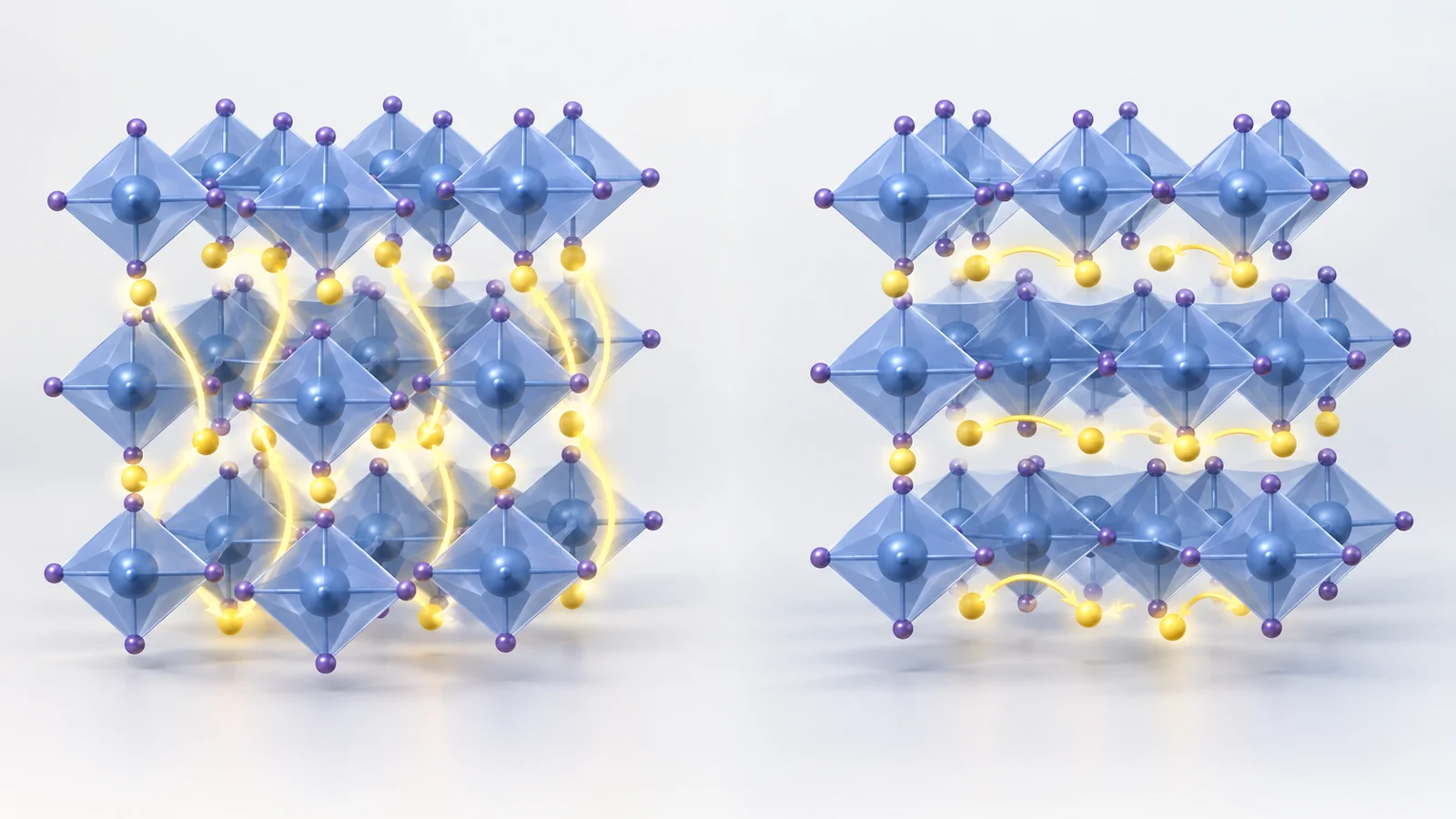
The direction of those hops differs between the alpha and beta structures. In the alpha forms, lithium preferentially diffuses across layers, where the lower reported energy barrier supports more directional motion. The transport is described as primarily collective, meaning the movement of one lithium ion is connected with the motion of others and with changes in the surrounding structure.
In beta-LZC, lithium mainly diffuses within a layer. The motion is more isotropic and is associated with higher energy barriers and predominantly individual diffusion. In plain terms, the beta structure offers a more difficult route in which ions are less dependent on a coordinated movement through neighboring sites.
The surrounding zirconium–chlorine framework helps shape those routes. Each zirconium is associated with a ZrCl6 octahedral unit, a local building block in which one zirconium center is surrounded by six chlorine atoms. The authors connect differences in the softening of these units, together with the layered arrangement of zirconium atoms, to the barriers lithium encounters. A framework that can adjust more readily may make certain hops easier, while a stiffer local environment can leave ions waiting longer.
This is the central value of the simulation: it links a measured material property, ionic conductivity, to an atomic sequence that readers can picture. The comparison is not only about whether one phase conducts more. It describes the waiting, direction and coordination that help explain why.
Three comparisons test different parts of the result
The study uses several kinds of agreement, and they answer different questions. First, the learned potential is compared with quantum-derived reference data. That checks whether the model reproduces the energies, forces and related quantities needed to simulate atomic motion.
Second, the calculated structures are compared with experimental structural information. The authors report that the selected computational treatment reproduces the crystal geometry with small deviations, including for the lattice parameters used to represent alpha- and beta-LZC. This supports the structural setup of the modeled phases.
Third, the calculated ionic conductivities for ordered alpha, disordered alpha and beta are reported to agree with experimental measurements. That comparison concerns the transport behavior itself, rather than only the local forces or the shape of the crystal.
Together, these checks make the mechanism more persuasive than any one comparison alone. They support the use of the model to investigate how lithium moves in the studied Li2ZrCl6 structures. They do not by themselves establish a charging rate, cycle life, safety improvement or manufacturing-ready battery. The supplied evidence explains atomistic transport in an electrolyte material; it does not establish performance in a complete working cell.
What this could change
If the reported structural relationships survive further experimental testing, and if the useful arrangements can be produced and retained inside working cells, electrolyte developers could begin designing Li2ZrCl6 around a more deliberate transport strategy. Instead of treating the crystal arrangement as a fixed background, they could aim to encourage the layered flexibility and coordinated pathways associated with lower resistance to lithium-ion motion in this chloride material.
That would create a practical possibility: a solid electrolyte that contributes less resistance to ion flow inside a battery. Reaching that outcome would still require control over how the material forms, how stable its arrangement remains and how the electrolyte behaves alongside electrodes. The study supplies a detailed explanation for what to engineer toward, not a promise of fast charging or a commercial battery result.
Key Sources
- Primary source: Unveiling the Lithium-Ion Transport Mechanism in Li2ZrCl6 Solid-State Electrolyte via Deep Learning-Accelerated Molecular Dynamics Simulations
arXiv · Preprint · 2025-08-07