
Since the previous research note · Earlier expectation not tested
Track continuity
Since the previous research note: Between lithium metal and solid electrolyte, a simulated lithium cluster forms
Previous expectation: Controlling lithium formation within the reaction layer at a solid-electrolyte contact could help developers prevent damage and improve battery durability.
What this study adds: This sodium–ceramic model follows electrode motion and interfacial gaps, showing local grain-boundary effects on void growth and faster void coalescence with increased current. It adds a distinct contact-evolution mechanism without testing lithium-cluster suppression.
What changed in this study
A solid-state battery depends on contact between a metal electrode and a solid separator. If a gap opens at that boundary, the important change is not only that some metal has moved away. The shape of the contact itself has changed, and that can alter where material continues to move.
A December 22, 2024 arXiv preprint studies this problem with a computational model for a sodium negative electrode against a ceramic solid electrolyte. It follows the metal electrode and the gaps at its surface together during sodium removal and return. The result is a more specific picture of how a contact can evolve: the separator’s internal crystal boundaries may be almost invisible when the interface is intact, then become locally relevant when a gap edge reaches them.
A contact can change before the electrode is gone
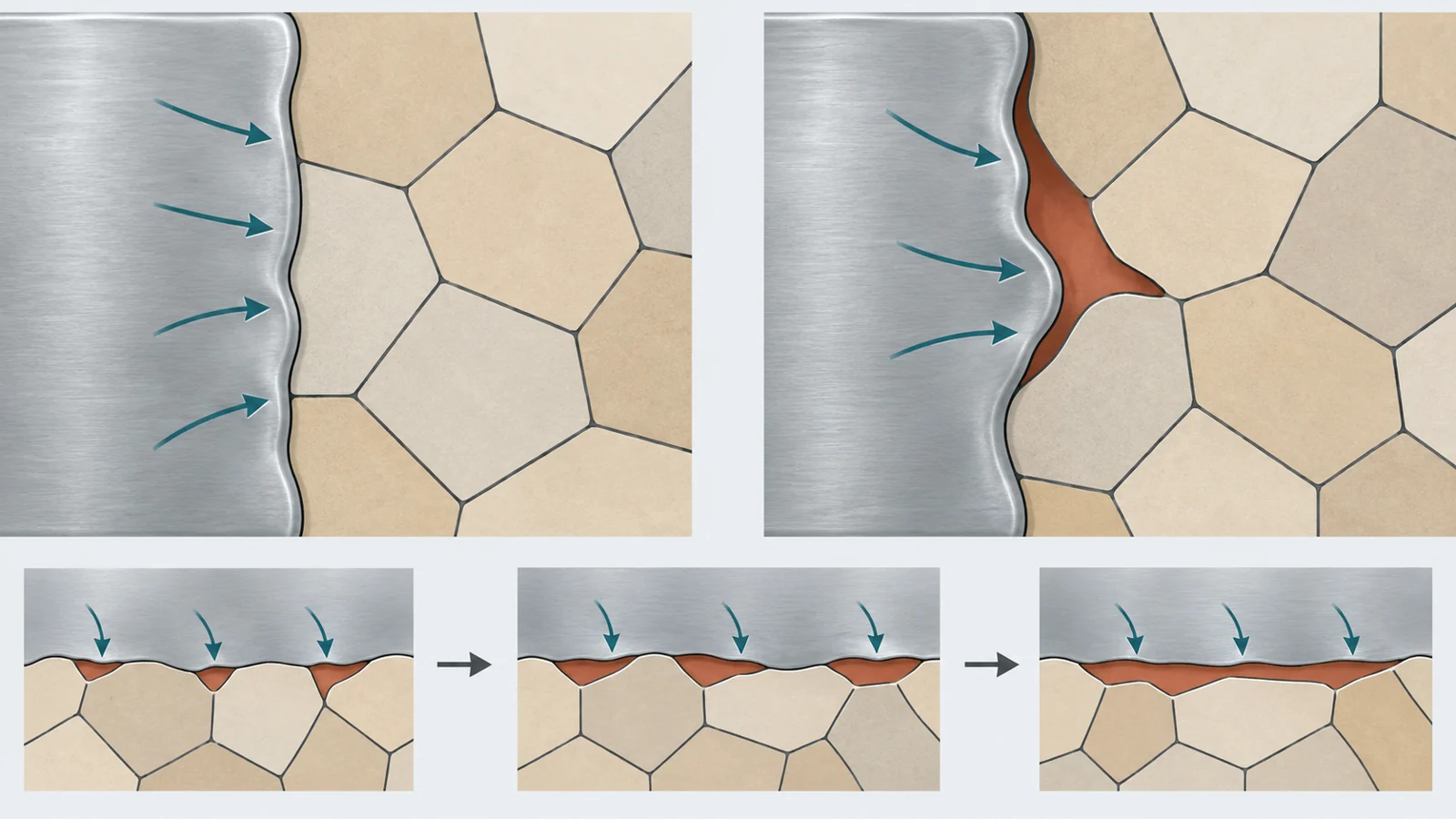
The study uses a diffuse-interface electrochemical model. In practical terms, the calculation does not treat the electrode and electrolyte boundary as a permanently fixed line. It allows the metal shape and the interfacial voids—gaps between the electrode and separator—to change as sodium is stripped from or plated back onto the negative electrode.
Stripping means removing sodium from the metal electrode. Plating means depositing sodium onto it again. Following both processes matters because the electrode can become thinner during removal and thicker during deposition, while a gap can expand, shrink, or interact with nearby features. Looking at only the electrode thickness would miss the changing geometry at the contact.
The model is demonstrated for sodium and a Na-β″-alumina ceramic separator. It compares three increasingly complicated situations. First, the electrode and electrolyte begin with a perfect interface. Next, the calculation includes a single interfacial void during stripping and plating. Finally, it follows stripping when multiple voids are present.
Each situation is considered with a homogeneous separator and with a polycrystalline separator. A homogeneous separator has uniform modeled properties. A polycrystalline one is made of many crystals, or grains, whose boundaries can have a different conductivity from the grain interiors. That arrangement lets the calculation ask two separate questions: what happens when the contact has no initial gap, and what happens when a moving gap edge encounters internal structure in the ceramic?
The first check is whether the sodium adds up
A moving boundary creates a basic accounting problem. If the simulated electrode changes thickness, the calculation must keep track of where the sodium has gone. Otherwise, a visually plausible change in shape could hide a numerical error.
In the intact-interface cases, the negative-electrode thickness decreases linearly with stripping time. The depletion rate is roughly proportional to the applied current density. During plating, the thickness increases linearly, and the deposition rate likewise rises approximately in proportion to the magnitude of the applied current density. The modeled deposition and depletion rates are nearly the same under the compared conditions.
The authors also compare the sodium loss calculated by the simulation with analytical values. Their agreement supports mass conservation in the simulations. That is an important internal consistency check: the model’s changing geometry is compatible with the amount of sodium it says is being removed.
It is not the same as showing that a working battery will behave with the same accuracy. A conservation check tests the bookkeeping and moving-interface formulation. It does not measure cycle life, capacity retention, energy density, charging speed, or safety in an operating cell. The calculation has to pass that internal check before its more detailed predictions about gaps can be interpreted, but passing it does not turn the model into a battery test.
Crystal boundaries matter where the gap edge arrives
Grain boundaries are the boundaries between crystals in the ceramic separator. Their conductivity can be lower or higher than the conductivity of the surrounding grain material. That difference might sound as though it should affect every part of the electrode–electrolyte interface equally. The simulations show a more local pattern.
When the interface is perfect, changing the conductivity assigned to the grain boundaries has no significant effect on the modeled behavior. There is no void edge in that case, so there is no moving gap boundary for the internal ceramic structure to redirect or interact with in the way examined here.
Once a void is present, its edge becomes a location where the geometry and transport conditions change together. As that edge meets grain boundaries, the void grows differently in local regions. The overall lesson is not that one conductivity choice is universally better. It is that the influence of the polycrystalline structure depends on where the gap is and how its edge moves through the separator’s internal pattern.
That distinction helps resolve an apparent contradiction. The ceramic can be heterogeneous without producing a large visible change in an intact interface, yet the same heterogeneity can matter once contact has been interrupted. The relevant feature is not simply that grain boundaries exist. It is their interaction with an evolving void edge.
Current sets the pace of growth and merging
The calculation also connects the local edge process with the larger evolution of the gaps. The reported void-growth rate is a linear function of the flux of sodium atoms at the void edge. That flux depends on the applied current density. In this model, increasing current therefore changes how quickly the edge advances through the contact geometry.
Individual growth and coalescence are different events. Growth is the enlargement of one gap. Coalescence occurs when separate gaps expand until they merge. The simulations show that the coalescence rate increases with applied current density. Grain-boundary conductivity can influence that merging as well, but only marginally in the reported comparisons.
This gives the model a useful temporal dimension. It does not only identify where a grain boundary can matter. It links the changing speed of sodium transport at a void edge to the later possibility that several gaps become one larger connected region. The relationship is still a modeled result for the sodium–ceramic system, not a universal current threshold or a failure-time forecast.
What the calculation can and cannot establish
The contribution is a modeling milestone about contact geometry and transport. It shows how one computational description can follow metallic-electrode motion and interfacial void evolution in the same simulation, then compare intact contact, one gap, and multiple gaps across uniform and polycrystalline separator descriptions.
The analytical sodium-conservation comparison strengthens confidence that the simulated electrode motion is internally consistent. The current-dependent thickness changes and the local response near grain boundaries give the model specific relationships to investigate further. They also make clear why a single average property for the ceramic may not describe every stage of contact evolution equally well.
The demonstrated calculations do not establish a measured improvement in battery durability or a quantitative advantage for a particular grain-boundary conductivity. They do not provide a numerical operating limit, a universal rule for choosing higher- or lower-conductivity boundaries, or a quantitative prediction of when a working cell will fail. The chemistry and separator in view are sodium and Na-β″-alumina; extending the result to lithium electrodes or other solid-electrolyte chemistries requires additional support. The study’s demonstrated question is also about electrode motion and interfacial gaps, not about suppressing electron-enabled lithium-cluster formation in a lithium interphase.
That boundary is part of the value of the result. A simulation can isolate a mechanism that would be difficult to separate in a working cell, while still leaving the question of predictive performance open. Here, the mechanism is the way current, sodium flux, grain-boundary structure, and gap geometry interact at a solid contact.
What this could change
If these modeled relationships prove predictive in working sodium cells, developers could use them to connect operating current and ceramic microstructure with the local evolution of electrode contact. If the relevant geometry and transport can then be controlled, that capability could help create interfaces that retain contact through repeated sodium removal and deposition, supporting more durable sodium solid-state batteries.
That possible payoff depends on the remaining bridge between a mass-conserving calculation and a validated operating cell. The immediate significance is narrower but concrete: the model gives researchers a way to ask how a gap grows, where a crystal boundary changes that growth, and when separate gaps begin to merge. Those are the physical details a future durability strategy would need to control.