
Since the previous research note · Earlier expectation not tested
Track continuity
Since the previous research note: A close-up view of an oxide microbattery in operation
Previous expectation: Limiting structural degradation while preserving lithium transport could help oxide solid-state batteries last longer.
What this study adds: This study identifies a conductivity-leading composition within a strontium-varied, tantalum-containing ceramic series and associates its behavior with favorable ceramic structure. The supplied evidence does not test whether that composition limits the operating degradation underlying the earlier forecast.
What changed in this study
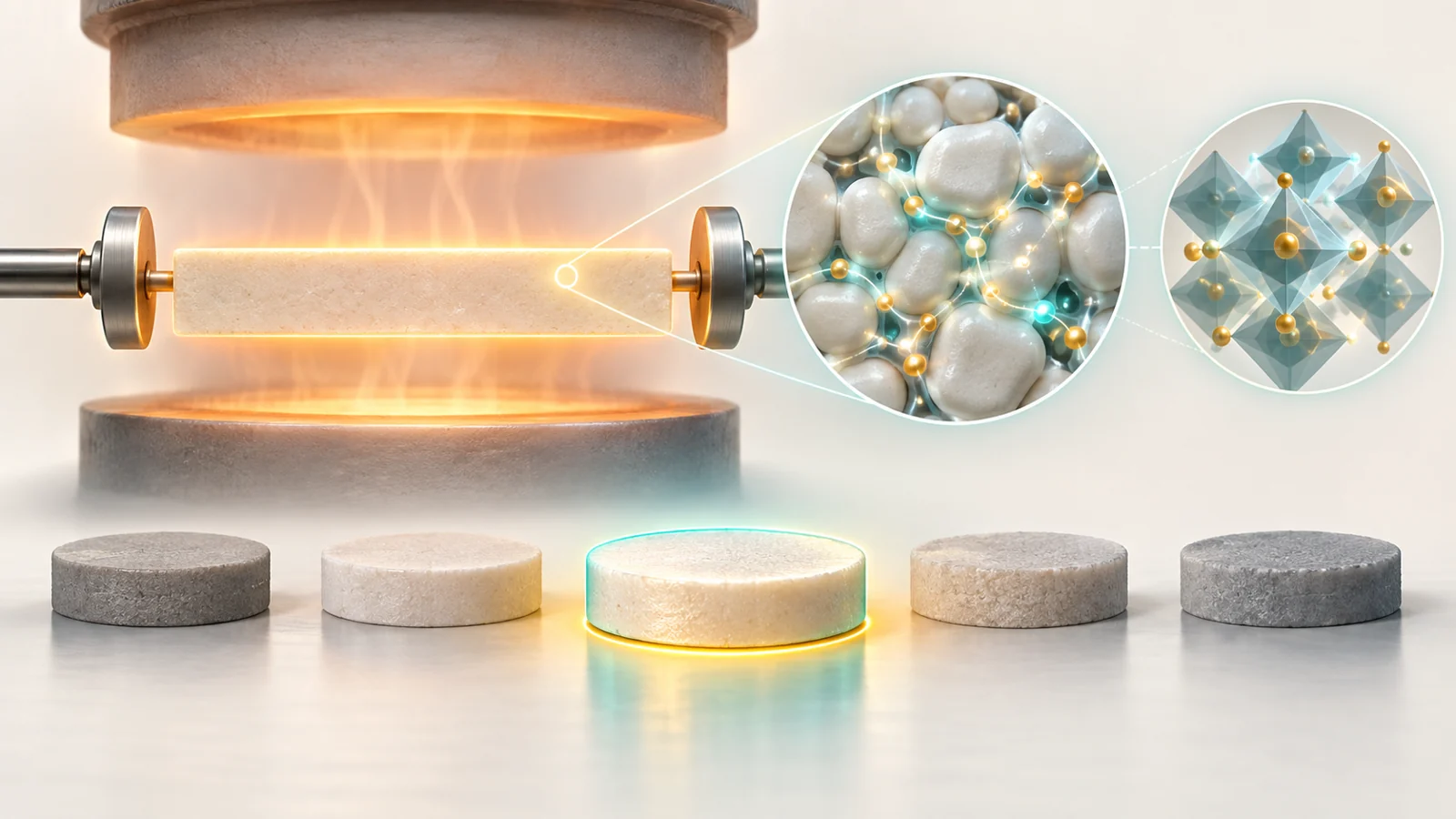
A solid electrolyte is a solid material that carries lithium ions inside a battery. For an all-solid-state design, that transport role is essential, but a strong measurement on a ceramic is not the same thing as a successful working battery. A November 2024 preprint offers a focused example of the difference. It varied the recipe of a garnet ceramic related to Li7La3Zr2O12, or LLZO, and found its strongest reported room-temperature ion transport in the sample containing a small amount of strontium.
The result is useful because it identifies a promising composition within a defined experiment. It also shows why the word best needs a boundary here: the leading sample was best among the tested recipes and preparation conditions, not automatically the best ceramic for every battery.
The recipe changed more than one ingredient
The researchers made the series Li6.75+xLa3-xSrxZr1.75Ta0.25O12 with x ranging from 0 to 0.20. In plain language, increasing x changed the nominal amounts of three elements at once. Strontium increased, lanthanum decreased, and lithium increased according to the formula. The tantalum content stayed fixed at 0.25.
That design matters when interpreting the result. It is not a clean comparison between an undoped LLZO ceramic and a single extra ingredient added while everything else remains constant. The samples are related compositions in which the recipe shifts as x changes. The study therefore answers a practical materials question: which member of this particular strontium-varied, tantalum-containing series performed best under the reported preparation conditions?
The answer was the x = 0.05 sample, described as the 0.05 Sr ceramic. It was sintered at 1050 °C and reached a reported room-temperature ionic conductivity of 3.5 × 10^-4 S/cm. The same sample had the series’ lowest reported activation energy, 0.29 eV. Adding more strontium within the tested range did not produce a higher reported maximum.
Two kinds of structure shape the result
The material can be considered at two different scales. At the crystal level, the LLZO framework is being modified to influence the arrangement of atoms and the conditions that support lithium-ion movement. The paper discusses the highly conducting cubic form of LLZO and the role of lithium vacancies in stabilizing or enabling more mobile-ion behavior. Doping is part of that crystal-chemistry strategy.
A ceramic, however, is not only a set of ideal crystal structures. It is also a sintered body made of grains, with interfaces and pores between them. The researchers used X-ray diffraction, density measurements and scanning electron microscopy to examine these structural, physical and morphological features. Sintering is the heat treatment that consolidates the ceramic, allowing particles to pack and grow together rather than remaining as a loose powder.
For the 0.05 Sr sample, the microscopy extract describes a compact structure and suitable grain growth. Its reported average particle size was 3.3 ± 0.03 micrometres. Pores can interrupt the effective path through a ceramic, so grain packing and consolidation can influence the total transport measured across the sample. The authors associate the favorable behavior with strontium acting as a sintering aid. That is their proposed connection between the recipe and the ceramic’s transport performance, rather than an independently isolated test of strontium’s causal contribution.
Keeping these scales separate helps avoid a common shortcut. A change in crystal chemistry and a change in the way ceramic grains pack may both affect the measured result, but they describe different parts of the material. The experiment points to a favorable combination in one prepared sample; it does not reduce the outcome to a single visual feature or a single ingredient.
The electrical measurements answer different questions
Ionic conductivity describes how readily lithium ions can move through the ceramic. The reported value of 3.5 × 10^-4 S/cm is therefore a transport measurement at room temperature, not a measurement of how much energy a complete battery stores or how long it operates.
Activation energy describes the temperature dependence of that transport. In this study, the value of 0.29 eV was the lowest reported for the series and accompanied the highest reported room-temperature ionic conductivity. In practical terms, the pair of measurements says that the leading sample carried ions particularly well under the tested conditions and showed the most favorable reported transport-temperature relationship among these samples.
The charge carrier also matters. A current through a ceramic can include movement associated with ions or with electrons, and a solid electrolyte is useful for a battery only when lithium-ion transport is the dominant role. The study’s DC conductivity measurement supported predominantly ionic conduction in the 0.05 Sr ceramic. That result strengthens the interpretation of the conductivity as electrolyte-relevant transport. It should not be read as proof that electronic conduction is exactly zero or that the material is ready for any device configuration.
A series optimum is not a finished battery
The most defensible reading is therefore layered. First, the researchers measured a clear within-series optimum: x = 0.05 gave the highest reported room-temperature ionic conductivity and the lowest reported activation energy. Second, they connected that behavior to a favorable ceramic structure and to strontium’s possible role during sintering. Third, they identified the sample as a suitable candidate for use as a solid electrolyte in an all-solid-state lithium-ion battery.
Those statements are not interchangeable. The first is the direct experimental comparison. The second is an interpretation of how composition and processing may have shaped the ceramic. The third is a materials recommendation that points toward a device application.
A working battery adds conditions that this result alone cannot settle. The ceramic would need to be formed into a usable electrolyte layer, joined to compatible electrodes, and kept functional while the battery operates. The supplied findings do not establish charging performance, cycle life, crack resistance, safety gains or production economics. Nor do they establish a universal optimum beyond the compositions and sintering condition examined here. The study’s value is more precise: it narrows attention to a composition and processing window where lithium-ion transport was strongest in this experiment.
What this could change
If the x = 0.05 composition can be reproduced in practical electrolyte layers and maintained alongside compatible electrodes during operation, battery developers could gain a solid ceramic layer that carries lithium ions with less resistance than poorer-performing members of this series. That capability could make an all-solid-state lithium-ion battery more workable by improving the internal transport pathway that connects its electrodes.
The conditional wording is important. The result does not demonstrate a better complete battery or prove longer life. It identifies a transport-performing ceramic candidate whose usefulness would depend on surviving the demands of real cell construction and operation. In that sense, the preprint advances the material from a broad recipe search toward a more specific composition target, while leaving device performance as the next practical question.
Key Sources
- Primary source: Investigation of the doping effects of Sr-Ta on the Ionic Conductivity of Garnet Li7La3Zr2O12 Solid Electrolyte
arXiv · Preprint · 2024-11-12