
Since the previous research note · Earlier expectation not tested
Track continuity
Since the previous research note: How a cerium-based filler changes a polymer battery electrolyte
Previous expectation: A cerium-based filler could help polymer solid electrolytes maintain battery performance over extended use if their transport and stability persist under practical conditions.
What this study adds: The current preprint examines a different, oxide-based microbattery and reports electrolyte cracking, particle shrinkage, and amorphous-phase formation during electrochemical investigation. It adds a view of structural degradation without testing the earlier filler chemistry or its durability prediction.
What changed in this study
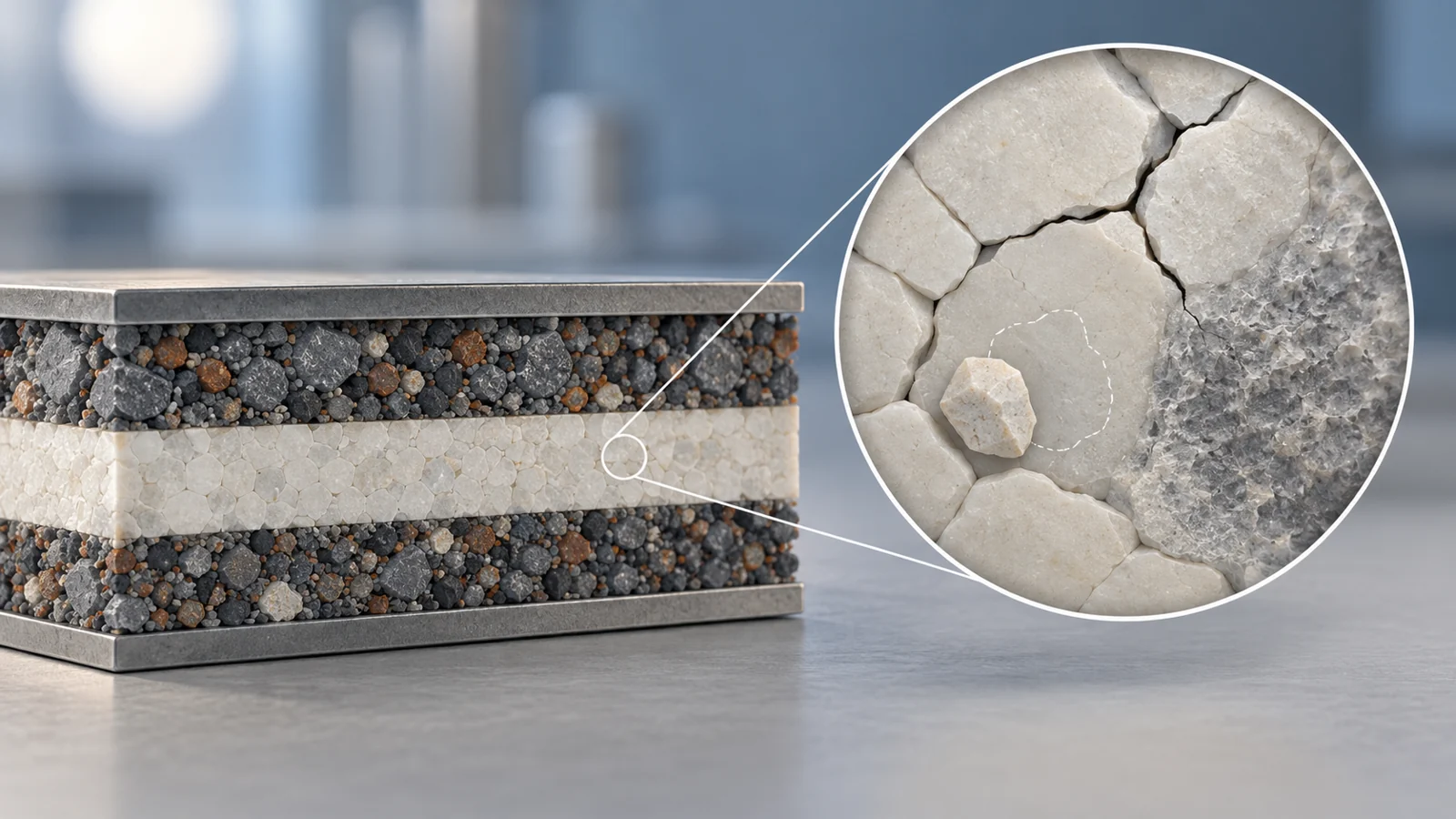
A battery can look intact from the outside while its solid interior is changing. In a November 3, 2024 arXiv preprint, researchers used in situ electrochemical transmission electron microscopy to watch an oxide-based all-solid-state microbattery during operation. The clearest event was also the most consequential to understand: cracks appeared in the solid electrolyte, the material that carries lithium ions between the electrodes.
That close-up view does not turn one tiny battery into a model for every solid-state design. It does, however, make hidden structural change visible while an electrochemical reaction is taking place. The result is a more concrete question for battery engineering: what happens inside the ion-carrying solid as a cell is used, and which changes might eventually limit its working life?
Watching a battery slice while it works
The experiment began with a very small, very thin piece of a battery rather than a complete commercial cell. The researchers prepared a focused-ion-beam lamella, a sliced specimen thin enough for electrons to pass through, and mounted it for electrochemical microscopy. Its solid electrolyte was LAGP. The positive electrode used a lithium iron phosphate, or LiFePO4, composite, while the negative electrode used a lithium vanadium phosphate, or LiVPO4, composite.
This arrangement gave the microscope two kinds of access. In situ TEM followed structural changes during electrochemical operation. Additional structural mapping compared the material before and after cycling, helping reveal changes in crystal structure and orientation that a single image during operation might not show as clearly.
The distinction matters. Seeing a feature develop while the battery is being operated provides a direct view of when it becomes visible in that prepared specimen. Comparing structural maps provides a different kind of information about order in the material. Neither view alone supplies a complete account of how a full-sized battery would age, but together they connect electrical operation with physical change at a scale that ordinary cell testing cannot directly resolve.
Three changes inside the electrolyte
The reported structural changes fall into three separate observations. First, cracks formed along grain boundaries in the solid electrolyte. Grain boundaries are the joins where individual crystalline grains meet. In the reported observation, the cracks began in the electrolyte layer, with no signs that they initiated in the electrode.
The authors associate this cracking with lithium diffusion and mechanical stress. That is a mechanistic interpretation of the observation, not the same thing as watching every step of the process or measuring the contribution of each possible force. The important finding is that the electrolyte itself became a visible site of fracture during electrochemical operation.
Second, electrolyte particles shrank. A particle becoming smaller is a geometric change; it does not by itself describe whether the material has lost its crystal order. Third, the researchers observed amorphous phases. Amorphous material has a less ordered atomic arrangement than a crystal. In practical terms, particle shrinkage and amorphization describe different kinds of change, even if they occur in the same operating environment.
The evidence presented here supports treating these as distinct features rather than arranging them into a proven sequence. It shows cracks, shrinking particles, and regions that became amorphous. It does not establish that one necessarily caused the next, or that all three followed the same timeline in every part of the specimen.
Why the electrical signal needs more than one explanation
The microscope supplied the physical view, but the battery also showed pronounced polarization. In simple terms, polarization is a departure of the measured voltage from the ideal voltage expected as the cell operates. A larger departure can indicate that the cell is meeting more resistance during its reaction, but the electrical behavior does not identify one cause by itself.
The discussion points to two possible contributors: limited contact between components in the electrode and resistance within the all-solid-state battery. If neighboring materials touch over less useful area, lithium-ion and electron pathways may be less effective. Internal resistance can also make operation require a larger voltage difference. These possibilities help explain why a structural change seen in the electrolyte should not automatically be treated as the sole origin of the measured polarization.
That separation between observation and attribution is central to the experiment. A crack is a physical feature visible in the material. Polarization is an electrical behavior recorded during operation. The two can be considered together, but the microscopy result alone does not assign a precise share of the electrical response to cracking, particle shrinkage, amorphous phases, contact, or other resistance within the prepared battery.
What this small experiment can and cannot tell us
The study offers a useful change in emphasis for solid-state battery research. Instead of asking only how much energy a cell stores or how its voltage changes, engineers can also ask where its internal structure changes while lithium is moving. Grain boundaries become more than lines between crystals: in this oxide microbattery, they were locations where cracks were observed. The electrolyte particles and their degree of order also become part of the durability story.
Still, the experiment concerns a prepared oxide microbattery and a microscopy geometry designed to make a thin specimen observable. The findings therefore support a specific statement about the behavior seen in this system, not a universal rule for every oxide electrolyte, polymer electrolyte, or solid-state battery architecture. They also do not by themselves establish a cycle-life improvement, a commercial-cell lifetime, greater pack safety, higher usable energy, or longer driving range.
The broader engineering implication is conditional. If similar grain-boundary cracking, particle shrinkage, or loss of crystal order also matter in practical oxide cells, then controlling those changes could become part of designing a more durable electrolyte. But engineers would still need to preserve lithium transport and the necessary contact among the battery’s components while limiting structural damage. The present observation identifies a place to investigate; it does not demonstrate that a particular material treatment has solved the problem.
What this could change
If these degradation mechanisms hold up in practical oxide solid-state cells, and if engineers can limit them without blocking lithium movement, the work could help shift battery design toward electrolytes that remain functional through more charging and discharging. That would support a longer-lasting form of solid-state battery, with potential value for demanding uses such as electric vehicles where durability, safety, and energy storage must work together.
The path from a watched crack in a thin microbattery slice to a dependable vehicle cell is long. Its value is that the path now includes a more tangible internal target: preserving the structure through which lithium ions travel while the battery is operating.
Key Sources
- Primary source: Investigation of Microstructural Evolution in All-Solid-State Micro-Batteries through in situ Electrochemical TEM
arXiv · Preprint · 2024-11-03