
Since the previous research note · Earlier expectation not tested
Track continuity
Since the previous research note: How ceramic particles and a deforming polymer shape contact with lithium
Previous expectation: Composite electrolytes might sustain useful contact with lithium if their mechanical behavior connects successfully to ion transport under operating conditions.
What this study adds: This computational study examines a different interface strategy, pairing a lithium–manganese sulfide electrode with a structurally related lithium–silicon sulfide electrolyte. It adds material-specific transport and atomic-exchange calculations, including a change in exchange energetics after lithium removal.
What changed in this study
In a solid-state battery, lithium ions must move through a solid layer while electrons travel through the electrode. That division sounds straightforward until the two solids meet. A material may carry lithium ions well on its own, while another may store charge and conduct electrons effectively, yet their boundary can still become a bottleneck if atoms rearrange, reactions begin, or lithium transport slows at the junction.
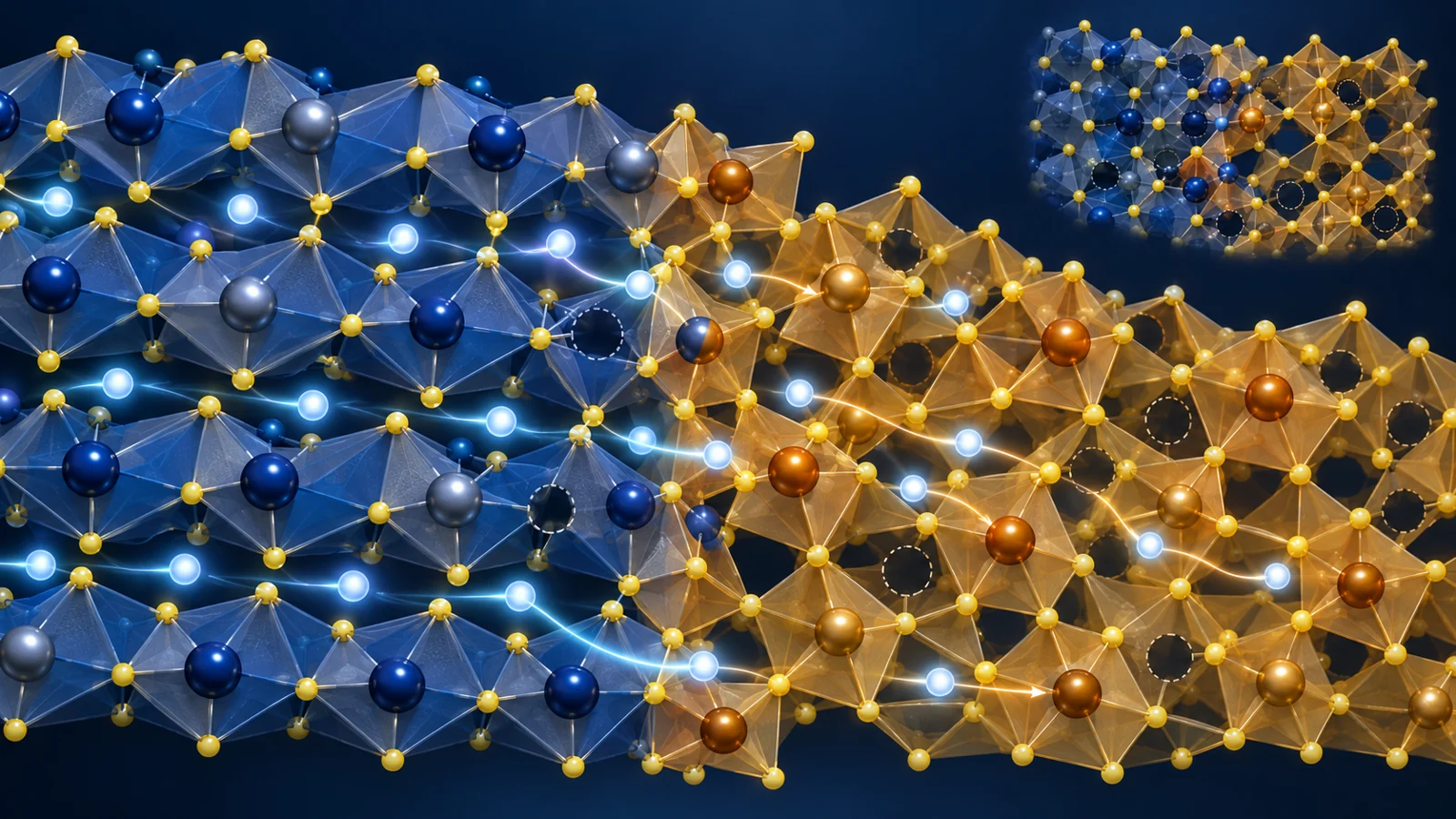
A computational preprint published on October 20, 2024, examines a strategy for making that boundary easier to manage. It proposes two sulfide materials with related atomic frameworks: Li$_{14}$Mn$_{2}$S$_{9}$, abbreviated LMS, as an all-electrochem-active electrode candidate, and Li$_{10}$Si$_{2}$S$_{9}$, abbreviated LSS, as a solid-state electrolyte candidate. The central idea is not that the materials are identical. Rather, their related structures may give lithium ions a more continuous path between them while limiting disruptive atomic exchange.
That proposal matters because the useful properties of separate materials do not automatically survive contact. The harder question is whether the pair remains a workable pair as the electrode changes during lithium removal.
A battery electrode has more than one job
The electrode side of a solid-state battery must accommodate electrochemical change and conduct electrons to an external circuit. It also needs pathways for lithium ions to enter and leave the active material. In many designs, an electrode contains an electrolyte phase and other additives to help provide internal ion or electron transport. Those additions can improve access to the active particles, but they also occupy space that could otherwise belong to charge-storing material and create additional internal boundaries.
The all-electrochem-active concept approaches the problem differently. An AEA electrode is intended to provide the needed electrochemical activity, electronic conduction, and lithium-ion transport without adding a separate solid electrolyte or other inactive substances throughout the electrode mixture. That does not remove the boundary between electrode and electrolyte: the two battery components still meet at an external interface. It changes where the internal transport problem is placed.
In the proposed pair, LMS is selected for the electrode role because the calculations identify substantial lithium content, a transition-metal component, lithium-ion transport, and electronic behavior that could support electrode operation. LSS is assigned the electrolyte role because its structure supports lithium motion while remaining a separate composition with silicon in place of manganese and a different population of lithium vacancies.
The shared framework therefore represents a design relationship, not a claim that one material can simply substitute for the other. Their lattice dimensions and chemical environments differ. The hoped-for benefit is that the difference between them can be crossed without requiring an entirely unrelated atomic arrangement on each side.
Lithium moves through vacancies and a flexible sulfur environment
The preprint uses atomistic simulations to follow how the two materials behave at elevated temperatures and then estimates room-temperature transport from Arrhenius relationships. In LSS, lithium vacancies provide unoccupied sites that lithium ions can move into. A vacancy is not a lithium ion pathway by itself, but a population of available sites can make successive hops possible through the structure.
The simulations also show a specific structural feature around silicon. Silicon remains associated with its bonded sulfur atoms, while some of those sulfur atoms rotate around the connected silicon units. That local motion occurs alongside lithium transport. The framework remains recognizable even as parts of the sulfur environment move, giving the authors a way to connect structural persistence with ion mobility.
For LSS, the calculated lithium-ion conductivity at 300 K is 2.01 mS/cm. This is an Arrhenius-derived estimate based on molecular-dynamics results at different temperatures. It is a bulk transport calculation for the modeled electrolyte, not a conductivity measurement from a fabricated sample. It is also not a measured resistance across the LMS–LSS boundary.
That distinction is important. A material can appear promising as a bulk ion conductor and still face a separate problem at the junction with an electrode. The proposed pair needs both properties: lithium must move through the electrolyte, and it must be able to cross into or out of the electrode without a severe interfacial penalty.
Joining the two structures changes the question
To study the boundary directly, the authors construct atomistic models containing an LMS region, an interfacial region, and an LSS region. They examine selected interface geometries with molecular dynamics using machine-learning interatomic potentials trained for the relevant interactions. These models allow the calculation to follow lithium motion and structural evolution in a joined system rather than treating the materials as isolated crystals.
One result concerns whether the interface remains structurally persistent during the simulated conditions. The modeled structures show no collapse toward the end of the calculations. That is useful, but it answers a limited question: the selected atomic arrangements remain intact over the simulated conditions and timescale.
A different calculation examines the energetic cost of exchanging one manganese site and one silicon site across the boundary. For the original, fully lithiated interface models, the reported formation energies are 0.525 eV and 0.853 eV for the two studied orientations. Positive values make that particular exchange energetically unfavorable in the modeled arrangements, which supports the interpretation that extensive manganese–silicon interdiffusion is difficult there.
These are related but distinct tests. Structural persistence asks whether the modeled interface stays together. Exchange energetics asks how favorable a particular kind of atomic rearrangement is. Neither result is a direct measurement of a fabricated junction’s resistance, and neither rules out every possible interfacial reaction.
The interface models also indicate that lithium transport can continue through the boundary region. Because LMS and LSS use related structural arrangements, the authors can examine lithium motion across a comparatively simple transition between the two phases. The calculation thus links three ideas: a lithium-conducting electrolyte, an electrode with its own ionic pathway, and a boundary where the atomic structures are related rather than completely mismatched.
Lithium removal makes compatibility state dependent
The most important complication appears when the electrode is no longer at its starting composition. During operation, lithium leaves the electrode during delithiation. Removing lithium changes the local chemical environment and can alter which atomic rearrangements are favorable.
The preprint models this change by introducing lithium vacancies into LMS and examining delithiated products. The calculations associate limited lithium removal with retained structural stability, while progressively greater removal lowers the stability of the modeled delithiated products and their intercalation voltage. The electrode candidate is therefore not a fixed object whose interface behavior can be evaluated only at its initial composition.
At the interface, the modeled manganese–silicon exchange energy changes sign in the delithiated case. The reported value is −0.048 eV, compared with positive values for the original LMS–LSS models. In the calculation, that sign change makes the exchange more energetically favorable and permits the possibility of some manganese–silicon interdiffusion at the lithium-depleted boundary.
This is a meaningful warning about state dependence. A pair that is chemically well matched at one lithium content may not remain equally matched across the full range of electrode compositions. At the same time, an exchange formation energy is not an interdiffusion rate. The value does not specify how quickly atoms would move, how much material would mix, how long a battery would operate, or whether cycling would inevitably cause failure.
The result instead identifies a condition that a future material pair would need to survive: compatibility must be evaluated across the electrode’s changing lithium content, not only in its initial state.
What the calculations can connect and what they leave open
The argument in the preprint is assembled from several computational layers. Electronic-structure calculations assess stability, electronic properties, and the behavior of lithium-removed products. Ab-initio molecular dynamics follows atomic and lithium motion for the individual materials and selected interfaces. Machine-learning interatomic potentials extend interface dynamics to larger modeled systems and provide a way to examine structural evolution and site exchange.
Together, these approaches can answer bounded questions about candidate compositions and idealized atomic arrangements. They can show whether a proposed structure remains stable in a simulation, estimate transport from modeled trajectories, and compare the energetic favorability of a specified atomic exchange.
The step from those results to a practical battery is larger. A manufactured cell would introduce processing choices, material defects, particle contacts, interfaces with their own shapes, and operating conditions that are not represented by every idealized model. The calculated 2.01 mS/cm value is not a device measurement, and the positive exchange energies are not a direct lifetime prediction. Model evaluation can support confidence in the calculations’ internal behavior, but it is not the same as demonstrating a working cell.
The preprint therefore offers a design principle and a set of material-specific questions rather than a completed battery architecture. Can the two compounds be made with the intended compositions? Can LMS provide useful electronic and ionic transport after the required lithium changes? Can the interface remain chemically and mechanically serviceable across those changes? Those questions determine whether the structural relationship becomes useful outside the calculation.
What this could change
If the pair can be synthesized, retains useful transport, and keeps its contact stable across the relevant lithium contents, the design could reduce the amount of electrode volume devoted to internal electrolyte and other transport additives. More of the electrode could then be assigned to active charge storage while lithium still has a path through the material.
That would not automatically deliver a higher-energy or longer-lasting battery. The conditional opportunity is narrower and more concrete: matching the atomic organization of an active electrode and a solid electrolyte could help developers design dense composite-free electrode regions with fewer internal transport boundaries. Whether that translates into a practical improvement depends on the state-dependent interface behavior that this study brings into view.