
Since the previous research note · Earlier expectation not tested
Track continuity
Since the previous research note: How a lithium battery contact changes from disorder to crystal
Previous expectation: Experimentally relevant simulations of evolving lithium-metal contacts could help designers create more durable solid-state battery interfaces.
What this study adds: This study addresses a different part of the battery, reporting a sulfur-composite preparation route intended to preserve ionic and electronic pathways within the cathode. A battery incorporating that composite is reported to operate stably over 1,000 cycles with nearly 100% Coulombic efficiency.
What changed in this study
Sulfur is attractive for lithium-sulfur batteries, but it creates a basic transport problem. In an all-solid-state design, where a solid material carries lithium ions instead of a liquid electrolyte, sulfur itself is poor at carrying both ions and electrons. A battery electrode can therefore contain plenty of active sulfur while still making it difficult for charge to reach all of it.
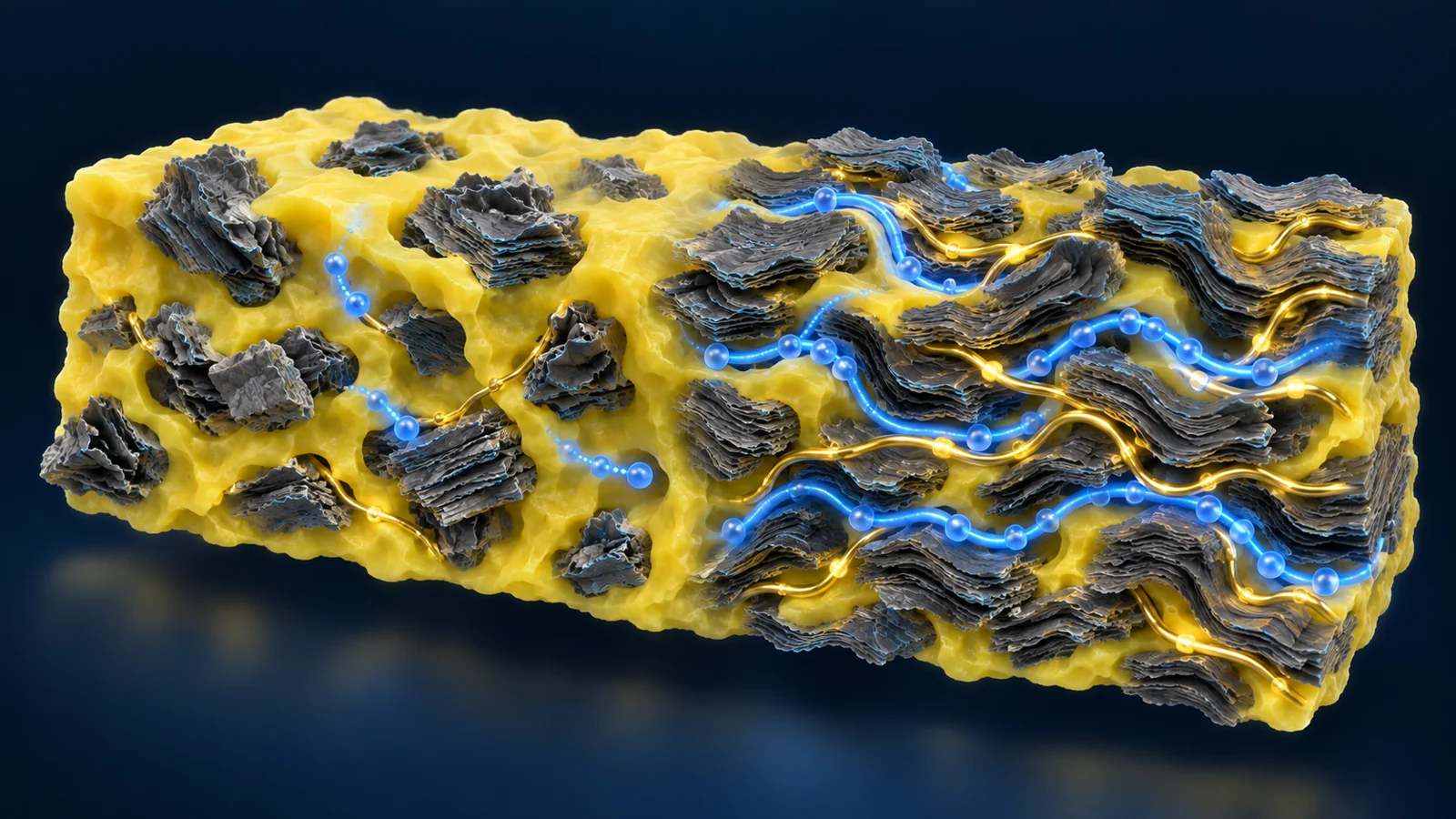
A February 20, 2024 research article addresses that problem through the structure of the sulfur composite, rather than by treating the conducting ingredient as a simple additive. The researchers combined sulfur with molybdenum disulfide, or MoS₂, nanoparticles in a flower-shaped material intended to keep ionic and electronic routes available through the cathode, the battery’s positive electrode.
Why adding a host material is not enough
MoS₂ nanoparticles are useful in the proposed design because the researchers describe them as capable of co-conducting lithium ions and electrons. Their large surface area also gives sulfur more of a host structure to contact. But that potential can be lost during preparation.
The abstract points to a physical problem with the particles themselves. As the MoS₂ nanoparticles crumple while they are mixed and impregnated with sulfur, they can become surrounded by sulfur. That can isolate parts of the host from the wider electrode, creating a material that contains conducting particles without preserving a continuous route through the composite.
This is why “add a conductor” is not a complete electrode strategy. The conducting phase has to remain positioned so that ions and electrons can reach the sulfur and then move onward through the electrode. The arrangement of the ingredients becomes part of the battery’s function.
The preparation sequence builds a more uniform composite
The reported intervention used two linked steps. First, the researchers mildly milled the MoS₂ nanoparticles together with sulfur. They then applied melt diffusion to generate a more uniform MoS₂/sulfur composite.
The order matters to the proposed solution. Milling changes how the two ingredients are combined before the heating-based diffusion step acts on the mixture. The resulting flower-shaped composite is intended to avoid the isolated pockets that can form when sulfur simply surrounds crumpled host particles. In this design, the host is not only present; it is arranged to support interconnected pathways for both lithium-ion and electron transport.
That emphasis shifts attention from the intrinsic properties of MoS₂ alone to the finished electrode architecture. A promising host material still needs a preparation route that lets its transport functions remain useful inside a sulfur-rich cathode.
What the cycling result actually tells us
The researchers report that an all-solid-state lithium-sulfur battery using the composite and the sulfide solid electrolyte Li₆PS₅Cl operated stably for more than 1,000 cycles. They also report Coulombic efficiency of nearly 100%.
Those figures answer different questions. The cycle count indicates that the assembled battery continued operating through a long sequence of charge and discharge events under the reported test conditions. Coulombic efficiency compares the amount of charge put into the battery with the amount returned. A value close to 100% indicates that, by this charge accounting, very little charge was lost from one cycle to the next.
Neither number should be read as a claim that the battery retained nearly all of its original capacity. A cell can return a similar fraction of the charge it accepts while its available capacity changes over time. Coulombic efficiency also does not equal energy efficiency, which would depend on the voltage at which charge is stored and released. The result is therefore meaningful evidence of sustained cycling behavior, but it is not a complete measure of practical battery performance.
The remaining distance to usable energy
A practical battery must deliver a useful amount of energy, not only continue cycling. The reported result alone cannot establish how much energy this electrode would provide in a practical cell, because that depends on how much sulfur contributes under the relevant loading and cell conditions. The supplied abstract also does not provide the detailed testing context needed to characterize those questions here.
That boundary does not erase the significance of the preparation method. It identifies what the cycling result can support: a composite design that was associated with extended operation and near-complete charge return in the reported battery. It does not yet turn those observations into a claim about commercial-scale storage, manufacturing readiness, or a particular deployed device.
What this could change
If the composite preserves useful lithium-ion and electron transport at practical sulfur loading and cell conditions, battery designers could make more of sulfur’s active material participate in repeated charge delivery. That would give sulfur-based electrodes a better chance of combining their high-energy promise with the durability required for useful storage.
The prospective capability is not simply to include a conducting host. It is to build the cathode so that the host, electrolyte, and sulfur remain functionally connected as the battery cycles. If that structural approach holds up beyond the reported result, it could help guide the development of more durable all-solid-state lithium-sulfur batteries without promising a specific product or deployment.
Key Sources
- Primary source: Constructing the Interconnected Charge Transfer Pathways in Sulfur Composite Cathode for All-Solid-State Lithium-Sulfur Batteries.
DOI or Journal Page · Peer-Reviewed Paper · 2024-02-20