
Since the previous research note · Earlier expectation not tested
Track continuity
Since the previous research note: How material placement could reshape a battery’s positive electrode
Previous expectation: Layered positive electrodes could provide more usable energy under demanding operation if their advantages survive fabrication and complete-cell use.
What this study adds: The current source supplies an atomistic mechanism for reaction-layer growth at a lithium-metal/solid-electrolyte contact, including a disordered intermediate and subsequent crystallization into a solid solution. It does not test the earlier positive-electrode architecture forecast.
What changed in this study
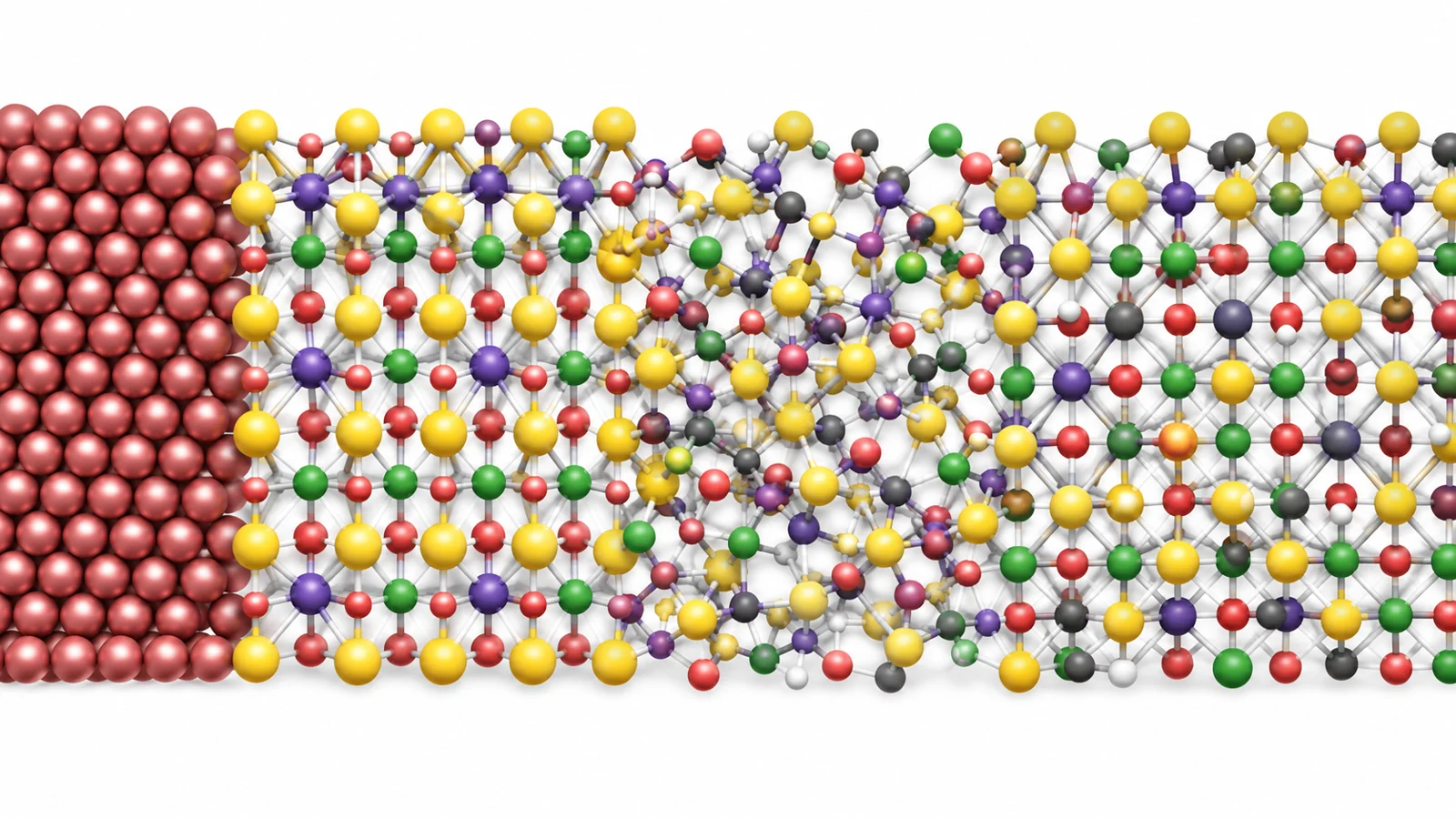
At the boundary between lithium metal and a solid electrolyte, the two materials do not simply remain as they were. Chemical reactions create a solid electrolyte interphase, or SEI, the reaction region that develops between them. Its structure matters because it becomes part of the contact through which lithium must move, yet the way that structure forms is difficult to observe atom by atom.
A February 6, 2024 arXiv preprint, Two-step growth mechanism of the solid electrolyte interphase in argyrodyte/Li-metal contacts, examines that question with an atomistic simulation of lithium metal touching Li₆PS₅Cl, an argyrodite solid electrolyte. The reported result is a sequence rather than an instant endpoint. The electrolyte first reacts into a disordered amorphous region. The products then crystallize more slowly into a mixed solid solution.
That distinction changes how the growing layer should be understood. A final snapshot can show what compounds are present, but it may not reveal the route by which the contact reached that state.
At the lithium contact, a layer is still forming
The study focuses on Li₆PS₅Cl in contact with metal lithium. In this setting, the electrolyte is reduced by lithium, producing the material that becomes the interphase. The central question is not only which chemical products appear. It is how the arrangement develops while the reaction proceeds.
Many descriptions of interphase growth are tested against the way measured thickness changes over time. The preprint notes that models built on different, mutually incompatible assumptions can nevertheless reproduce reported thickness trends when they contain adjustable parameters. Matching a curve is useful, but it can leave the underlying atomic pathway unresolved. Several distinct processes may produce a similar-looking increase in thickness.
The simulation approaches the problem differently by following atomic rearrangements directly. The calculation uses machine-learning interatomic potentials trained on first-principles calculations. That combination is intended to retain an atom-level description while reaching a size and duration beyond what conventional first-principles molecular dynamics could normally handle. The abstract describes more than 30,000 atoms simulated over 10 nanoseconds.
The value of that scale is explanatory. It gives the calculation enough room and time to represent a developing reaction region rather than treating the interface only as a fixed starting boundary or reducing its evolution to a fitted parameter.
The first transformation leaves an amorphous region
The reported sequence begins when lithium reduces the argyrodite. The initial reaction produces an amorphous phase. In plain terms, the atoms in this region do not yet have the repeating long-range order associated with a crystal.
This is more than a temporary change in appearance. It places the reaction on an indirect route. The electrolyte does not move straight from its original crystalline structure to the final crystalline products in one completed step. It passes through a metastable, overlithiated state that is less ordered before the reaction products settle into a more stable arrangement. The authors interpret their simulation as supporting an earlier experimentally motivated hypothesis of that kind of indirect reduction.
The timing of the two processes is also important. The chemical reaction that creates the amorphous region occurs first, while crystallization of the reaction products is kinetically slower. “Kinetically slower” describes the pace of the transformation, not a claim that the final layer is automatically better or worse for a battery. It indicates that chemical conversion and structural ordering are separate parts of the layer’s history.
That history could matter when researchers try to connect interphase composition with its later behavior. A layer that looks chemically complete may still be changing structurally, and a disordered intermediate may be the stage through which the eventual product arrangement becomes possible.
The products form a mixed crystal
The final structure in the simulation is not a set of separate crystalline bands, one made of lithium sulfide, another of lithium phosphide and another of lithium chloride. Instead, the reported crystalline products form a 5Li₂S·Li₃P·LiCl solid solution.
A solid solution is a shared crystal structure in which different chemical constituents occupy the same overall crystalline phase. That is a more specific structural description than simply listing Li₂S, Li₃P and LiCl as products. The list identifies chemical ingredients; the solid-solution description also tells us how those ingredients are arranged relative to one another.
This distinction is one reason the growth pathway matters. If the layer were represented only by its eventual chemical formula or by a catalogue of products, the amorphous stage and the later ordering process could disappear from view. The simulation instead connects the final mixed arrangement to the preceding reduction and crystallization steps.
The result also illustrates why interphase design cannot be reduced to asking whether a reaction has occurred. Researchers may need to distinguish among the starting electrolyte, a disordered reaction region and an ordered product phase, while recognizing that the transition between them is part of the material’s identity.
A mechanism is not yet a battery-performance result
The preprint gives a detailed result for one simulated material pairing: Li₆PS₅Cl and lithium metal. Its scale and duration make the calculation more informative about atomic evolution, but they also define the scope of what can be concluded from it.
The described pathway does not establish that every lithium-metal/solid-electrolyte contact follows the same sequence. Nor does it establish that the resulting solid solution is protective, sufficiently ion-conducting or mechanically stable during battery operation. The findings do not by themselves demonstrate longer cycle life, faster charging, greater energy density, improved safety or commercial readiness.
The agreement with an experimentally motivated hypothesis should be read in the same careful way. It supports the interpretation that reduction can proceed indirectly through an overlithiated intermediate, but it is not direct experimental observation of the simulation’s entire trajectory. The study’s contribution is the atomistic account of how this particular contact evolves in the modeled conditions.
That is still a meaningful advance in the question being asked. Instead of treating interphase thickness as the main observable, the work supplies a possible sequence linking chemical reaction, loss of long-range order and subsequent crystallization. Further confidence would require testing how robust that sequence is across contact configurations and other solid electrolytes, as well as determining how the resulting structures behave in operating cells.
What this could change
If large-scale atomistic simulations can continue to predict contact evolution that is relevant to experiments, battery-material and interface designers could gain a more precise way to control reactions where lithium metal meets a solid electrolyte. They could use the distinction between the early amorphous region and the later mixed crystal to search for compositions or processing conditions that limit damaging reactions while preserving useful lithium transport.
The potential payoff is conditional. The simulated mechanism must hold up across relevant materials, and the resulting interphases must prove compatible with the mechanical and transport demands of a working cell. If those steps succeed, understanding how the layer forms—not only what it contains—could help guide more durable lithium-metal/solid-electrolyte contacts and, in turn, longer-lasting solid-state batteries.
Key Sources
- Primary source: Two-step growth mechanism of the solid electrolyte interphase in argyrodyte/Li-metal contacts
arXiv · Preprint · 2024-02-06