
Since the previous research note · Earlier expectation not tested
Track continuity
Since the previous research note: How removing lithium changes sulfur bonds in a solid electrolyte
Previous expectation: Spectral signs of sulfur-bond changes might help developers screen electrolytes and design interfaces that preserve ion-conducting contact during cycling.
What this study adds: This preprint compares cathode architectures in simulations, finding limited benefit from electrolyte channels and a promising arrangement with more electrolyte near the separator and more active material near the current collector. It adds an electrode-layout milestone without testing the earlier spectral-screening or degradation forecast.
What changed in this study
A battery electrode does not have to be arranged uniformly from one side to the other. A new simulation study asks whether changing where the active material and electrolyte sit inside the positive electrode, or cathode, could make an all-solid-state battery work better under demanding conditions.
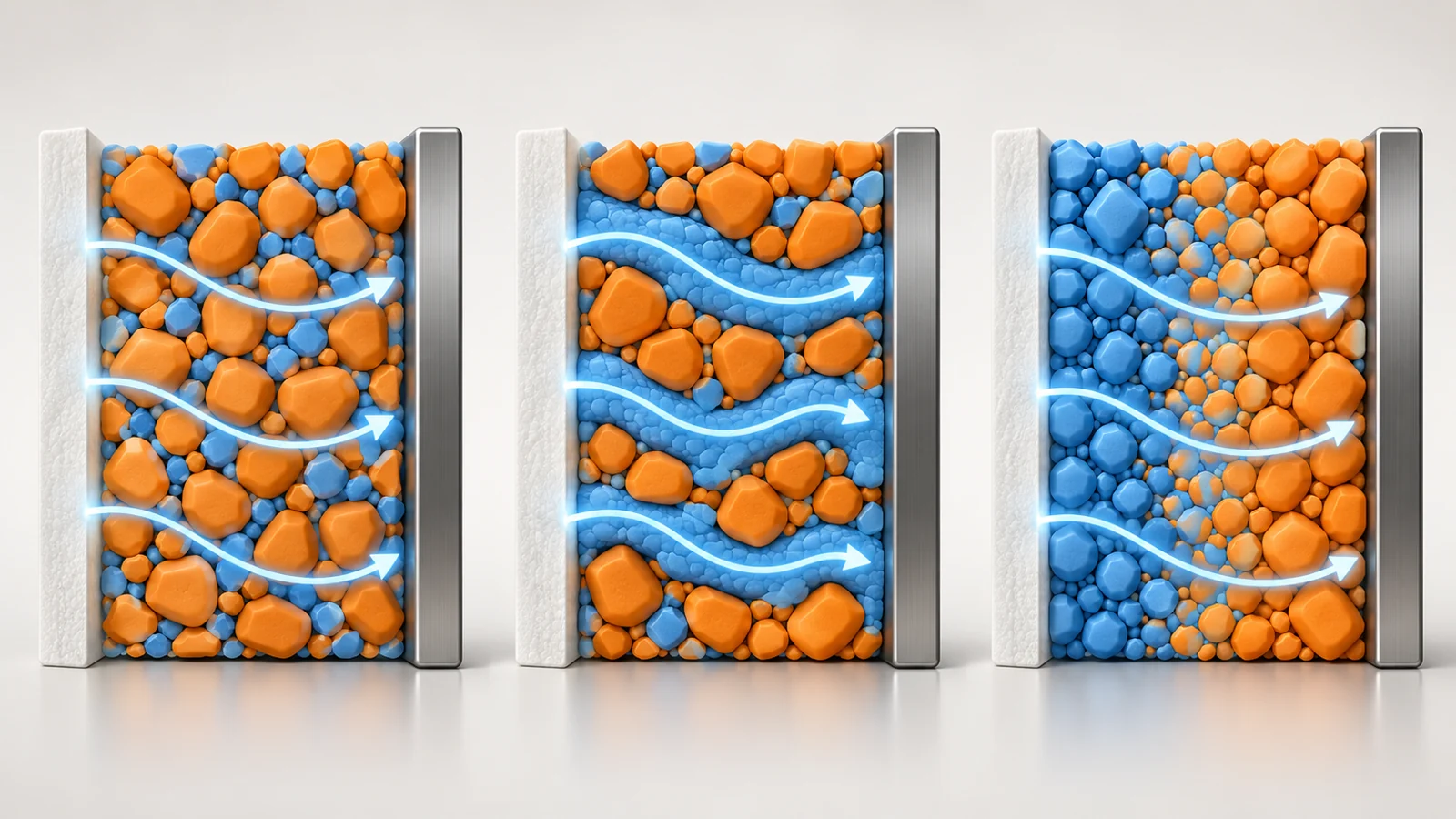
The comparison produces an unexpected result. Electrolyte-filled channels make ion transport easier, but they do not significantly improve the tested solid-state designs overall. A two-layer arrangement looks more promising because it places more solid electrolyte near the separator and more active material near the current collector. The difference is a reminder that improving one part of an electrode can help only if the rest of the structure can make use of that improvement.
The surprising comparison starts in a virtual cathode
The work appeared as an October 30, 2023 arXiv v1 preprint and uses structure-resolved electrochemical simulations rather than manufactured cells. The researchers generated three-dimensional virtual cathode microstructures and compared an unstructured design with perforated and layered alternatives.
The virtual structures were based on a stochastic three-dimensional generator calibrated to the microstructure of conventional liquid-electrolyte battery cathodes. The same generated cathode structures were used for the liquid-electrolyte reference case and the all-solid-state case. Keeping the underlying geometry consistent makes the comparison more focused: differences in the simulated response are connected to the electrolyte setting and the deliberate electrode layout, rather than to an entirely different starting shape.
The solid-state model used NMC811 as the active material and Li6PS5Cl as the solid electrolyte. It also treated the solid-state electrode as binder-free, with the separator represented as solid electrolyte. The material parameters came from the literature and were used within the study’s electrochemical model. These choices create a defined test bed for asking how geometry affects transport and active-material use.
A channel improves one thing by giving up another
The appeal of a channel is straightforward. A solid electrolyte pathway running through a composite cathode can offer ions a less obstructed route. In the simulations, increasing the channel radius raised the effective ionic conductivity by reducing the difficulty of transport through the electrolyte phase.
But the channel occupies space that could otherwise contain active material. As the channels became wider, the theoretical capacity fell. For the largest channel radius examined in the relevant comparison, the theoretical capacity dropped to 72 percent of the unstructured cathode’s value, even as effective ionic conductivity increased.
That tradeoff matters because better ion transport is an intermediate improvement, not a guarantee of higher cell performance. If a design carries ions more easily but stores less charge, the transport gain has to compensate for the lost active material. In the reported solid-state comparison, electrolyte-filled channels did not produce a significant overall performance increase over unstructured electrodes.
The result does not make channels universally ineffective. It shows that the channel designs tested here did not convert their conductivity advantage into a comparable net benefit under the modeled conditions. A strategy that works well in a liquid-electrolyte reference design therefore cannot be assumed to transfer directly to a solid-state cathode.
Layering changes where each material does the work
The two-layer concept approaches the same constraint from a different direction. Instead of distributing electrolyte channels through the whole cathode, it changes the composition across the electrode thickness. The side near the separator contains a higher fraction of solid electrolyte, while the side near the current collector contains a higher fraction of active material.
This arrangement gives the separator-side region more electrolyte to support ionic movement, while preserving a heavily loaded region where the current collector gathers electronic current from the cathode. In the model, that spatial division can balance transport with active-material loading more effectively than simply cutting pathways through a uniform structure.
The useful balance depends on how hard the electrode is being driven. Active-material utilization is shaped by both charge-transfer kinetics and ionic transport. At higher current density, utilization falls more noticeably across the cathode because ions have less time to reach and react throughout its thickness. The two layers do not therefore behave as interchangeable blocks; their position changes how much of the active material can participate.
At 8 mA/cm², one of the tested layered configurations produced higher capacity than alternatives despite having lower active-material loading. The modeled advantage came from better utilization of the material that was present. That is the central distinction from the channel result: the layered design changes the location of the tradeoff so that transport support is concentrated where it can help the rest of the electrode remain useful under load.
The finding is a design opportunity, not a universal recipe. The study does not establish one layer ratio that will be best for every solid electrolyte, cathode thickness, current density or manufacturing process. It does show why the position of a material inside an electrode can matter as much as its total fraction.
The model is informative but not a finished battery
The simulations travel beyond a simple cartoon of a battery, but they remain a model comparison. They resolve virtual cathode structures, use specified active and electrolyte materials, and calculate how transport and utilization vary through the electrode. That makes them useful for separating geometric effects and identifying designs worth testing.
The energy-density calculation has a narrower accounting boundary than a complete battery specification. It assumes ideal matching between the negative and positive electrodes and excludes the mass of current collectors and the cell housing. Its values therefore describe the modeled electrode-level comparison under those assumptions, not the energy density of a finished cell or battery pack.
Practical performance would also depend on whether a layered structure could be manufactured with its intended composition and contact quality intact. The reported simulations do not establish production scalability, cycling durability, safety improvement or commercial readiness. Nor do they establish how the tested geometry would behave across all solid electrolytes, materials and operating conditions. Those questions become important precisely because the proposed benefit depends on maintaining both transport and useful active-material loading in a real structure.
This study also addresses a different question from research into chemical signatures at battery interfaces. It does not test whether sulfur-bond spectral changes predict interface degradation. Its contribution is an electrode-layout comparison: where the materials sit, and how that placement affects simulated utilization and transport.
What this could change
If the layered advantage survives fabrication and complete-cell operation, electrode architecture could give compact battery-powered equipment more usable stored energy during demanding operation without relying only on adding more active material. The potential benefit would come from keeping a larger share of the existing cathode electrochemically useful when current is high.
That outcome remains conditional. A practical cell would need to preserve solid-electrolyte contact, maintain the intended layer composition and retain enough active material to store substantial energy. If those requirements can be met together, the result points toward a more targeted way to design solid-state cathodes: place each component where its contribution is most valuable, rather than assuming that a uniform structure or an evenly distributed network of channels is the best compromise.
Key Sources
- Primary source: Influence of Electrode Structuring Techniques on the Performance of All-Solid-State Batteries
arXiv · Preprint · 2023-10-30