
Since the previous research note · Earlier expectation not tested
Track continuity
Since the previous research note: How a battery’s positive electrode can swell, open gaps and retain contact
Previous expectation: Matching electrolyte mechanical behavior and applied pressure to a composite cathode could permit more energy-storing material while controlling damage, if electrochemical function is preserved.
What this study adds: This preprint reports a conductivity maximum in a germanium-containing ceramic series with varying tantalum, together with structural observations and reported stability after five months in air. It addresses electrolyte transport and material preparation rather than testing cathode deformation, loading or pressure.
What changed in this study
A solid electrolyte is the battery material that carries lithium ions between electrodes without being a liquid. Its job is simple to describe but difficult to optimize: ions must move through a solid quickly enough for the material to be useful, while the ceramic must also be made into a dense, stable layer.
An August 15, 2023 arXiv preprint reports one attempt to tune that balance in a garnet-structured ceramic called lithium lanthanum zirconium oxide, or LLZO. The researchers kept the nominal germanium content fixed and varied the tantalum content across five formulations. The best result came neither from the lowest nor the highest tantalum level, but from the middle of the tested range.
A solid battery layer has one basic job
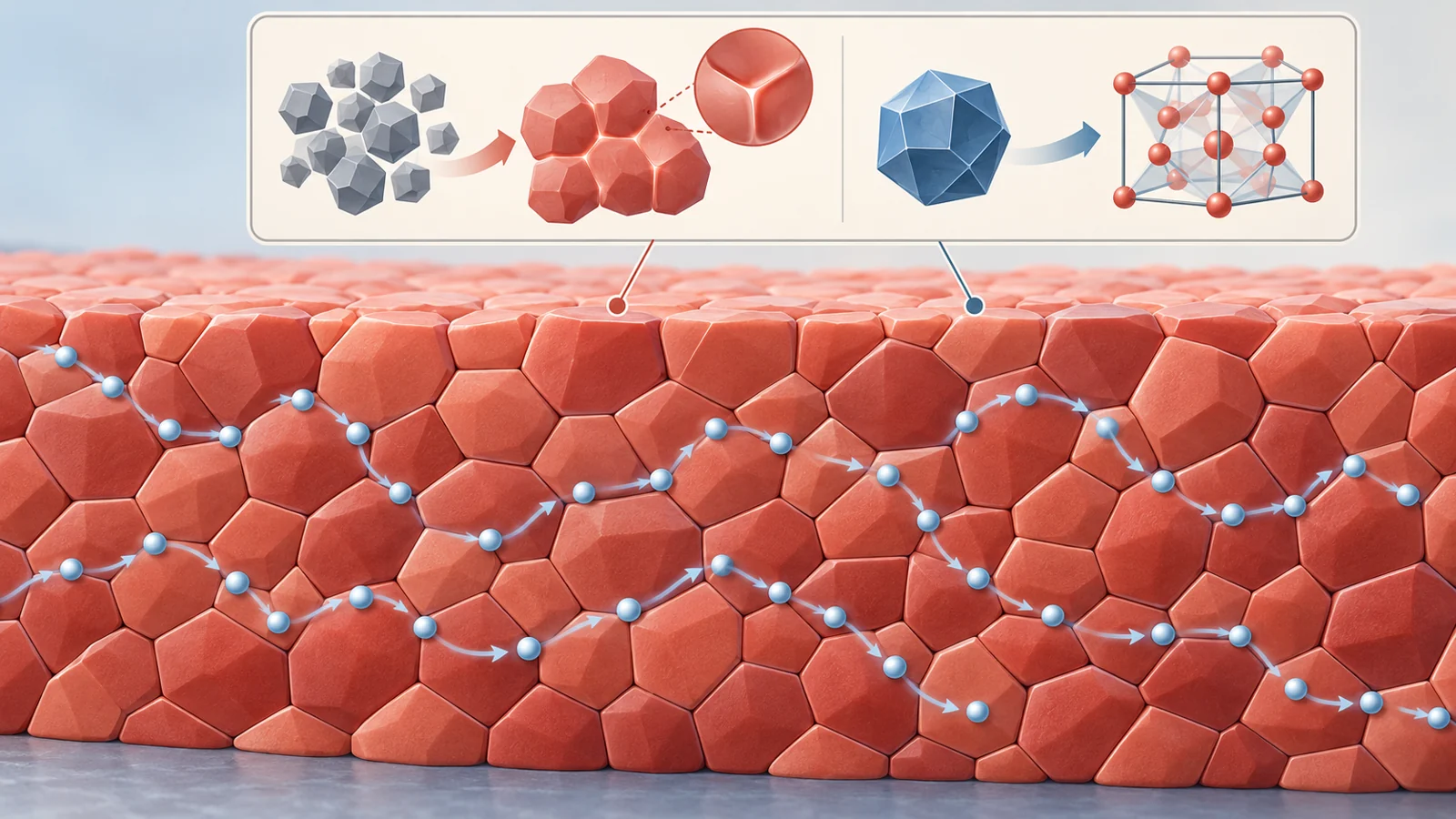
In a conventional liquid-electrolyte battery, lithium ions travel through a liquid between the electrodes. An all-solid-state battery instead aims to use a solid ion-conducting layer. For that layer to function, lithium ions need a pathway through the ceramic’s crystal structure and between the microscopic grains that make up a sintered sample.
The conductivity measurement describes how readily charge is carried through the prepared material. It is not a direct measurement of charging speed, battery capacity or the performance of a complete cell. Those outcomes also depend on how the electrolyte is fabricated, joined to electrodes and operated under practical conditions.
The preprint focuses on the material-level question first: can a particular ceramic composition transport lithium ions effectively at room temperature?
The strongest result came from the middle tantalum recipe
The researchers synthesized the series Li₆.₈−yGe₀.₀₅La₃Zr₂−yTaᵧO₁₂ with y set to 0, 0.15, 0.25, 0.35 and 0.45. Germanium stayed at the same nominal level while tantalum varied. Here, y is a composition coefficient in the chemical formula. A value of 0.25 does not mean that 25 percent of the ceramic is tantalum.
Among these five tested formulations, the y = 0.25 ceramic reached the highest reported ionic conductivity: 6.61 × 10⁻⁴ S/cm at 25 °C. The sample was sintered at 1050 °C for 7.30 hours, and its reported minimum activation energy was 0.25 eV. Activation energy here indicates how strongly the measured transport changes with temperature; the lower value was associated with the sample that produced the highest conductivity in this series.
That pattern matters because it shows the value of searching across a composition range rather than assuming that adding more of one element will continually improve transport. The result is an optimum within these five nominal recipes and their preparation conditions. It is not a universal optimum for every LLZO ceramic, processing schedule or solid electrolyte.
The experiment also does not independently separate germanium’s contribution from tantalum’s. Because the germanium level was held fixed while tantalum changed, the comparison identifies how this co-doped series behaved as tantalum content varied. It does not, by itself, prove that the two additives produce a distinct synergistic effect.
The crystal structure changes how the result is read
X-ray diffraction indicated that the samples were dominated by a cubic phase, the crystal arrangement associated in the study with high lithium-ion conduction. Put plainly, the atoms in the ceramic were arranged mainly in a three-dimensional structure that the researchers considered favorable for ion transport.
Microscopy supplied a different piece of information. In the highlighted y = 0.25 sample, neighboring grains appeared well connected, and the sample’s density measurements were consistent with a relatively dense ceramic. A ceramic is built from many microscopic grains, so the quality of contact between those grains can affect whether an ion-conducting path remains continuous across the material. Large amounts of pore space can interrupt that path; connected grains provide a more continuous solid network.
The authors interpret the preparation this way: germanium acts as a sintering aid, helping the ceramic densify during heating, while tantalum helps stabilize the cubic phase. That division of roles is a plausible explanation tied to the study’s structural observations, but it remains an interpretation of the observed composition, diffraction and microscopy results. The measurements show the material’s phase and grain structure alongside its conductivity; they do not isolate every step of the causal chain.
This distinction is useful. A conductivity number does not stand alone as a property of a chemical formula. It belongs to a particular composition, ceramic microstructure and thermal treatment.
Air exposure tests a different kind of usefulness
The researchers also examined the y = 0.25 ceramic after exposure to air for five months and reported that its ionic conductivity remained stable. That observation addresses a practical question separate from the room-temperature measurement: can the prepared ceramic retain the reported behavior during a period of ambient handling?
The result makes the material easier to think about as something that could be processed and stored outside a perfectly controlled atmosphere. It does not establish universal ambient stability, a retention percentage for every sample or a battery service lifetime. Exposure behavior can depend on the material, its surface condition and the way it is incorporated into a device, so the reported five-month observation should remain attached to this ceramic and this study.
The current confirms that ions carried most of the measured conduction
The preprint reports direct-current measurements made with a constant voltage applied to silver electrodes. These measurements were used to confirm that the conduction across the ceramic was predominantly ionic rather than mainly electronic.
That is an important identification step. A solid electrolyte is useful because lithium ions, not a large electronic current through the separator, are supposed to carry charge between the battery’s electrodes. Together with the conductivity and activation-energy results, the DC measurements support the interpretation that the prepared ceramics were conducting lithium ions in the reported tests.
Even so, the evidence remains at the prepared-material level. It does not show how the ceramic behaves after contact with a particular cathode or anode, under the pressure of an assembled cell, during repeated cycling or in a manufacturing process. Nor does it establish a numerical advantage over a specified liquid electrolyte or another independently verified baseline.
What this could change
If the composition and processing result can be reproduced and the ceramic continues to perform after fabrication and electrode integration, battery developers could gain a solid electrolyte layer that transports lithium ions at room temperature while tolerating some ambient handling. That combination could make an ion-conducting ceramic easier to fabricate, store and integrate into an all-solid-state cell.
The practical payoff is conditional. The conductivity belongs to a particular germanium-containing, tantalum-varied ceramic series, and the reported air-exposure observation concerns the highlighted sample. Before the material could support a working battery design, its performance would need to survive the physical steps of making a layer, joining it to electrodes and operating the assembled cell.
Key Sources
- Primary source: Enhancement in Li-ion Conductivity through Co-doping of Ge and Ta in Garnet Li$_7$La$_3$Zr$_2$O$_{12}$ Solid Electrolyte
arXiv · Preprint · 2023-08-15