
Since the previous research note · Earlier expectation not tested
Track continuity
Since the previous research note: How researchers narrow the search for solid-state battery coatings
Previous expectation: Screened coatings could become useful bridges between solid electrolytes and electrodes if their adhesion, compatibility and lithium transport survive working-cell conditions.
What this study adds: This report examines a different route, combining a self-healing polymer with direct-cast electrode integration and reporting contact imaging alongside symmetric-cell and lithium–sulfur cycling. It adds an experimental interface-engineering example without testing the earlier coating-screening forecast.
What changed in this study
Solid-state batteries replace a liquid pathway with a solid electrolyte, but that creates a demanding boundary: the electrode and electrolyte must stay in close contact while the cell operates. The researchers behind a May 30, 2023 version 1 report set out to address that interface with a polymer designed to repair its own internal connections.
The report combines that material with a direct-cast battery construction. It describes more than 6,000 hours in lithium–lithium symmetric cells and 700 cycles in complete solid-state lithium–sulfur cells. Those figures are notable, but they describe two different tests and do not amount to a commercial battery lifetime.
Why the interface matters
Ion transfer between an electrode and the solid electrolyte depends on contact at their interface. The report identifies limited ion conductivity, high electrode–electrolyte interfacial resistance and uncontrolled lithium dendrite growth as central obstacles for solid-state lithium-metal batteries. Keeping the boundary intact is therefore part of making the materials work together, not merely a packaging detail.
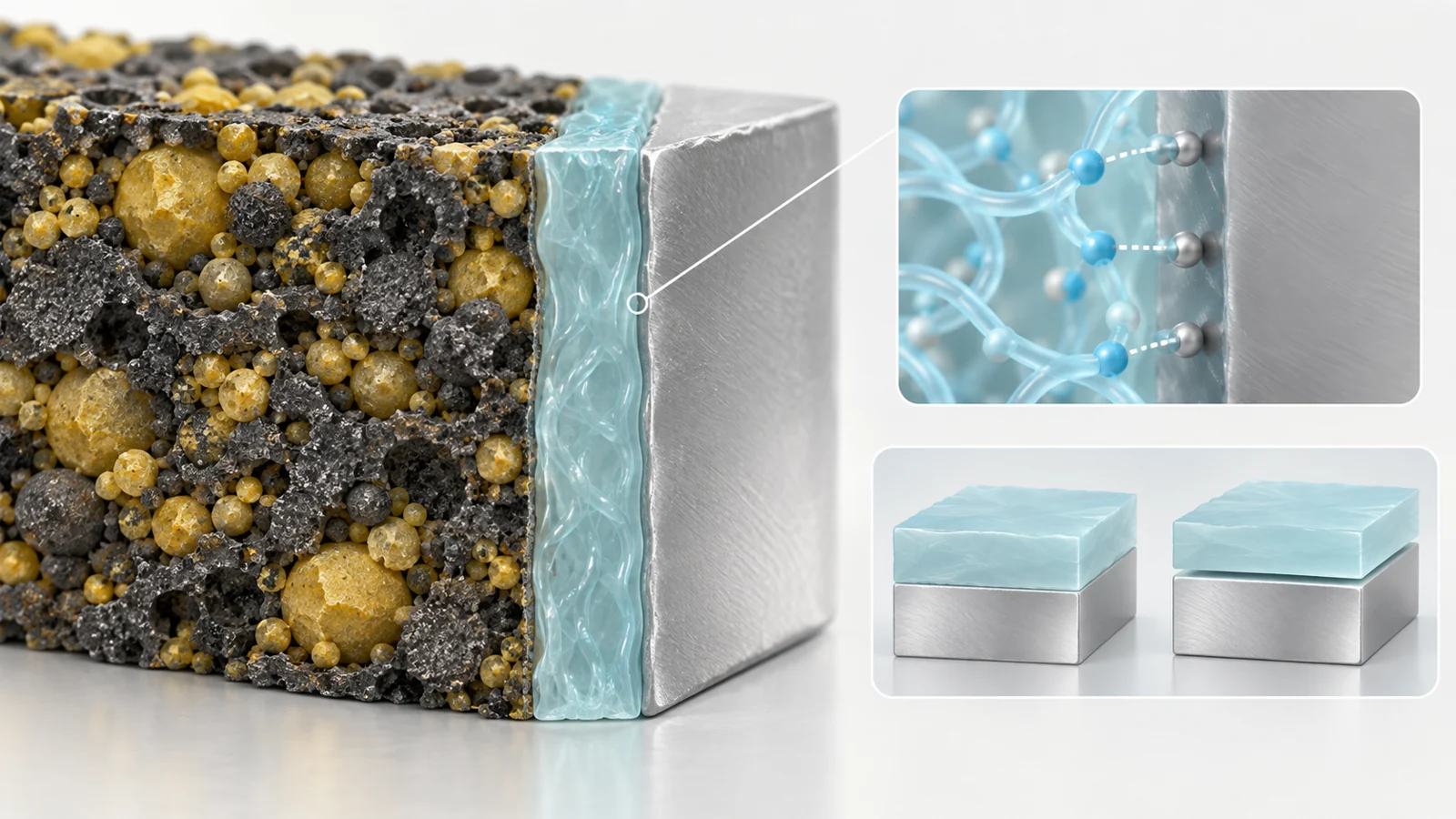
The proposed electrolyte is a poly(ether-urethane) solid polymer electrolyte. Its suggested self-healing behavior comes from two kinds of chemical interaction: dynamic covalent disulfide bonds that can rearrange, and hydrogen bonds between urethane groups. In the authors’ account, those interactions help the electrolyte maintain contact with both electrodes over cycling.
That is a narrower claim than saying the whole battery heals after damage. Here, self-healing refers to the behavior designed into the polymer at the electrode–electrolyte boundary.
The material is placed directly against the electrodes
Rather than preparing separate layers and joining them later, the researchers cast the polymer electrolyte directly onto sulfur-based cathodes and lithium-metal anodes. The resulting integrated electrolyte–electrode structures were then assembled into cells.
This construction changes where the interface is formed. A traditionally laminated cell brings already-made components together. Direct casting allows the polymer to form against each electrode during preparation, while its dynamic bonds are intended to help preserve that contact during operation.
The report also uses ultrasound imaging to compare the two arrangements. The abstract says the integrated structures showed better interfacial contact than traditionally laminated ones. That imaging matters because it supplies a physical comparison alongside the electrical cycling results. It does not, by itself, show how much of the later endurance came from the polymer chemistry and how much came from the direct-cast construction.
The headline numbers come from different cells
The more than 6,000-hour result belongs to lithium–lithium symmetric cells. These cells contain lithium on both sides and are useful for studying how a lithium-facing electrolyte interface behaves under repeated operation. They are not complete lithium–sulfur batteries, so the number should not be read as evidence that a full battery delivered power for more than 6,000 hours.
The separate lithium–sulfur result is 700 cycles. That test combines the solid polymer electrolyte with a sulfur-based cathode and a lithium-metal anode, making it more representative of the report’s intended full-cell pairing. The authors also describe good rate performance, although the abstract does not provide a retained-capacity percentage at cycle 700 or a practical service-life estimate.
The distinction changes how the results should be read. The symmetric-cell result shows prolonged operation in a lithium-only configuration. The full-cell result shows that the integrated approach was cycled in a solid-state lithium–sulfur battery for 700 cycles. Neither figure alone establishes how the cell would perform in an application with a specified power demand, capacity requirement or operating schedule.
Endurance is promising but attribution remains open
The experiment joins two interventions: a polymer with proposed self-healing chemistry and an integrated method for placing that polymer against the electrodes. The evidence summarized here does not separate their contributions quantitatively. A long test therefore supports the durability of the combined design, rather than proving that bond rearrangement alone produced the result.
The same caution applies to broader battery claims. The report does not establish elimination of lithium dendrites, quantified safety gains or achieved energy density in the supplied evidence. Nor does a 700-cycle count establish production-scale repeatability, manufacturing economics or deployment readiness. The authors present mass production as a possible extension of the approach, not as an outcome already demonstrated.
That leaves the central advance in a useful middle ground. The study offers an experimental example of treating the electrode–electrolyte boundary as an active materials problem. It pairs a chemical design intended to preserve contact with a manufacturing step that forms the interface directly, then checks the resulting structure with imaging and cycling tests.
What this could change
If the combined design continues to perform under broader working-cell conditions, a polymer that can rearrange its connections could help solid-state lithium–sulfur batteries keep usable contact between their electrodes and electrolyte for longer periods. Direct casting could also provide a route toward assembling those interfaces as part of the electrode-making process rather than relying only on later lamination.
That conditional capability would matter because it links durability with manufacturability. A lithium–sulfur cell that maintains its interfaces through repeated use could make the high-capacity sulfur and lithium-metal pairing more practical to develop. The 2023 report does not establish that endpoint, but it shows one way researchers were trying to move the interface from a passive seam to a material that can help preserve the cell’s structure.
Key Sources
- Primary source: Interfacial self-healing polymer electrolytes for ultralong-life solid-state lithium-sulfur batteries
DOI or Journal Page · Peer-Reviewed Paper · 2023-05-30