
Since the previous research note · Earlier expectation not tested
Track continuity
Since the previous research note: How magnesium fluoride changed sodium transport in a ceramic
Previous expectation: A reproducible magnesium fluoride preparation effect could yield a sodium ceramic electrolyte with better ion transport and sustained sodium-metal operation if it remained useful with compatible electrodes.
What this study adds: The current lithium-battery perspective introduces a separate materials-design direction based on twinned ceramic microstructures and mobile twin boundaries. It addresses mechanical accommodation rather than testing the earlier sodium-electrolyte preparation effect.
What changed in this study
Solid electrolytes promise a battery architecture in which the ion-conducting material is solid rather than liquid. Yet a ceramic can be chemically attractive and still be mechanically vulnerable. Repeated charging changes the stresses inside a cell, and a brittle electrolyte has to remain intact while staying in contact with neighboring materials.
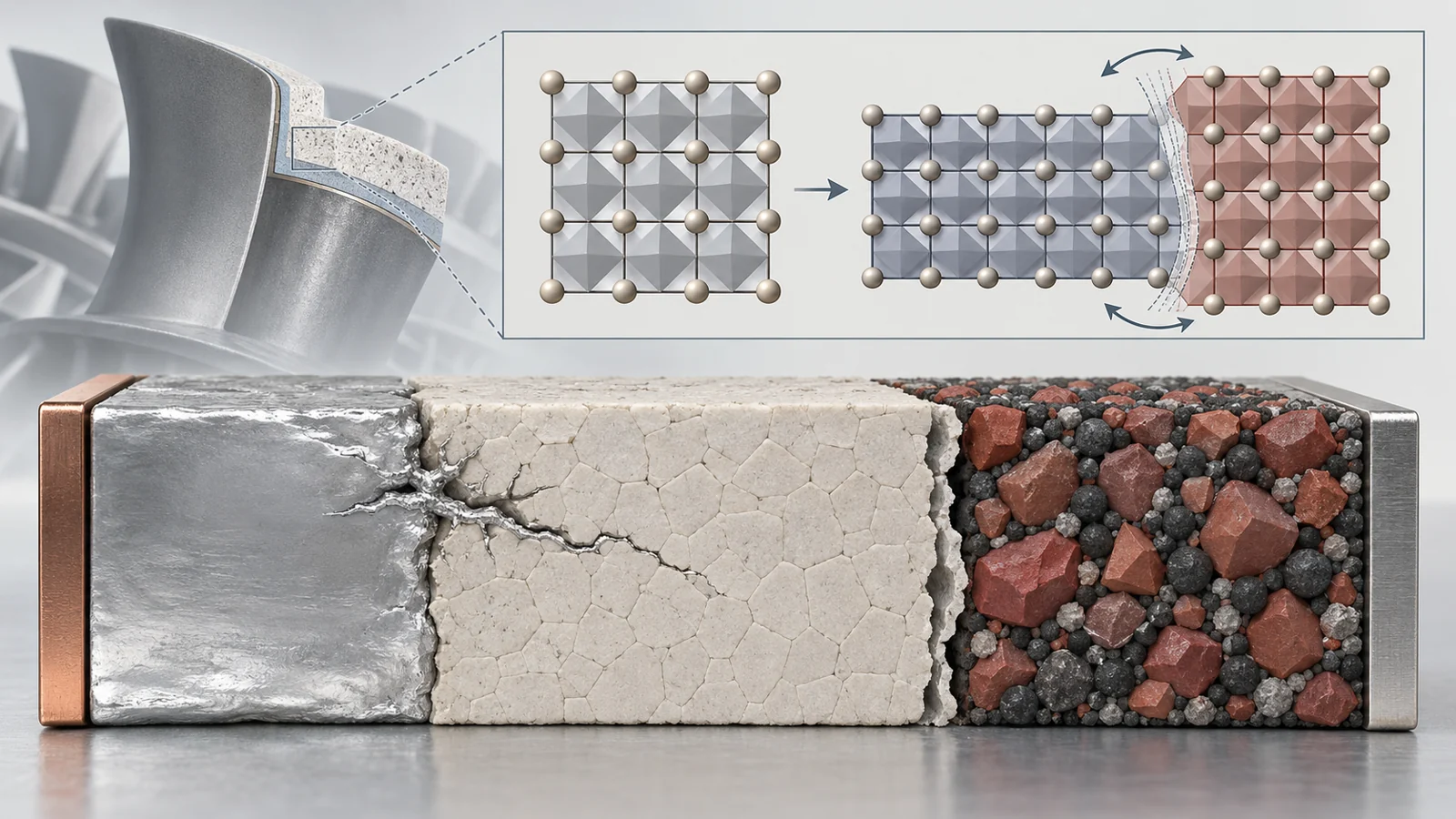
A February 18, 2023 arXiv preprint presents a perspective on one possible answer: design ceramic electrolytes with ferroelastic or transformation-toughening behavior. The idea borrows from ceramic thermal-barrier coatings used on superalloy turbine blades, but the proposed battery application remains a materials strategy rather than a demonstrated performance result.
The mechanical problem is not one problem
The perspective separates two ways a solid electrolyte can lose its usefulness during battery operation. At the lithium-metal anode, dendrite growth can be associated with crack propagation through the ceramic. At the other side of the electrolyte, changes in the cathode lattice during charging and discharge can promote debonding at the cathode–electrolyte interface.
Those failure routes are related because both involve mechanical stress, but they are not identical. One concerns a crack advancing through the electrolyte; the other concerns contact being lost between two solid materials. A design that helps accommodate stress might therefore be relevant to both, while solving neither automatically.
This is why the authors focus on toughness as a property of the material’s internal structure. Their question is not simply whether a ceramic can conduct lithium ions. It is whether the same ceramic can rearrange some of its crystal regions under stress instead of allowing a damaging stress concentration to keep driving a crack or separating an interface.
A lesson from turbine coatings
The cross-field comparison comes from aerospace materials. Thermal-barrier coatings on turbine blades face repeated stress as temperatures change substantially. According to the perspective, engineers addressed a similar mechanical challenge by exploiting ferroelastic and transformation-toughening mechanisms in ceramics.
The relevance is the underlying design logic. A material can be made more tolerant of cyclic loading when parts of its crystal structure are able to change orientation or transform in a controlled way. That does not mean a battery electrolyte experiences the same temperatures or stresses as a turbine coating. It means the coating precedent offers a useful example of how ceramic design can move beyond treating brittleness as an unchangeable feature.
Transferring that logic to a solid battery requires more than borrowing the word “toughening.” The electrolyte must still conduct ions, coexist with its electrodes, and preserve a useful structure during operation. The perspective therefore turns to a specific kind of crystal transformation that could create the needed internal arrangement.
One parent lattice can make two variants
The authors illustrate the mechanism with a simple square-to-rectangle transformation. Imagine a crystal that has a square lattice at high temperature. As conditions change, that structure becomes unstable and distorts into a rectangle. The original square symmetry permits two equivalent choices: the rectangle can be elongated along one direction or along the perpendicular direction.
The result is not necessarily one uniform distorted crystal. Different regions can choose different orientations. Neighboring areas that share the lower-symmetry structure but differ in orientation form a twinned microstructure. The boundary between those regions is a twin boundary.
This picture matters because the variants are related, rather than being unrelated defects mixed together. A high-symmetry parent structure provides the symmetry needed for multiple lower-symmetry orientations to coexist. The perspective generalizes the same idea beyond the two-dimensional sketch: a carefully selected three-dimensional crystal transformation could create a network of variants with internal boundaries.
Under the proposed ferroelastic mechanism, those regions and their boundaries could help the material accommodate mechanical loading. Local rearrangement would change how strain is distributed through the ceramic. The central possibility is that movement of twin boundaries could help the ceramic accommodate stress and resist crack propagation.
Mobility matters as much as coexistence
Finding a distorted crystal is not enough. The candidate electrolyte would need a high-symmetry parent phase that transforms to a lower-symmetry phase with a slight symmetry-breaking strain. That combination helps produce several orientational variants instead of only one final arrangement.
But the perspective places equal emphasis on what happens at the boundaries between those variants. The twin boundaries must be highly mobile. Multiple orientations provide the internal structure; mobility provides a way for that structure to respond when the surrounding battery materials impose changing stresses.
This distinction is easy to miss. A ceramic might contain several crystal orientations while the boundaries between them remain effectively fixed. In that case, the material would have the appearance of a twinned microstructure without necessarily possessing the proposed stress-accommodation mechanism. The design target is therefore a combination of phase-transformation behavior, variant coexistence, and boundary movement.
These requirements narrow the search for useful solid electrolytes. Researchers would have to look for ion-conducting ceramics whose free-energy landscape favors a high-symmetry structure at elevated temperature and a symmetry-breaking distorted structure at lower temperature, while also retaining boundaries that can move under relevant conditions. The perspective supplies design principles for that search, not a validated recipe for a working battery material.
From an attractive principle to a battery material
The aerospace precedent establishes why ferroelastic and transformation toughening are worth considering. It does not, by itself, demonstrate that the same approach works in a lithium battery electrolyte. The proposed resistance to crack propagation also should not be read as prevention of lithium dendrite growth or as a complete solution to every interface problem.
A practical candidate would need to satisfy the structural conditions described above while remaining a useful solid electrolyte in contact with battery electrodes. The available account does not establish a particular material that has achieved that combination, nor does it provide a basis here for numerical claims about toughness, cycling life, energy density, charging speed, safety, or manufacturing readiness.
That makes the February 2023 perspective valuable in a specific way. It changes the design question from “How can a brittle ceramic survive?” to “Can an ion-conducting ceramic be built with crystal variants and mobile boundaries that accommodate the stresses imposed by a battery?” Answering that question would require evidence from candidate materials and operating cells, rather than analogy alone.
What this could change
If a suitable solid electrolyte can form the proposed twinned microstructure and keep its twin boundaries usefully mobile during battery operation, developers could gain a ceramic better able to preserve its integrity and contact with electrodes through repeated charging. That could help future all-solid-state battery designs retain usable performance for longer, provided the structural response also remains compatible with ion transport, electrode interfaces, and practical manufacturing. The perspective presents that as a possible capability, not a promised lifespan gain.
Key Sources
- Primary source: Ferroelastic toughening: can it solve the mechanics challenges of solid electrolytes?
arXiv · Preprint · 2023-02-18