
Since the previous research note · Earlier expectation not tested
Track continuity
Since the previous research note: A ceramic recipe and its grain boundaries shape lithium-ion transport
Previous expectation: Tuning ceramic chemistry and processing could give developers a more effective lithium-ion electrolyte if its gains survived electrode integration and useful cycling.
What this study adds: This sodium-conducting ceramic study reports improved transport after adding magnesium fluoride and longer sodium-metal symmetric-cell operation. It adds a distinct preparation-additive example without testing the earlier lithium composition, cooling strategy or complete-cell forecast.
What changed in this study
A solid electrolyte has to do something deceptively difficult: let charged ions move while keeping the battery’s electrodes physically separated. In ceramic electrolytes, that movement depends not only on the material’s chemical ingredients but also on how the ceramic is prepared.
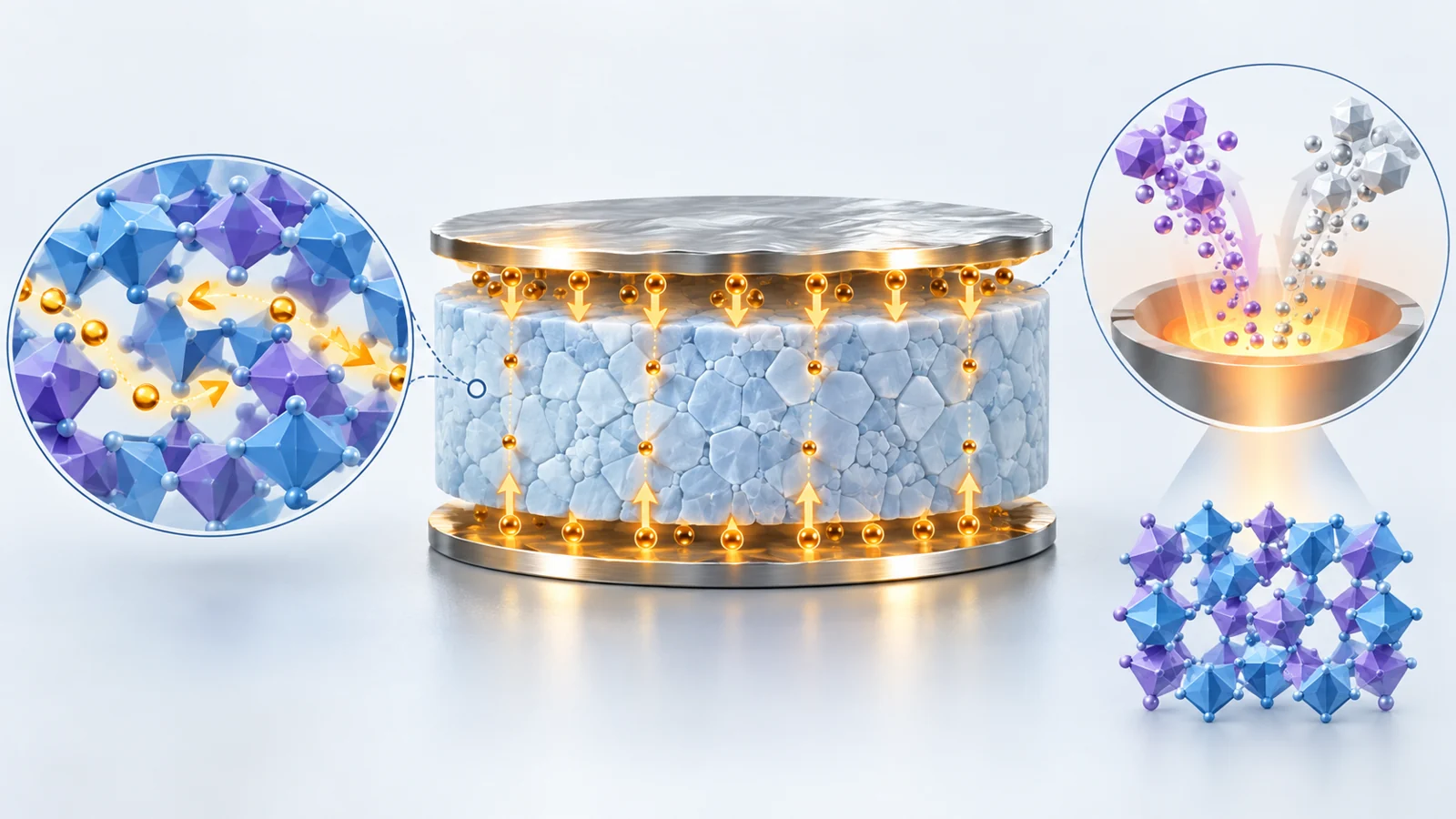
A February 2023 preprint tested that idea with a very small recipe change. The researchers added 1 wt% magnesium fluoride, or MgF₂, while preparing a sodium-ion-conducting ceramic in the NASICON family. They report a total room-temperature ionic conductivity of 2.03 mS/cm, an improvement of approximately 181.3% compared with the material without the additive. Ionic conductivity here means how readily ions move through the solid.
That is a substantial materials result, but it is still a transport measurement rather than a direct measurement of battery speed, capacity or lifetime. The value of the study is in showing how a minor preparation change can be connected to both ion movement through the ceramic and its behavior against sodium metal.
A one-percent addition changes the measurement
NASICON ceramics provide pathways through which sodium ions can move. The measured conductivity reflects the combined behavior of the ceramic, including the ease with which ions pass through its structure. The study also reports an activation energy of 0.277 eV, another quantity associated with the conditions under which that transport occurs.
The important comparison is the scale of the change relative to the amount added. Magnesium fluoride was only 1 wt% of the preparation, yet the reported room-temperature conductivity reached 2.03 mS/cm and rose by about 181.3%. That does not mean the additive itself becomes a separate sodium-conducting layer. It suggests that a small ingredient can influence the structure through which sodium ions travel.
The authors describe the modified NASICON as having fewer defects and higher performance. Their measurements therefore point toward a preparation effect: the additive may help the ceramic form a more favorable internal structure during processing. The result is not a claim that every ceramic will respond in the same way. It is a specific observation in this sodium-conducting material system.
Why the preparation recipe matters
The researchers connect the conductivity trend to structural modeling. They calculated possible ionic migration channels and compared the areas of structural bottlenecks with ionic conductivity across different compositions. The conductivity and bottleneck measurements showed similar composition-dependent trends, which the authors use to support their explanation of how sodium ions move through the ceramic framework.
A bottleneck is useful as an intuition: even when a material contains connected pathways, narrow sections can make movement more difficult. The modeling does not turn the ceramic into a visible tunnel system, and it does not identify a unique atomic site occupied by magnesium or fluorine. Instead, it provides a way to relate measured transport to features of the crystal structure.
The proposed effect also begins during sintering. The authors report that MgF₂ remains in a flowing liquid state during this part of preparation, allowing it to diffuse through the NASICON pellet. They associate that movement with the more stable composition and the resulting performance. This is a proposed microscopic explanation, supported by the study’s characterization and modeling, rather than a complete proof of one precise chemical rearrangement.
That distinction matters because the same conductivity result can arise from several linked changes in a ceramic. A preparation additive might influence defects, local composition or the geometry of ion pathways without behaving like a simple ingredient that occupies one clearly demonstrated position in the lattice.
The sodium-metal test adds a different stress
Conductivity tells us how readily ions cross the ceramic. It does not by itself show how the material behaves when sodium metal repeatedly exchanges sodium with its surfaces. To probe that question, the researchers built a symmetric cell with sodium foil pressed against both faces of a NASICON pellet.
In this arrangement, sodium is plated onto one side during part of the electrical cycle and stripped away during another part. Reversing the direction of the process makes the two sides take turns receiving and giving up sodium. Because both electrodes are sodium metal, the test focuses on the interaction between sodium, the ceramic electrolyte and the interfaces on either side, rather than on the different roles of a full battery’s anode and cathode.
The paper reports longer stable sodium plating and stripping operation for the MgF₂-doped material. The duration figures need to be read in the context of their particular test conditions and endpoints, so the most defensible summary is that the additive-treated ceramic supported more sustained operation in this symmetric sodium-metal arrangement. That is a useful complement to the conductivity measurement because it asks whether the material remains functional while sodium is repeatedly deposited and removed.
Conductivity is one piece of the battery picture
The two tests answer related but different questions. The conductivity result concerns sodium-ion transport through the ceramic at room temperature. The symmetric-cell result concerns repeated sodium-metal exchange across the ceramic interfaces. Together, they make the preparation change more interesting than a single conductivity number would be.
They still do not establish how a complete battery would perform. These measurements do not provide complete-cell capacity retention, energy density, charging speed or service life. A ceramic can move ions effectively and operate for an extended period in a symmetric test while facing additional challenges when paired with a cathode and assembled into a full device.
The mechanism also remains narrower than a finished explanation of the material. The matching trends between conductivity and modeled bottleneck areas support the authors’ interpretation, while the supplied structural evidence does not establish a unique causal pathway or a precise location for magnesium or fluorine. The result is therefore best understood as a preparation-and-transport advance with a plausible structural account, not as a fully resolved atomic mechanism or a finished battery demonstration.
What this could change
If the preparation effect is reproducible and remains useful when the ceramic is integrated with compatible electrodes, battery developers could gain a sodium solid electrolyte that transports ions more readily and supports sustained sodium-metal operation. That would give researchers another way to improve a ceramic electrolyte by adjusting how it is made, rather than relying only on a new base composition.
The small additive level could also become attractive for manufacturing if the process proves controllable at larger scale and its cost implications are validated. In that conditional future, MgF₂ would matter not because one percent guarantees a better battery, but because a modest preparation change might help produce a more capable sodium electrolyte through a practical materials route.
Key Sources
- Primary source: MgF$_2$ as an effective additive for improving ionic conductivity of ceramic solid electrolytes
arXiv · Preprint · 2023-02-14