
Since the previous research note · Earlier expectation not tested
Track continuity
Since the previous research note: How lithium movement changes contact with a solid electrolyte
Previous expectation: If coupled predictions transferred to working cells and practical mechanical conditions preserved lithium-metal contact, developers could sustain more even current and reduce one route to premature failure.
What this study adds: This graphite-composite study connects interphase morphology and lithium and fluorine distributions with first-cycle electrochemical behavior across solid-electrolyte contents. It adds a chemical and compositional interface question without testing the earlier lithium-metal contact forecast.
What changed in this study
A battery electrode can lose part of its available charge before its cycling story has properly begun. The practical question is not only how much lithium enters a graphite electrode, but how much of that charge returns when lithium comes back out during the first cycle.
A September 8, 2022 arXiv preprint examined that question at the surface of graphite composite electrodes. It compared electrodes containing different proportions of graphite and a solid electrolyte, then related their surface shape and chemistry to first-cycle electrochemical behavior. The study does not identify a universal best formulation. Its value is more specific: it shows how measurements of a thin reaction layer can connect microscopic differences at an electrode surface with charge that is not recovered on the way back out.
The comparison began with a changing recipe
The composite electrodes combined natural graphite, the solid electrolyte LSTP, a binder system and conductive Super-P. The researchers varied the graphite-to-LSTP ratio and examined both pristine and cycled electrodes. Here, the added solid electrolyte is a lithium-ion-conducting material within the composite. It should be distinguished from the solid electrolyte interphase, or SEI, which is the reaction layer that forms at the electrode surface during cycling.
That distinction matters because changing the amount of LSTP can also change which material reaches the surface, how neighboring particles touch, and what the interphase forms around. A recipe with more solid electrolyte is therefore not simply a stronger or weaker version of the same surface. It can present graphite, LSTP, or both to the reactions that accompany lithium movement.
The electrochemical comparison centered on lithiation and delithiation capacities, irreversible capacity and Coulombic efficiency. Coulombic efficiency is the fraction of charge recovered after charge has been put into the electrode. It is different from energy efficiency, which also accounts for voltage, and from battery lifetime, which concerns performance over repeated cycling. The cited table describes first-cycle testing at 0.1 C, with five cells prepared for each sample case.
Three measurements connected surface texture to chemistry
Surface-height measurements described the physical shape of the electrode before and after cycling. Those images could show whether the surface became more or less uneven, but shape alone could not identify where lithium was concentrated or which compounds were present in the interphase.
Electrochemical strain microscopy added a local response measurement. The authors interpreted variations in the strain response in relation to lithium near the surface, allowing them to compare local lithium-related behavior with the topography at corresponding positions. The method was used comparatively across solid-electrolyte contents rather than as a complete direct measurement of lithium concentration.
Chemical depth profiling supplied a different layer of information. X-ray photoelectron spectroscopy, combined with argon-ion etching, examined composition at successive depths in the interphase. The analysis focused in part on the distribution of lithium and fluorine. Taken together, the measurements linked three kinds of observation: the shape of the cycled surface, a local response associated with lithium, and chemical composition through the surface layer.
The authors then compared those observations with the electrode-scale electrochemical results. Their reported association was that nanoscale fluctuations in lithium and fluorine within the interphase tracked with irreversible capacity and Coulombic efficiency. In other words, the first-cycle charge outcome was considered alongside the local conditions under which the surface reaction layer had formed.
The uneven interface was part of the explanation
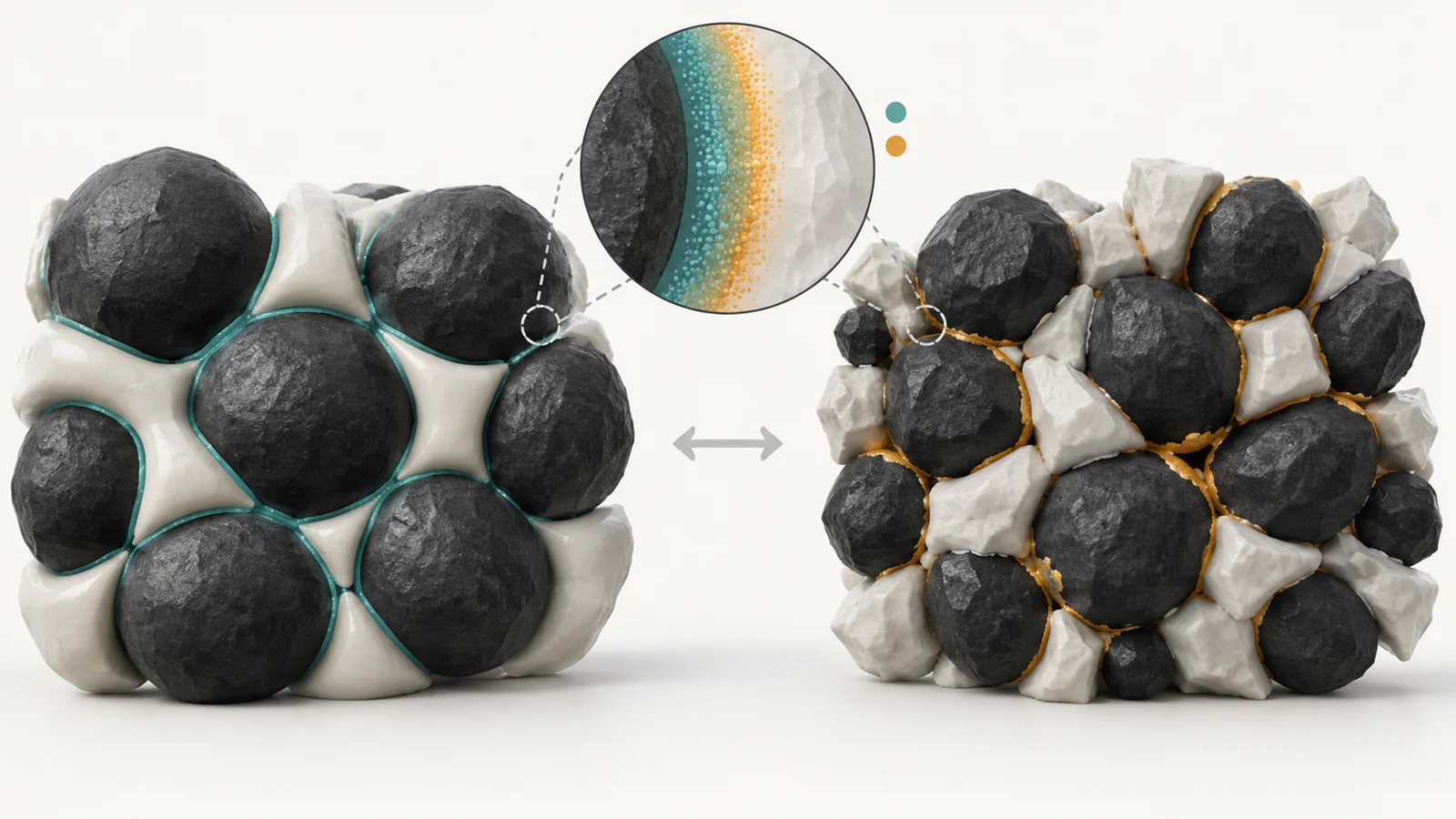
The study’s interpretation turns on local contact environments rather than on solid-electrolyte content as an isolated control knob. The authors describe graphite and LSTP as electrochemically different constituents. In areas dominated by one of them, the interphase could develop under a relatively consistent local environment. Where graphite and LSTP were both exposed, the distribution of the solid electrolyte could alter the paths available for lithium-ion movement.
That proposed difference helps explain why two electrodes with different graphite-to-LSTP ratios might show different surface patterns and different lithium responses. A mixed neighborhood can create changes in local lithium-ion flux, which may then be reflected in the morphology and chemistry of the interphase. The authors present this as a hypothetical model connecting constituent distribution, local contact and interphase structure—not as a direct observation of every step in that sequence.
The reported measurements also point to a composition-dependent surface transition. The study discusses pronounced morphological changes in samples identified as LSTP12 and LSTP24, alongside differences in the local strain response. At higher LSTP content, the interpretation becomes harder because graphite particles were mostly covered with LSTP above 30 wt% LSTP. That coverage prevented the same pristine-versus-cycled topographic comparison from being applied in the same way.
The broader implication is that adding a solid electrolyte may change both the quantity of a component and the arrangement of the surface where reactions occur. Those two effects are difficult to separate if the electrode is judged only by its bulk recipe or only by a single capacity number.
The measurements set a clear boundary around the claim
The strain-response comparison has an important technical qualification. A more accurate quantitative interpretation would require the effective Vegard coefficient, which relates chemical composition to strain in the relevant material. The authors note that this coefficient was not measured, while also explaining that their relative comparison across solid-electrolyte contents remains useful for the intended analysis.
The electrochemical table also describes the first cycle, not a complete durability record. The observed associations therefore do not show that interphase uniformity alone caused the differences in irreversible capacity or Coulombic efficiency. These correlations do not establish how much a deliberate change in interphase uniformity would improve charge recovery or identify a formulation that would work best across different cell designs.
The evidence concerns graphite composite electrodes and their surface layers. It does not establish the behavior of an entire practical solid-state cell architecture. Long-term durability, fast charging, safety improvements, commercial readiness and full-cell energy gains remain outside what these results demonstrate. The study also addresses a different question from research about preserving lithium-metal contact under mechanical conditions; that mechanism is not tested here.
What this could change
If the reported association reflects a controllable mechanism and survives testing in working cells, electrode developers could use surface composition and interphase structure as design targets alongside the overall amount of solid electrolyte. The practical capability would be modest but useful: formulate graphite composites so that less charge is lost irreversibly during initial cycling, leaving more of the electrode’s available charge recoverable.
That possibility depends on transferring a nanoscale relationship into a reproducible electrode process. It would require the local arrangement of graphite and solid electrolyte, the resulting lithium and fluorine distributions, and the first-cycle electrochemical response to remain linked under the conditions relevant to real cells. The preprint supplies a way to ask that question more precisely; it does not yet turn the relationship into a product-ready recipe.
Key Sources
- Primary source: Correlating Nanoscale Structure with Electrochemical Property of Solid Electrolyte Interphases in Solid-State Battery Electrodes
arXiv · Preprint · 2022-09-08