
Since the previous research note · Earlier expectation not tested
Track continuity
Since the previous research note: A transport model could help researchers read solid-electrolyte curves more fully
Previous expectation: Better interpretation of electrical measurements could guide electrolyte improvements that eventually reduce battery energy losses.
What this study adds: Atomistic calculations examine adhesion and lithium transport at boundaries formed by electrolyte decomposition, identifying limited crossing in selected models and possible contact-loss contributions to resistance. This adds a microscopic account of interface behaviour without testing the earlier measurement model.
What changed in this study
Solid-state batteries are often discussed as a way to move lithium ions through a solid material instead of a flammable liquid. But replacing the liquid does not make the electrode boundary chemically inactive. When lithium metal meets some solid electrolytes, the electrolyte can decompose and produce new compounds right where the electrode and electrolyte must exchange lithium.
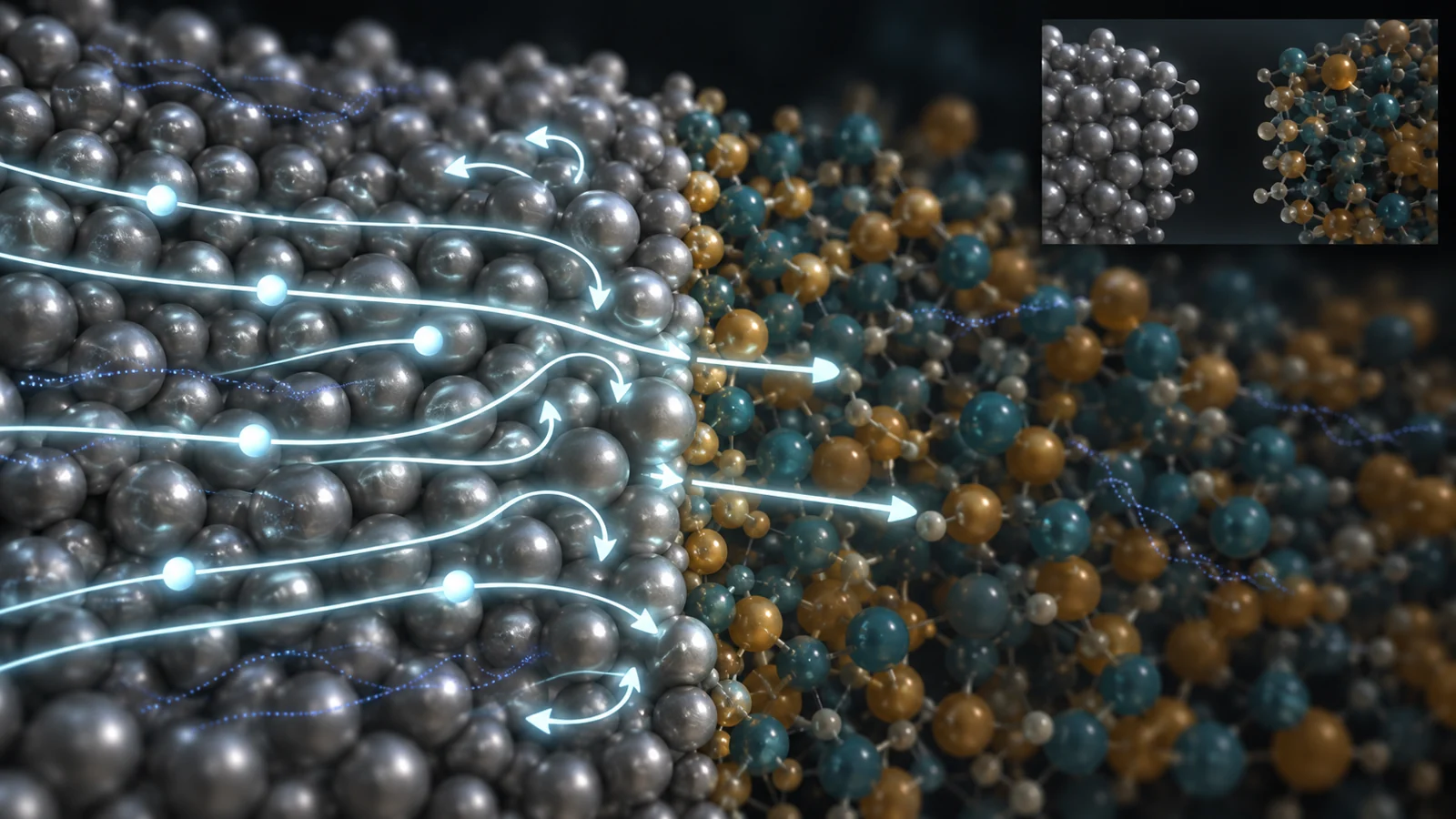
That hidden boundary is the focus of a computational preprint published as arXiv version 1 on May 3, 2022. Titled The Resistive Nature of Decomposing Interfaces of Solid Electrolytes with Alkali Metal Electrodes, the study examines how decomposition products join to lithium or sodium metal, and then asks whether lithium can cross selected versions of those joins efficiently.
The distinction matters because a battery interface has to perform two jobs at once. Its two sides need to remain in contact as the electrode changes, and lithium ions need a usable path across the boundary. A chemically stable-looking join may still be a poor route for transport.
The hidden boundary is made by chemistry
The researchers considered solid electrolytes including lithium-containing materials such as Li₃PS₄ and Li₆PS₅Cl, as well as Na₃PS₄ for the sodium case. Against highly reducing lithium or sodium metal, these materials can decompose. The resulting interface is therefore not simply the original electrolyte touching the original electrode. It is a new solid-solid region made from the metal and the compounds produced by the reaction.
Sulfur-containing solid electrolytes are especially important in this context because their decomposition products may resist lithium-ion movement or allow electronic movement in unwanted ways. The study does not treat decomposition as a single uniform event. Instead, it examines particular combinations of metal and products, including Li₃P, Li₂S and LiCl on the lithium side of the investigation.
At atomic scale, the boundary can reorganize as atoms from the metal and compound sides interact. Lithium or sodium atoms from the metal can form stabilizing bonds with anions from the compound side. Some joins require little rearrangement when the crystal structures fit closely; others involve more substantial changes. That difference affects whether the interface can remain physically connected.
Adhesion asks whether the join can hold
One of the study’s central descriptors is the work of adhesion. In plain language, this is the energetic cost of separating two surfaces that have joined. It turns the vague idea of a “stable contact” into a quantity that can be compared across modeled interfaces.
This is useful because initial contact is not the same as lasting contact. During battery operation, the amount and shape of the metal can change. The paper also raises possible loss of contact between the solid electrolyte and its decomposition products. The resulting gaps or poorly connected regions could add to impedance even before considering how quickly lithium ions move through the interface.
The calculated bonds therefore provide more than a picture of which atoms sit beside one another. They help describe the mechanical character of the boundary: whether the two sides form a joined region that can plausibly remain connected, or whether the interface may be vulnerable to contact loss. Adhesion, however, answers a different question from ion transport. A boundary can be well joined and still offer limited passage for lithium.
Longer atomistic views need a different tool
To investigate transport, the researchers combined first-principles calculations with a machine-learned model of atomic interactions. First-principles methods use quantum-mechanical calculations to describe how atoms and electrons interact, but applying them directly to very large systems over long periods is expensive. The machine-learned model was trained on accurate first-principles data so that it could reproduce those interactions while making larger and longer molecular-dynamics simulations practical.
That distinction is important. The model is not an artificial-intelligence forecast of battery lifetime, charging speed or safety. It is a computational shortcut for following atoms as they move. With it, the researchers could study interface models containing 8,320 atoms and run trajectories lasting at least 10 nanoseconds. Those longer trajectories give lithium more opportunity to reveal whether it crosses the boundary in the selected structures.
The approach also links two scales of description. The first-principles calculations establish the energetics and atomic arrangements used to examine interface stability. The learned atomic-interaction model then permits a larger dynamical view, where the question is not only which structure is favorable but how atoms move within it over time.
Holding together is not the same as conducting
For selected lithium interfaces, the simulations found that diffusion across the boundary remained limited. The study focused on interfaces between lithium metal and decomposition products associated with argyrodite-type solid electrolytes, including models involving Li₃P, Li₂S and LiCl. In these cases, the interface could be treated as a physically defined atomic structure while still presenting a resistive route for lithium-ion movement.
This gives the problem a more specific shape. A decomposition layer is not automatically useful simply because it separates the metal from the original electrolyte, and it is not fully described by whether its two sides are bonded. The lithium ions must also find enough accessible motion across the interfacial region. If that crossing is restricted, the boundary can contribute to the resistance experienced by the cell.
The finding is about the selected atomistic models, not every product that can form when a solid electrolyte reacts with lithium. Nor does it establish a measured improvement or deterioration in a working battery. Its value is that it connects an electrical consequence, increased interfacial resistance, to two microscopic possibilities that can be examined separately: loss of physical contact and limited lithium diffusion.
The survey is broader than the transport test
The paper’s structural and interfacial-energetics work covers more than the few models used for detailed lithium transport. The researchers examined more than 20 solid-solid interfaces involving products of selected lithium and sodium electrolytes reacting with alkali metals. That broader survey helps identify which heterogeneous interfaces are worth treating as physically plausible or stable enough for closer study.
The transport investigation is narrower. Each distinct interface can require substantial retraining of the machine-learned atomic-interaction model, because a model trained on binary bulk systems does not automatically transfer to every heterogeneous boundary. The authors describe this interface-specific retraining as highly resource intensive. As a result, the calculations do not cover the full range of possible lithium or sodium interfaces.
Real buried interfaces can also contain many arrangements that differ from the idealized models. Crystal mismatch, local disorder, reaction history and mechanical evolution may all change the structure that forms. The study’s calculations are consequently best read as a microscopic demonstration of how adhesion and transport can diverge, rather than as a ranking of all solid-electrolyte interfaces.
What this could change
If these mechanisms hold in working cells, interface engineering would need to preserve two properties at the same time. It would need to keep the metal and solid reaction products in contact as the electrode changes, while also leaving lithium ions a sufficiently open route across the boundary. Achieving both could reduce interfacial energy losses and make current delivery through solid-state metal-electrode cells more dependable.
That is a conditional capability, not an outcome demonstrated by this preprint. The practical promise lies in having a sharper way to connect atomic structure with the performance limits that appear at a buried electrode boundary. A solid electrolyte may remove some problems associated with liquid electrolytes, but its usefulness still depends on what happens in the narrow, reactive region where the solid meets the metal.
Key Sources
- Primary source: The Resistive Nature of Decomposing Interfaces of Solid Electrolytes with Alkali Metal Electrodes
arXiv · Preprint · 2022-05-03