
Since the previous research note · Earlier expectation not tested
Track continuity
Since the previous research note: X-rays reveal the uneven interior of an aluminum-doped electrolyte
Previous expectation: Controlling mechanically consequential strain inside LLZO grains could help make solid electrolytes less prone to cracking and support longer-lasting cells.
What this study adds: This preprint examines a different material system, pairing nearly pure microparticle silicon with a sulfide electrolyte and reporting interface passivation, electrode densification and full-cell performance. It does not test the proposed link between LLZO grain strain, processing and fracture.
What changed in this study
Carbon additives usually earn their place in battery electrodes by helping electrons move between particles. Removing them can therefore seem like an unlikely route to a better silicon anode. Yet a preprint published on March 7, 2021, reports laboratory cells built with an anode containing 99.9% microparticle silicon by weight, paired with a sulfide solid electrolyte. In this combination, added carbon came with a chemical cost.
The attraction of silicon is straightforward. The paper describes a material capable of storing more than 3,500 milliamp-hours of charge per gram, compared with around 370 for graphite. Turning that material advantage into a useful battery requires managing what happens both inside the expanding electrode and where it touches the electrolyte, the material through which lithium ions travel.
The researchers tested their silicon against NCM811, a layered-oxide cathode, in complete laboratory cells. That choice matters because the positive and negative electrodes must work together with a limited supply of lithium. Tests against an excess lithium reservoir can make it harder to judge how much lithium an experimental anode consumes irreversibly. Here, the full-cell arrangement puts that accounting closer to the practical battery problem.
Why the carbon comparison matters
An electrode has to support the movement of both electrons and lithium ions. Carbon is commonly added to help with the electronic side of that task. But an additive that improves electrical connections can also change the reactions occurring around those connections. Its usefulness depends on the surrounding materials.
The researchers compared silicon–sulfide systems with and without carbon additives. After lithiation, when lithium had entered the silicon, the sample without carbon retained the characteristic X-ray diffraction features of the crystalline electrolyte and unreacted silicon. In the carbon-containing sample, most of the electrolyte’s original diffraction features had disappeared. The authors interpreted this as evidence of much more extensive electrolyte decomposition in the presence of carbon.
That comparison gives a concrete reason to question the usual electrode recipe. For this material pairing, the familiar conductive additive was associated with damage to the electrolyte’s original structure. Omitting it also allowed an exceptionally high proportion of the anode’s mass to be silicon. The reported 99.9% figure describes the anode composition; it says nothing about the silicon fraction of the entire cell, which also contains a cathode, electrolyte and other components.
A reaction layer that changes the next reaction
A fresh interface between silicon and a sulfide electrolyte does not remain chemically untouched. Some electrolyte reacts as the silicon takes up lithium, forming an interphase often called the solid electrolyte interphase, or SEI. This initial reaction consumes lithium that can no longer contribute in the same way to subsequent charging and discharging.
The important question is how that reaction develops. A passivating interphase acts as a boundary layer that limits further chemical reaction while allowing the cell to operate. A continuously growing interphase would instead keep drawing down the cell’s usable lithium supply and could make ion transport increasingly difficult. X-ray diffraction alone cannot settle that question because a small amount of material at an interface may be difficult to detect with a measurement dominated by the bulk sample.
To investigate the lithium balance, the team used titration gas chromatography. They assembled five full cells and cycled them for one through five cycles, respectively. Afterward, they reacted the remaining lithium–silicon material with anhydrous ethanol and measured the hydrogen released. This chemical accounting helped distinguish lithium remaining in the alloy from lithium consumed in interphase formation.
The authors report interphase-related lithium consumption equivalent to 11.7% of the cell’s capacity after the first cycle, increasing slightly to 12.4% after the second. The accumulated interphase and active lithium then changed little over the remaining early cycles examined. A separate electrical measurement supported the same interpretation over a longer observation period: impedance rose initially, consistent with formation of the reaction layer, and then remained relatively steady during the subsequent 30 cycles. Together, these observations support passivation over the measured periods, with a real initial lithium cost.
Growing particles can fill the gaps between them
Silicon also changes physically when it takes up lithium. Its particles expand, so an electrode made from those particles has to accommodate a substantial change in volume. Looking only at the expansion of solid silicon, however, misses the empty space in the starting electrode.
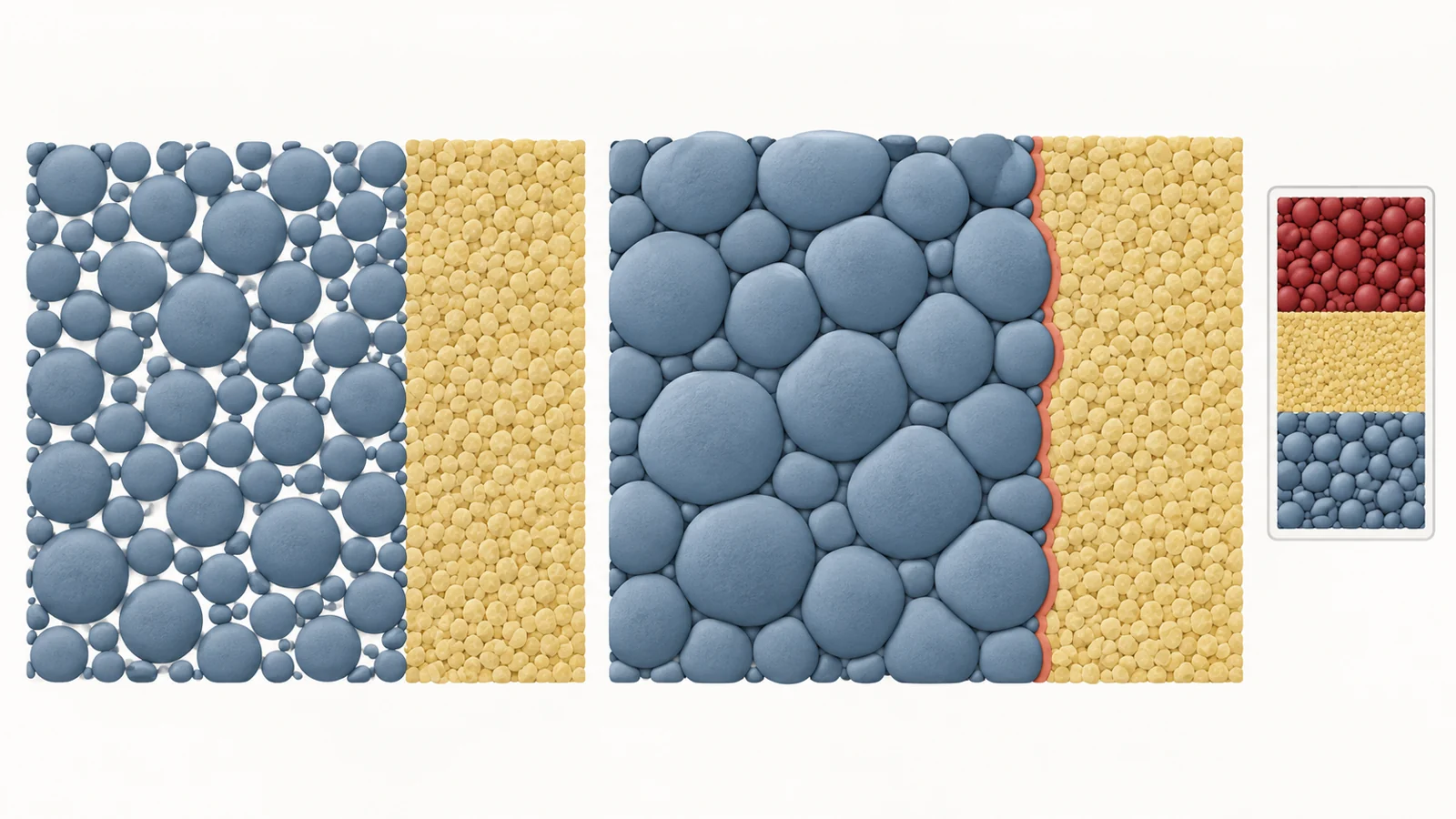
The paper reports that the lithiated silicon electrode reached a thickness of approximately 55 micrometers. The authors connected that thickness with a calculated porosity below 10%, consistent with their observations of electrode densification. As the particles enlarged, they occupied more of the gaps that had initially separated them. Some of the change therefore appeared as lost pore space, alongside an increase in the electrode’s external thickness.
A loose bed of particles and a solid block need not respond to expansion in the same way. The bed has internal room to fill. This helps explain why the electrode’s thickness response could be smaller than a simple calculation based on silicon’s material expansion would suggest. The particles still grew, and the electrode still thickened. Densification describes how that growth was accommodated; it does not establish that repeated expansion and contraction leave every contact and mechanical feature intact.
Capacity, current and temperature answer different questions
The performance results become more useful when their units are kept separate. Areal capacity, expressed in milliamp-hours per square centimeter, describes how much charge an electrode stores for its footprint. Current density, in milliamps per square centimeter, describes how quickly charge moves through that area. A high value for one does not automatically imply a high value for the other.
In a loading experiment using a cathode sized for 12 mAh/cm², the silicon anode delivered more than 11 mAh/cm² of reversible capacity at 0.1C, corresponding to 1.2 mA/cm². The C-rate expresses current relative to a nominal capacity; 0.1C represents a nominal ten-hour charging or discharging rate.
At 1C, or 12 mA/cm² in that experiment, the reported reversible capacity was more than 4 mAh/cm². The silicon-specific capacities associated with these two conditions were 2,890 and 1,050 mAh/g, respectively. Increasing the current tenfold came with substantially less accessible charge. This is a useful capacity–rate tradeoff to see explicitly: putting more storage material into an electrode does not ensure that all of its capacity can be reached quickly.
Separately, the authors report room-temperature operation at a current density of 5 mA/cm². That result addresses charge and discharge at a comparatively high current under room-temperature conditions. It should be read as its own demonstration, alongside the loading experiment, rather than combined with the highest capacity into a single operating specification.
Temperature testing addressed another dependency. At a moderate current density of 0.3 mA/cm², cells operated across −20°C to 80°C, with capacity utilization increasing as temperature rose. At low temperatures, polarization increased substantially, meaning that the cell required a larger voltage departure from its equilibrium behavior to sustain current. The authors suggested that limited lithium-ion movement within the solid electrolyte contributed to this response.
No shorting was observed at −20°C in the reported test. That observation accompanies poorer cold-temperature electrical performance; it does not establish general battery safety. The temperature range, room-temperature current result and high-loading capacity describe different experimental conditions, each exposing a different part of the design’s behavior.
From electrode measurements to a battery specification
These experiments connect a material choice to structural measurements, lithium accounting and full-cell operation. They nevertheless leave a substantial distance between a promising electrode and a specified battery that someone could select for a device or vehicle.
The relevant measurements cover different timescales and operating demands. Lithium accounting over the first five cycles addresses early losses. Impedance measurements over 30 cycles track resistance development. Loading and rate tests show how much charge is accessible under selected conditions. Establishing durable operation at useful loading requires those demands to be brought together over sustained cycling, with the cell’s physical operating requirements accounted for.
Whole-cell energy density also requires a different calculation from silicon’s charge capacity per gram. Energy depends on voltage as well as charge, and the mass and volume calculation must include both electrodes, the electrolyte, current collectors and packaging. A large material-level capacity advantage cannot be carried directly across as a corresponding increase in battery energy density.
As presented in this March 2021 preprint, the work is a laboratory demonstration with supporting mechanistic measurements. Independent replication, scalable manufacturing and a complete product specification remain outside what these results establish. In particular, the evidence does not supply a quantified benefit for a commercial device or vehicle.
What this could change
If silicon-rich anodes can retain useful capacity and durability in scalable complete cells, they could help store more energy within a given battery mass or volume. The causal opportunity comes from devoting more of the anode to a material that stores substantial charge, while making the rest of the cell compatible with its chemical and physical behavior.
For portable devices, that could support longer operation within a similar battery space. For electric vehicles, it could allow more energy to fit into a constrained battery compartment. Realizing either benefit would require the electrode advantage to survive the demands of the complete cell. This preprint gives a concrete material pairing through which that possibility can be investigated.
Key Sources
- Primary source: Carbon Free High Loading Silicon Anodes Enabled by Sulfide Solid Electrolytes for Robust All Solid-State Batteries
arXiv · Preprint · 2021-03-07