
Solid-State Battery Development
Can solid-state batteries sustain repeated charging and discharging while keeping ions moving efficiently and electrode–electrolyte contacts intact?
Following this work shows whether improvements in electrolyte conductivity and electrode design translate into durable battery cells. Imaging and cycling studies can connect material changes to the mechanisms that limit battery life.
Where it stands now
Main bottleneck
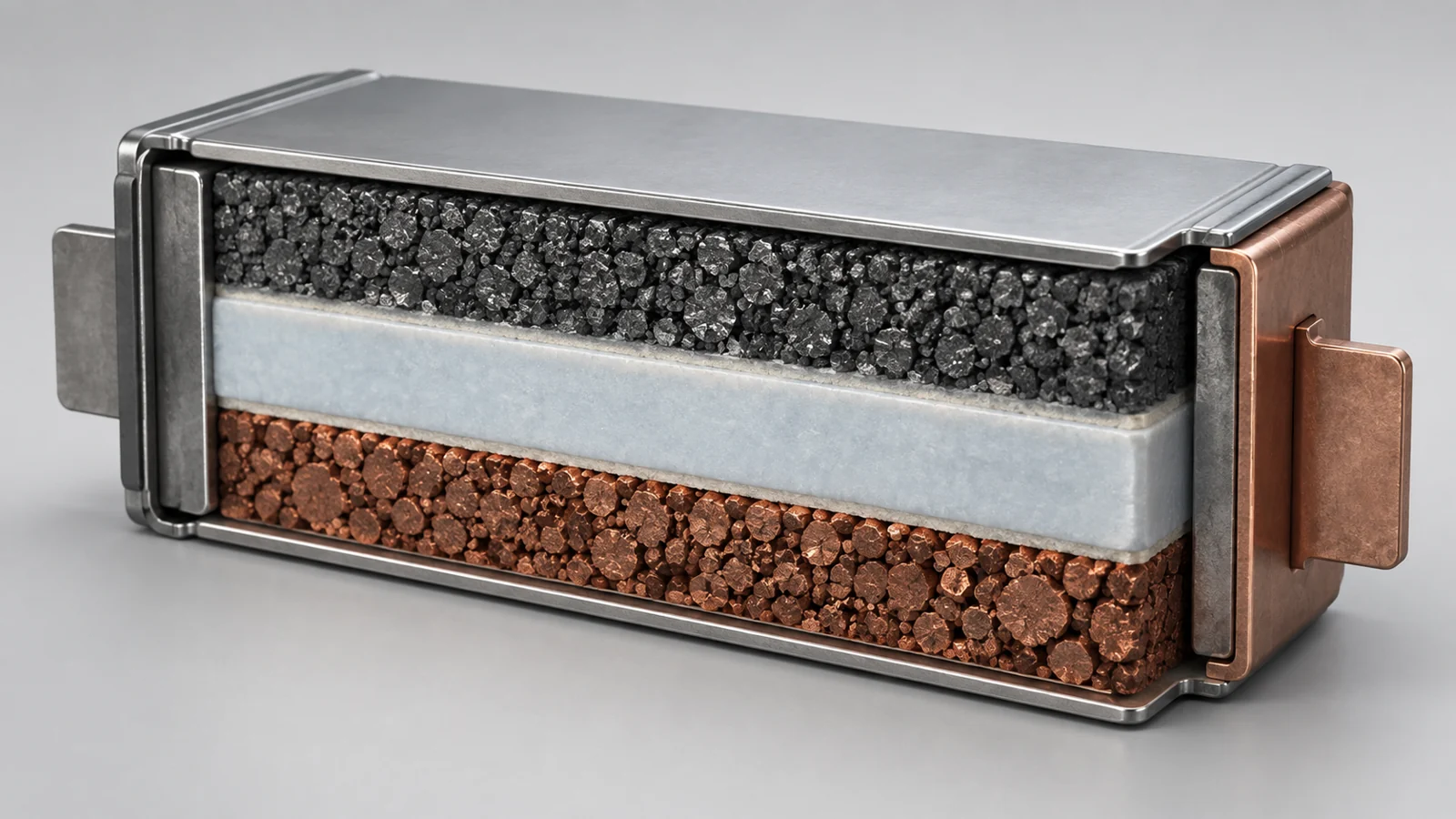
Maintaining chemically stable, mechanically intact electrode–electrolyte interfaces during cycling remains the central barrier: reactions, voids, fractures and metal growth can undermine contact and ion transport.
Watch next
Reproducible full-cell tests combining high electrode loading with sustained cycling, supported by measurements showing that interface resistance, contact loss and damaging metal growth remain controlled under clearly reported operating conditions.
Progress timeline
How the evidence has changed over time.
2026 · 11 updates
- Lithium and sodium share growth rules, but sodium leaves a changed interfaceResearch note 47 of 57 · Source date 2026-03-01
Since the previous research note · Earlier expectation not tested
Track continuity
Since the previous research note: How neutrons reveal the buried contact between lithium metal and a solid electrolyte
Previous expectation: Connecting buried-interface profiles with cell behavior could help engineers form contacts that remain effective during battery use.
What this study adds: Virtual-electrode imaging adds a dynamic view of lithium and sodium growth and a resolved sodium-removal sequence, including a persistent layer that changes subsequent microstructure. This supplies a distinct mechanism-focused milestone without testing the earlier forecast about contact-forming processes and cell behavior.
Current research note
- Why electrical flow and cracking can open a ceramic battery barrierResearch note 48 of 57 · Source date 2026-03-20
Since the previous research note · Earlier expectation not tested
Track continuity
Since the previous research note: Lithium and sodium share growth rules, but sodium leaves a changed interface
Previous expectation: If observed metal growth and removal behavior translated to realistic cells, interface design could preserve contact and improve durability through repeated cycling.
What this study adds: This preprint introduces an analytical account of crack-mediated metal penetration, including a slower growth pathway and predicted variation between samples. It does not test the earlier contact-preservation or cycling forecast.
Current research note
- How a layered ceramic changes cycling in a battery with a solid electrolyteResearch note 49 of 57 · Source date 2026-03-23
Since the previous research note · Earlier expectation not tested
Track continuity
Since the previous research note: Why electrical flow and cracking can open a ceramic battery barrier
Previous expectation: Controlling crack-tip behavior could eventually help ceramic battery barriers tolerate higher charging currents and resist metal penetration more consistently.
What this study adds: The current preprint adds a full-cell comparison of dense and three-layer ceramic electrolytes, linking a 25-cycle capacity advantage with impedance behavior and lithium depth profiles. It does not establish a test of the earlier crack-growth forecast.
Current research note
- How sodium removal can break contact in a solid-state batteryResearch note 50 of 57 · Source date 2026-03-24
Since the previous research note · Earlier expectation not tested
Track continuity
Since the previous research note: How a layered ceramic changes cycling in a battery with a solid electrolyte
Previous expectation: A layered ceramic electrolyte could help solid-state cells retain usable capacity if its structural advantage survives longer cycling and practical integration.
What this study adds: Sodium model-cell experiments distinguish a discharge-side vacancy-transport limitation and show that a tin–sodium interlayer changes the measured activation barrier and critical current. This adds a mechanism-focused milestone rather than testing the earlier layered-ceramic forecast.
Current research note
- What adding one lithium atom reveals about a solid battery interfaceResearch note 51 of 57 · Source date 2026-04-12
Since the previous research note · Earlier expectation not tested
Track continuity
Since the previous research note: How sodium removal can break contact in a solid-state battery
Previous expectation: Suitable sodium-conducting interlayers could help sodium solid-state batteries sustain higher discharge currents with more reliable contact and less demanding compression.
What this study adds: The current source examines a different metal–electrolyte pair through calculations of lithium insertion and migration at a lithium-metal/Li3OCl contact. It adds an atomic-scale chemical compatibility milestone without testing the earlier sodium-interlayer forecast.
Current research note
- Why a battery can look stable while its interface keeps changingResearch note 52 of 57 · Source date 2026-04-27
Since the previous research note · Earlier expectation not tested
Track continuity
Since the previous research note: What adding one lithium atom reveals about a solid battery interface
Previous expectation: Li3OCl could become a useful solid-electrolyte partner for lithium-metal anodes if it resists unwanted lithium incorporation while preserving ion movement and stable contact during operation.
What this study adds: The current preprint supplies a dynamic modeling framework that separates cycling-scale contact changes from accumulated chemical decomposition and predicts rate-dependent performance reversals. Its representative sulfide pressure comparison does not test that Li3OCl-specific expectation.
Current research note
- Lithium can move faster without changing its route through a solidResearch note 53 of 57 · Source date 2026-05-07
Since the previous research note · Earlier expectation not tested
Track continuity
Since the previous research note: Why a battery can look stable while its interface keeps changing
Previous expectation: Joint control of lithium contact and accumulating interface chemistry could help future solid-state cells sustain delivered performance under repeated demanding use.
What this study adds: The current preprint adds a bulk-electrolyte mechanism, predicting that lattice strain changes lithium diffusion in Li3YCl6 without shifting the crossover between its two transport regimes. That result does not test the earlier coupled interface forecast.
Current research note
- Why fast lithium transfer may not solve a battery’s contact problemResearch note 54 of 57 · Source date 2026-06-05
Since the previous research note · Earlier expectation not tested
Track continuity
Since the previous research note: Lithium can move faster without changing its route through a solid
Previous expectation: Controlling strain in Li3YCl6 while maintaining stable interfaces could help preserve lithium transport as a solid-state battery operates.
What this study adds: The current source examines a different material and a different transport question, calculating rapid intrinsic lithium transfer at a lithium/Ga-doped LLZO interface and distinguishing it from practical contact-related resistance. It provides neither a test nor validation of the earlier strain forecast.
Current research note
- A thinning sodium branch can leave a remnant behindResearch note 55 of 57 · Source date 2026-07-16
Since the previous research note · Earlier expectation not tested
Track continuity
Since the previous research note: Why fast lithium transfer may not solve a battery’s contact problem
Previous expectation: Favorable lithium transfer kinetics could reduce losses at a lithium–ceramic interface if effective contact can be maintained.
What this study adds: A different sodium-system simulation explains how grain-boundary geometry and electronic disconnection can leave metal remnants that accelerate penetration across repeated cycles. It does not test lithium/Ga-LLZO transfer or the earlier contact-dependent benefit.
Current research note
- How carbon and a protective coating shape a solid-state battery's lifeResearch note 56 of 57 · Source date 2026-07-22
Since the previous research note · Earlier expectation not tested
Track continuity
Since the previous research note: A thinning sodium branch can leave a remnant behind
Previous expectation: Preventing persistent sodium remnants might help sodium solid-state cells withstand more cycling before metal penetration causes failure.
What this study adds: This lithium study reports a silicon-modified sulfide electrolyte paired with a coated composite cathode and compares how conductive-carbon content affects cycling and interface chemistry. It adds a cathode-degradation design result without testing the earlier sodium-remnant mechanism.
Current research note
- How researchers tune a battery interface to carry lithium ionsResearch note 57 of 57 · Source date 2026-07-27
Since the previous research note · Earlier expectation not tested
Track continuity
Since the previous research note: How carbon and a protective coating shape a solid-state battery's life
Previous expectation: Balancing carbon and a protective cathode coating could help solid-state lithium cells retain useful capacity in cold and warm conditions if the design survives practical operating conditions.
What this study adds: The current source examines the electrolyte function of the interphase in separator-free lithium-metal test cells, with formation chemistry, deposition location and mechanical reinforcement as engineering variables. Its reported first-cycle comparison addresses a different cell component and endpoint from the earlier temperature-dependent durability forecast.
Current research note
2025 · 9 updates
- Inside a working battery, aligned crystals shape cathode reactions and lithium growthResearch note 38 of 57 · Source date 2025-02-05
Since the previous research note · Earlier expectation not tested
Track continuity
Since the previous research note: How contact layout and pressure shape charge flow in a solid battery interface
Previous expectation: Durable contact arrangements could reduce interface resistance and preserve more of a solid-state battery's working voltage.
What this study adds: The current preprint follows crystal structure during operation, reporting an orientation-dependent cathode reaction, a lithium-rich insulating interface limiting lithium removal, and evolving lithium orientation on titanium. It supplies a distinct view of processes inside an operating cell without testing the earlier contact-layout forecast.
Current research note
- How materials must work together in a solid-state sodium batteryResearch note 39 of 57 · Source date 2025-05-07
Since the previous research note · Earlier expectation not tested
Track continuity
Since the previous research note: Inside a working battery, aligned crystals shape cathode reactions and lithium growth
Previous expectation: Controlling insulating interfaces and lithium growth could make more stored energy usable over repeated operation in compact solid-state batteries.
What this study adds: This sodium-focused review broadens the track to electrolyte transport, electrode contact, operating temperature and material-resource choices. Its supplied evidence does not test the earlier lithium-cell interventions or their predicted gains.
Current research note
- Where lithium meets a solid electrolyte, an unfamiliar layer keeps evolvingResearch note 40 of 57 · Source date 2025-06-12
Since the previous research note · Earlier expectation not tested
Track continuity
Since the previous research note: How materials must work together in a solid-state sodium battery
Previous expectation: Solid-state sodium batteries could become an additional renewable-energy storage option if ion transport, durable contact, operating conditions and scalable materials can work together.
What this study adds: The current lithium-interface simulations identify an unexpected reaction product, transport-limited layer growth and sideways lithium motion associated with creep. They add an atomistic interface mechanism to the track without testing the sodium-cell integration or storage-use forecast.
Current research note
- Lithium leaves silicon with a new structure to design aroundResearch note 41 of 57 · Source date 2025-07-22
Since the previous research note · Earlier expectation not tested
Track continuity
Since the previous research note: Where lithium meets a solid electrolyte, an unfamiliar layer keeps evolving
Previous expectation: If predicted interface chemistry and ion motion were confirmed, simulations could help researchers design more durable contacts in solid-state batteries.
What this study adds: Microscopy of silicon electrodes reveals uneven initial lithium uptake and evolution toward a more uniform amorphous structure over repeated cycles. This adds a distinct electrode-interior design problem without testing the earlier interfacial-phase or transport predictions.
Current research note
- Following lithium through different structures of the same solid electrolyteResearch note 42 of 57 · Source date 2025-08-07
Since the previous research note · Earlier expectation not tested
Track continuity
Since the previous research note: Lithium leaves silicon with a new structure to design around
Previous expectation: More predictable silicon deformation could let developers build electrodes that accommodate expansion and preserve useful storage performance for longer.
What this study adds: The current preprint examines a different component, the solid electrolyte, and connects lithium transport in Li2ZrCl6 to structural arrangement and ion motion. It does not test silicon deformation, electrode formation or the earlier durability forecast.
Current research note
- Inside a ceramic battery where crystal seams shape transport and fractureResearch note 43 of 57 · Source date 2025-08-09
Since the previous research note · Earlier expectation not tested
Track continuity
Since the previous research note: Following lithium through different structures of the same solid electrolyte
Previous expectation: Deliberately controlling Li2ZrCl6 crystal arrangements could reduce resistance to lithium-ion motion if those arrangements can be produced and retained in working cells.
What this study adds: This review broadens the engineering picture to interfaces between crystals, electronic leakage, fracture and processing tradeoffs. Its iodide-doped halide example concerns boundary resistance and does not establish a test of that earlier forecast.
Current research note
- Tracing lithium through chloride–bromide solids that carry ions in batteriesResearch note 44 of 57 · Source date 2025-10-10
Since the previous research note · Earlier expectation not tested
Track continuity
Since the previous research note: Inside a ceramic battery where crystal seams shape transport and fracture
Previous expectation: Better control of ceramic contacts, leakage, and fracture could eventually let lithium-metal cells operate at useful rates with less external compression.
What this study adds: Targeted model training enables stable simulations of chloride–bromide electrolytes and investigation of composition-dependent lithium transport. This adds a computational materials-development capability without testing the earlier cell-mechanics expectation.
Current research note
- How nitrogen changes a chloride solid for battery ion transportResearch note 45 of 57 · Source date 2025-10-11
Since the previous research note · Earlier expectation not tested
Track continuity
Since the previous research note: Tracing lithium through chloride–bromide solids that carry ions in batteries
Previous expectation: Experimentally validated simulations could help researchers prioritize chloride–bromide electrolyte candidates before synthesis.
What this study adds: This preprint reports a separate nitrogen-driven route to disordered chloride electrolytes, including structural evidence and conductivity and cycling results for a hafnium-based composition. These findings add a materials-synthesis milestone without validating the earlier simulation-based screening forecast.
Current research note
- How neutrons reveal the buried contact between lithium metal and a solid electrolyteResearch note 46 of 57 · Source date 2025-12-06
Since the previous research note · Earlier expectation not tested
Track continuity
Since the previous research note: How nitrogen changes a chloride solid for battery ion transport
Previous expectation: Nitrogen-driven changes in chloride electrolytes could broaden the materials available for durable solid-state batteries if their transport properties survive practical integration and scalable production.
What this study adds: This study adds a measurement perspective, comparing neutron probes of buried lithium–LiPON interfaces and showing how preparation and length scale affect their interpretation. It does not test nitrogen-modified chlorides or the earlier forecast about their integration and production.
Current research note
2024 · 15 updates
- How a lithium battery contact changes from disorder to crystalResearch note 23 of 57 · Source date 2024-02-06
Since the previous research note · Earlier expectation not tested
Track continuity
Since the previous research note: How material placement could reshape a battery’s positive electrode
Previous expectation: Layered positive electrodes could provide more usable energy under demanding operation if their advantages survive fabrication and complete-cell use.
What this study adds: The current source supplies an atomistic mechanism for reaction-layer growth at a lithium-metal/solid-electrolyte contact, including a disordered intermediate and subsequent crystallization into a solid solution. It does not test the earlier positive-electrode architecture forecast.
Current research note
- How preparation keeps a sulfur battery’s charge-carrying particles connectedResearch note 24 of 57 · Source date 2024-02-20
Since the previous research note · Earlier expectation not tested
Track continuity
Since the previous research note: How a lithium battery contact changes from disorder to crystal
Previous expectation: Experimentally relevant simulations of evolving lithium-metal contacts could help designers create more durable solid-state battery interfaces.
What this study adds: This study addresses a different part of the battery, reporting a sulfur-composite preparation route intended to preserve ionic and electronic pathways within the cathode. A battery incorporating that composite is reported to operate stably over 1,000 cycles with nearly 100% Coulombic efficiency.
Current research note
- How a battery material might correct uneven lithium growthResearch note 25 of 57 · Source date 2024-08-06
Since the previous research note · Earlier expectation not tested
Track continuity
Since the previous research note: How preparation keeps a sulfur battery’s charge-carrying particles connected
Previous expectation: Preserving connected lithium-ion and electron pathways in sulfur composite cathodes under practical cycling conditions could support more durable solid-state lithium-sulfur batteries.
What this study adds: This preprint examines a different problem, the moving lithium–electrolyte boundary, and identifies a modeled role for long-range feedback in suppressing shape disturbances. It proposes candidate self-regulating material mechanisms without testing the earlier cathode-connectivity forecast.
Current research note
- What changes when a battery model smooths out its inner structureResearch note 26 of 57 · Source date 2024-08-11
Since the previous research note · Earlier expectation not tested
Track continuity
Since the previous research note: How a battery material might correct uneven lithium growth
Previous expectation: Materials that sustain a corrective response to uneven lithium growth could help preserve interface contact and support more durable lithium-metal cells.
What this study adds: This source compares geometrically averaged and resolved simulations of solid-state battery cycling, identifying differences in predicted outcomes and examining parameter sensitivity. It contributes a separate milestone on the tools used to assess designs, rather than testing the proposed corrective interface response.
Current research note
- From crystal-structure data to a tested battery electrolyte recipeResearch note 27 of 57 · Source date 2024-09-02
Since the previous research note · Earlier expectation not tested
Track continuity
Since the previous research note: What changes when a battery model smooths out its inner structure
Previous expectation: Combining averaged and geometry-resolved battery models could help identify designs with greater usable capacity if their predictions held up in physical cells.
What this study adds: This source reports model-guided NASICON composition selection followed by synthesis checks and conductivity measurements on three recommended materials. It adds a materials-selection contribution without testing the earlier modeling combination or its capacity forecast.
Current research note
- How ceramic particles and a deforming polymer shape contact with lithiumResearch note 28 of 57 · Source date 2024-09-24
Since the previous research note · Earlier expectation not tested
Track continuity
Since the previous research note: From crystal-structure data to a tested battery electrolyte recipe
Previous expectation: Predictions from structure and property data could help researchers select sodium-electrolyte recipes that retain useful conductivity after fabrication and cell integration.
What this study adds: This source models a different system, a lithium-metal interface with a ceramic-filled polymer electrolyte, and examines how particle design and polymer viscoelasticity affect contact over time. It adds an interface-mechanics contribution to Solid-State Battery Development without testing the earlier recipe-selection forecast.
Current research note
- Related atomic frameworks may help lithium cross a battery boundaryResearch note 29 of 57 · Source date 2024-10-20
Since the previous research note · Earlier expectation not tested
Track continuity
Since the previous research note: How ceramic particles and a deforming polymer shape contact with lithium
Previous expectation: Composite electrolytes might sustain useful contact with lithium if their mechanical behavior connects successfully to ion transport under operating conditions.
What this study adds: This computational study examines a different interface strategy, pairing a lithium–manganese sulfide electrode with a structurally related lithium–silicon sulfide electrolyte. It adds material-specific transport and atomic-exchange calculations, including a change in exchange energetics after lithium removal.
Current research note
- How a cerium-based filler changes a polymer battery electrolyteResearch note 30 of 57 · Source date 2024-10-31
Since the previous research note · Earlier expectation not tested
Track continuity
Since the previous research note: Related atomic frameworks may help lithium cross a battery boundary
Previous expectation: Structurally matched electrode and electrolyte materials could allow more electrode volume to store charge if their transport and contact stability proved adequate.
What this study adds: The current study reports a cerium-centered framework filler in a polymer electrolyte, including transport measurements at 60 °C and qualitative cycling results in lithium-metal cells. It addresses electrolyte composition rather than the earlier proposed electrode architecture.
Current research note
- A close-up view of an oxide microbattery in operationResearch note 31 of 57 · Source date 2024-11-03
Since the previous research note · Earlier expectation not tested
Track continuity
Since the previous research note: How a cerium-based filler changes a polymer battery electrolyte
Previous expectation: A cerium-based filler could help polymer solid electrolytes maintain battery performance over extended use if their transport and stability persist under practical conditions.
What this study adds: The current preprint examines a different, oxide-based microbattery and reports electrolyte cracking, particle shrinkage, and amorphous-phase formation during electrochemical investigation. It adds a view of structural degradation without testing the earlier filler chemistry or its durability prediction.
Current research note
- How changing a battery ceramic's recipe shifts lithium-ion movementResearch note 32 of 57 · Source date 2024-11-12
Since the previous research note · Earlier expectation not tested
Track continuity
Since the previous research note: A close-up view of an oxide microbattery in operation
Previous expectation: Limiting structural degradation while preserving lithium transport could help oxide solid-state batteries last longer.
What this study adds: This study identifies a conductivity-leading composition within a strontium-varied, tantalum-containing ceramic series and associates its behavior with favorable ceramic structure. The supplied evidence does not test whether that composition limits the operating degradation underlying the earlier forecast.
Current research note
- How rapid alternating current could warm a solid-state batteryResearch note 33 of 57 · Source date 2024-11-15
Since the previous research note · Earlier expectation not tested
Track continuity
Since the previous research note: How changing a battery ceramic's recipe shifts lithium-ion movement
Previous expectation: A selected ceramic composition could improve lithium-ion transport if its performance survives practical layer construction and operation with compatible electrodes.
What this study adds: This source introduces a different route to improving transport: heating solid-state cells through rapid alternating electrical excitation, supported by symmetric-cell experiments and pack modeling. It does not test the earlier ceramic composition or its integration forecast.
Current research note
- Could a molecular coating ease solid-state battery manufacturing?Research note 34 of 57 · Source date 2024-12-05
Since the previous research note · Earlier expectation not tested
Track continuity
Since the previous research note: How rapid alternating current could warm a solid-state battery
Previous expectation: Rapid internal electrical warming could let solid-state batteries deliver more of their stored energy if the modeled gains survive cell and pack integration.
What this study adds: The current source addresses a separate manufacturing obstacle by reporting molecular protection of a sulfide electrolyte during controlled humidity exposure and retained function in a specified battery configuration. It provides no test of the earlier heating forecast.
Current research note
- Between lithium metal and solid electrolyte, a simulated lithium cluster formsResearch note 35 of 57 · Source date 2024-12-17
Since the previous research note · Earlier expectation not tested
Track continuity
Since the previous research note: Could a molecular coating ease solid-state battery manufacturing?
Previous expectation: A water-repelling molecular treatment could give manufacturers more flexibility in handling sulfide electrolytes if it survives realistic processing without harming battery function.
What this study adds: The current simulations identify an isolated lithium cluster within the lithium–Li6PS5Cl interphase and propose an electronic explanation for its formation. This adds a mechanism-focused milestone concerning the assembled material interface, without testing the earlier handling forecast.
Current research note
- When sodium moves, the battery contact moves with itResearch note 36 of 57 · Source date 2024-12-22
Since the previous research note · Earlier expectation not tested
Track continuity
Since the previous research note: Between lithium metal and solid electrolyte, a simulated lithium cluster forms
Previous expectation: Controlling lithium formation within the reaction layer at a solid-electrolyte contact could help developers prevent damage and improve battery durability.
What this study adds: This sodium–ceramic model follows electrode motion and interfacial gaps, showing local grain-boundary effects on void growth and faster void coalescence with increased current. It adds a distinct contact-evolution mechanism without testing lithium-cluster suppression.
Current research note
- How contact layout and pressure shape charge flow in a solid battery interfaceResearch note 37 of 57 · Source date 2024-12-31
Since the previous research note · Earlier expectation not tested
Track continuity
Since the previous research note: When sodium moves, the battery contact moves with it
Previous expectation: Predictive models of changing sodium contact could eventually help developers preserve interfaces through repeated sodium removal and deposition.
What this study adds: Controlled experiments at an electrode/Li6PS5Cl interface quantify how contact geometry and pressure affect resistance, with continuum simulations reproducing the geometry-dependent trend. This adds an electrical consequence of contact arrangement without testing the earlier forecast about sodium contact evolution.
Current research note
2023 · 9 updates
- How magnesium fluoride changed sodium transport in a ceramicResearch note 14 of 57 · Source date 2023-02-14
Since the previous research note · Earlier expectation not tested
Track continuity
Since the previous research note: A ceramic recipe and its grain boundaries shape lithium-ion transport
Previous expectation: Tuning ceramic chemistry and processing could give developers a more effective lithium-ion electrolyte if its gains survived electrode integration and useful cycling.
What this study adds: This sodium-conducting ceramic study reports improved transport after adding magnesium fluoride and longer sodium-metal symmetric-cell operation. It adds a distinct preparation-additive example without testing the earlier lithium composition, cooling strategy or complete-cell forecast.
Current research note
- What turbine coatings could teach us about tougher battery electrolytesResearch note 15 of 57 · Source date 2023-02-18
Since the previous research note · Earlier expectation not tested
Track continuity
Since the previous research note: How magnesium fluoride changed sodium transport in a ceramic
Previous expectation: A reproducible magnesium fluoride preparation effect could yield a sodium ceramic electrolyte with better ion transport and sustained sodium-metal operation if it remained useful with compatible electrodes.
What this study adds: The current lithium-battery perspective introduces a separate materials-design direction based on twinned ceramic microstructures and mobile twin boundaries. It addresses mechanical accommodation rather than testing the earlier sodium-electrolyte preparation effect.
Current research note
- How researchers narrow the search for solid-state battery coatingsResearch note 16 of 57 · Source date 2023-03-28
Since the previous research note · Earlier expectation not tested
Track continuity
Since the previous research note: What turbine coatings could teach us about tougher battery electrolytes
Previous expectation: A ceramic electrolyte with suitably mobile twin boundaries could preserve its integrity and electrode contact during repeated charging if ion transport and manufacturing requirements were also met.
What this study adds: This source introduces a separate-surface computational screen for coating adhesion and compatibility, identifying candidates for oxide and sulfide electrolyte systems. It addresses coating selection without testing the earlier twin-boundary mechanism.
Current research note
- A repairable polymer is cast onto both battery electrodesResearch note 17 of 57 · Source date 2023-05-30
Since the previous research note · Earlier expectation not tested
Track continuity
Since the previous research note: How researchers narrow the search for solid-state battery coatings
Previous expectation: Screened coatings could become useful bridges between solid electrolytes and electrodes if their adhesion, compatibility and lithium transport survive working-cell conditions.
What this study adds: This report examines a different route, combining a self-healing polymer with direct-cast electrode integration and reporting contact imaging alongside symmetric-cell and lithium–sulfur cycling. It adds an experimental interface-engineering example without testing the earlier coating-screening forecast.
Current research note
- How a battery’s positive electrode can swell, open gaps and retain contactResearch note 18 of 57 · Source date 2023-06-30
Since the previous research note · Earlier expectation not tested
Track continuity
Since the previous research note: A repairable polymer is cast onto both battery electrodes
Previous expectation: A repairable polymer cast directly onto electrodes could help lithium–sulfur cells preserve contact during use while simplifying interface assembly.
What this study adds: This preprint models how active-material loading, electrolyte deformation and external pressure affect mechanical defects within a composite cathode, including an NMC-based design map. It adds a distinct mechanical-design contribution without testing the earlier polymer or casting approach.
Current research note
- Why the middle recipe mattered in a ceramic battery electrolyteResearch note 19 of 57 · Source date 2023-08-15
Since the previous research note · Earlier expectation not tested
Track continuity
Since the previous research note: How a battery’s positive electrode can swell, open gaps and retain contact
Previous expectation: Matching electrolyte mechanical behavior and applied pressure to a composite cathode could permit more energy-storing material while controlling damage, if electrochemical function is preserved.
What this study adds: This preprint reports a conductivity maximum in a germanium-containing ceramic series with varying tantalum, together with structural observations and reported stability after five months in air. It addresses electrolyte transport and material preparation rather than testing cathode deformation, loading or pressure.
Current research note
- How a battery model follows particles as contact breaksResearch note 20 of 57 · Source date 2023-09-23
Since the previous research note · Earlier expectation not tested
Track continuity
Since the previous research note: Why the middle recipe mattered in a ceramic battery electrolyte
Previous expectation: A particular ion-conducting ceramic could become easier to fabricate and integrate into a solid-state cell if its properties survived handling, processing and joining to electrodes.
What this study adds: This preprint introduces a computational framework connecting particle–electrolyte separation to lithium-transfer degradation and demonstrates how neighboring particles can intensify interface fracture. It adds a way to investigate a mechanical integration problem without testing the earlier ceramic or its forecast.
Current research note
- How removing lithium changes sulfur bonds in a solid electrolyteResearch note 21 of 57 · Source date 2023-10-01
Since the previous research note · Earlier expectation not tested
Track continuity
Since the previous research note: How a battery model follows particles as contact breaks
Previous expectation: A validated particle-scale model could help designers find electrode arrangements that retain mechanical contact as lithium moves.
What this study adds: The current source adds a chemical account of lithium-removal-driven structural changes in a sulfur-based solid electrolyte and identifies associated X-ray signatures. Its Li6PS5Cl comparison suggests a possible local structural basis for improved stability without testing particle geometry or fracture predictions.
Current research note
- How material placement could reshape a battery’s positive electrodeResearch note 22 of 57 · Source date 2023-10-30
Since the previous research note · Earlier expectation not tested
Track continuity
Since the previous research note: How removing lithium changes sulfur bonds in a solid electrolyte
Previous expectation: Spectral signs of sulfur-bond changes might help developers screen electrolytes and design interfaces that preserve ion-conducting contact during cycling.
What this study adds: This preprint compares cathode architectures in simulations, finding limited benefit from electrolyte channels and a promising arrangement with more electrolyte near the separator and more active material near the current collector. It adds an electrode-layout milestone without testing the earlier spectral-screening or degradation forecast.
Current research note
2022 · 7 updates
- What happens when lithium metal meets a broken-down solid electrolyteResearch note 7 of 57 · Source date 2022-05-03
Since the previous research note · Earlier expectation not tested
Track continuity
Since the previous research note: A transport model could help researchers read solid-electrolyte curves more fully
Previous expectation: Better interpretation of electrical measurements could guide electrolyte improvements that eventually reduce battery energy losses.
What this study adds: Atomistic calculations examine adhesion and lithium transport at boundaries formed by electrolyte decomposition, identifying limited crossing in selected models and possible contact-loss contributions to resistance. This adds a microscopic account of interface behaviour without testing the earlier measurement model.
Current research note
- Inside LLZO, the lithium-conducting ceramic with two crystal formsResearch note 8 of 57 · Source date 2022-06-23
Since the previous research note · Earlier expectation not tested
Track continuity
Since the previous research note: What happens when lithium metal meets a broken-down solid electrolyte
Previous expectation: Preserving contact and lithium-ion passage at reactive electrode boundaries could reduce interface losses and make current delivery more dependable.
What this study adds: This source shifts attention to transport within LLZO, reporting a conductivity contrast between crystal forms and describing lithium sites and doping-dependent lattice dimensions. It does not establish whether the earlier interface conditions were achieved.
Current research note
- How lithium movement changes contact with a solid electrolyteResearch note 9 of 57 · Source date 2022-06-29
Since the previous research note · Earlier expectation not tested
Track continuity
Since the previous research note: Inside LLZO, the lithium-conducting ceramic with two crystal forms
Previous expectation: A better understanding of LLZO's structure might help produce ceramic electrolytes that carry lithium ions more effectively, provided they also work with stable interfaces and suitable mechanical properties.
What this study adds: The current preprint models void evolution and current distribution at the lithium–electrolyte interface, with a lithium–LLZO material setting identified in the supplied text. It addresses an interface condition relevant to that expectation without testing whether structural understanding produces better ion transport.
Current research note
- What graphite surface layers reveal about unrecovered chargeResearch note 10 of 57 · Source date 2022-09-08
Since the previous research note · Earlier expectation not tested
Track continuity
Since the previous research note: How lithium movement changes contact with a solid electrolyte
Previous expectation: If coupled predictions transferred to working cells and practical mechanical conditions preserved lithium-metal contact, developers could sustain more even current and reduce one route to premature failure.
What this study adds: This graphite-composite study connects interphase morphology and lithium and fluorine distributions with first-cycle electrochemical behavior across solid-electrolyte contents. It adds a chemical and compositional interface question without testing the earlier lithium-metal contact forecast.
Current research note
- The hidden material between ceramic grains helps explain the best pelletResearch note 11 of 57 · Source date 2022-11-11
Since the previous research note · Earlier expectation not tested
Track continuity
Since the previous research note: What graphite surface layers reveal about unrecovered charge
Previous expectation: Controlling graphite surface composition and interphase structure could reduce irreversible charge loss during initial cycling if the relationship transfers to working cells.
What this study adds: The current source examines transport through LAGP ceramic electrolyte pellets and connects the best preparation in a four-temperature comparison to inter-grain morphology and phase composition. It adds a processing-and-transport milestone without testing graphite charge recovery.
Current research note
- How an outside sensor tracks lithium touching a solid electrolyteResearch note 12 of 57 · Source date 2022-12-24
Since the previous research note · Earlier expectation not tested
Track continuity
Since the previous research note: The hidden material between ceramic grains helps explain the best pellet
Previous expectation: Reproducible control of material between LAGP ceramic grains could reduce internal ion-transport losses if electrode interfaces did not become the larger bottleneck.
What this study adds: The current preprint introduces thermal sensing of the buried lithium–LLZO contact and reports contact evolution during operation with a microscopy cross-check. This adds an interface-diagnostic milestone without testing the earlier LAGP materials forecast.
Current research note
- A ceramic recipe and its grain boundaries shape lithium-ion transportResearch note 13 of 57 · Source date 2022-12-27
Since the previous research note · Earlier expectation not tested
Track continuity
Since the previous research note: How an outside sensor tracks lithium touching a solid electrolyte
Previous expectation: Durable external thermal sensing could help battery developers follow buried lithium contact changes and compare interface designs without repeatedly dismantling test cells.
What this study adds: This source introduces a composition-and-processing route to improved lithium-ion conductivity in ceramic electrolytes, including an air-quenched hafnium-containing material at roughly 2.7 times its LSTZ benchmark. It does not test the earlier sensor, contact model or durability forecast.
Current research note
2021 · 6 updates
- X-rays reveal the uneven interior of an aluminum-doped electrolyteResearch note 1 of 57 · Source date 2021-01-24
- A nearly pure silicon anode meets a sulfide solid electrolyteResearch note 2 of 57 · Source date 2021-03-07
Since the previous research note · Earlier expectation not tested
Track continuity
Since the previous research note: X-rays reveal the uneven interior of an aluminum-doped electrolyte
Previous expectation: Controlling mechanically consequential strain inside LLZO grains could help make solid electrolytes less prone to cracking and support longer-lasting cells.
What this study adds: This preprint examines a different material system, pairing nearly pure microparticle silicon with a sulfide electrolyte and reporting interface passivation, electrode densification and full-cell performance. It does not test the proposed link between LLZO grain strain, processing and fracture.
Current research note
- How a model follows lithium through a solid electrolyte to the cell's operating limitResearch note 3 of 57 · Source date 2021-04-07
Since the previous research note · Earlier expectation not tested
Track continuity
Since the previous research note: A nearly pure silicon anode meets a sulfide solid electrolyte
Previous expectation: Silicon-rich anodes could help complete batteries store more energy in a given space or mass if their capacity and durability survive scale-up.
What this study adds: This source introduces a model distinguishing two lithium transport mechanisms and benchmarks it against a lithium-metal/LiPON/lithium-cobalt-oxide thin-film cell. It adds a modeling milestone without testing the earlier silicon-anode forecast.
Current research note
- A model follows lithium’s two ways of moving through a solid electrolyteResearch note 4 of 57 · Source date 2021-07-06
Since the previous research note · Earlier expectation not tested
Track continuity
Since the previous research note: How a model follows lithium through a solid electrolyte to the cell's operating limit
Previous expectation: Validated transport models could help researchers match electrolytes to electrodes and current demand, potentially extending thin-film cell operation before cathode saturation.
What this study adds: This source develops the electrolyte description through two transport mechanisms, an energy-aware formulation intended to connect scales, and analysis identifying the equilibrium mobile-lithium fraction as especially influential. These contributions refine the modeling foundation but do not test the earlier forecast of improved cell operation.
Current research note
- How indium and tin change electrode contact in solid-state batteriesResearch note 5 of 57 · Source date 2021-07-23
Since the previous research note · Earlier expectation not tested
Track continuity
Since the previous research note: A model follows lithium’s two ways of moving through a solid electrolyte
Previous expectation: A validated description of two ways lithium moves through a solid electrolyte could help researchers match electrolyte behavior to electrodes and operating demands in larger battery simulations.
What this study adds: This study adds experiments on lithium-rich alloy electrodes against a sulfide electrolyte and calculations of lithium migration within those alloys. It separates pressure-supported contact from internal electrode transport without establishing a test of the earlier electrolyte model.
Current research note
- A transport model could help researchers read solid-electrolyte curves more fullyResearch note 6 of 57 · Source date 2021-10-01
Since the previous research note · Earlier expectation not tested
Track continuity
Since the previous research note: How indium and tin change electrode contact in solid-state batteries
Previous expectation: Improving internal transport while preserving favorable electrode contact could make more stored lithium usable in lithium-rich indium and tin anodes.
What this study adds: This October 1, 2021 preprint introduces an electrolyte diagnostic model and reports agreement between simulated and experimental impedance curves. Its distinct contribution to Solid-State Battery Development is interpreting electrolyte measurements; the supplied evidence does not connect that comparison to the earlier alloy forecast.
Current research note
How this Track works
This page changes as new evidence arrives. Open any update to see what researchers found at that point in the story.