
Since the previous research note · Earlier expectation not tested
Track continuity
Since the previous research note: How adding bacteria changed concrete under load
Previous expectation: Bacterial concrete could eventually reduce disruptive repairs in salt-exposed infrastructure if its damage tolerance and resistance to inward transport persist under realistic conditions.
What this study adds: The current study adds a fibre-and-mineral formulation comparison, showing that compression, splitting tension and water uptake respond differently to fibre choices. It does not test the earlier forecast's persistence under realistic salt exposure and loading.
What changed in this study
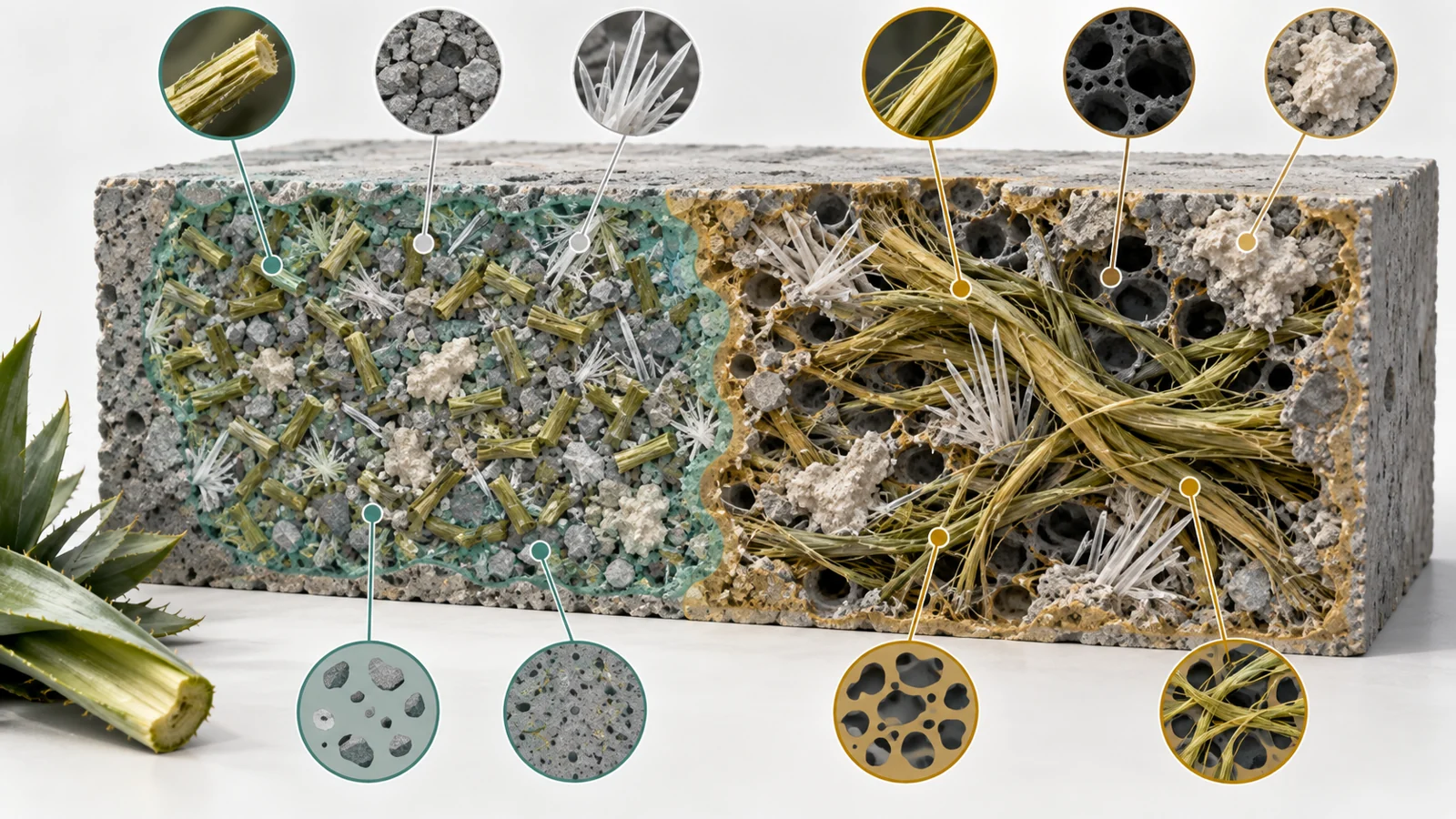
Concrete designed to repair its own cracks has to do more than form a mineral deposit. It also has to carry loads, resist wear and limit the movement of water through its hardened structure. A study published on May 14, 2026, tested those demands together by combining alkali-treated pineapple leaf fibres, bacterial mineralization and a 10% replacement of cement with wollastonite.
The experiment measured strength after 7 and 28 days, along with water absorption and abrasion resistance. It also examined selected samples for mineral formation. The results show why the phrase “self-healing concrete” needs careful interpretation here: calcium carbonate deposition was observed, but autonomous crack-healing efficiency was not directly measured.
One formulation does several different jobs
The mixture used two Bacillus types: a ureolytic Bacillus species and the non-ureolytic Bacillus cohnii. The cultures were combined with wollastonite, a naturally occurring calcium silicate mineral with a needle-like structure. The concrete also contained alkali-treated pineapple leaf fibres, tested at lengths of 5, 10, 15 and 20 millimetres and at proportions from 0.25% to 1%.
The bacterial description can sound more specific than the actual recipe. Although one organism was classified as ureolytic, the experiment did not add urea. Calcium lactate pentahydrate supplied the calcium nutrient. The intended interaction was therefore a composite formulation: fibres could reinforce the cement matrix, wollastonite could contribute a mineral phase and the bacterial consortium could support calcium carbonate formation.
At 28 days, the bacterial-wollastonite mixture without the pineapple fibres had a reported compressive-strength increase of 23% compared with the plain control. The strongest reported fibre formulation used 15 mm fibres at 0.5% and reached a 26% increase against that same control. That figure describes the complete formulation relative to the control; it is not a 26% fibre-only improvement added to bacterial wollastonite concrete.
Strength changes with the loading direction
Compression and splitting tension place different demands on concrete. A compression test pushes a specimen together, while a splitting-tension test loads it in a way that exposes its weakness under pulling forces. A fibre arrangement that helps one response is not automatically the best choice for the other.
The 15 mm, 0.5% mixture produced the highest reported compression result. The maximum reported splitting-tensile result came from a different recipe: 20 mm fibres at 1%. That mixture reached 4.82 MPa at 28 days, compared with 3.71 MPa for the control, an increase of about 30%. Its compression improvement, however, was only 6.4% over the control.
The comparison matters more than any single headline percentage. Longer fibres can provide mechanical interlocking and help bridge stresses, but adding more material does not create a universal optimum. In the 20 mm series, increasing fibre content was associated with a drop in compressive performance. The 1% mixture recorded 44.95 MPa, only 6.4% above the 28-day control; the authors attributed the reduced compressive performance to defects, stress concentrations and poorer fibre–matrix contact.
The study used three specimens for each experiment, with wet-cured samples tested at the two curing ages. That design supports a controlled laboratory comparison, but it does not turn the best-performing mixture into a general recipe for structural concrete.
Fresh concrete still has to move and disperse
The fibre choice affects the mixture before it hardens. As fibre length and proportion increased, the concrete became less fluid. Longer fibres also tended to gather into clusters and disperse less easily. The researchers adjusted the dosage of Auramix 400 superplasticizer, a flow-aiding admixture, to compensate for the stiffer mixture.
The reported superplasticizer dosages ranged from 0.3% to 0.65% of the binder weight across the fibre variations. That adjustment is not a minor preparation detail. Fibres only reinforce the matrix effectively when they are distributed through it. Clusters can leave poorly filled regions, while insufficient flow can make compaction and placement less uniform.
This creates a practical dependency between the laboratory result and construction. A formulation that performs well after curing still needs a repeatable mixing, dosing and placement process. The target is not simply to select the longest or most abundant fibre, but to keep the reinforcement dispersed without creating new voids or making the fresh concrete too difficult to handle.
Keeping water out is a separate test
Water absorption probes a different property from compressive or tensile strength. In the study, cured 100 mm cubes were dried, immersed and weighed during a 72-hour absorption test. The fibre series showed why a stronger result in one loading mode should not be treated as evidence of lower water entry.
For the 20 mm fibres, the reported absorption values relative to the control increased by 5.75%, 7.78%, 13.11% and 17.31% as the fibre content rose from 0.25% to 1%. The explanation proposed in the study is that longer fibres and poorer dispersion can introduce additional voids and create easier paths for water. Lower-fibre mixtures, particularly some of the 5 mm formulations, performed better on absorption than other fibre variations.
The reported values need to be read with their comparator and measurement stage attached. A percentage describing change from 7 to 28 days is not interchangeable with a percentage describing change from a control mixture, and neither is the same as an absolute absorption value. The experiment therefore does not identify one recipe as best across strength, water uptake and workability.
Abrasion observations added another piece to the picture. Fibre-reinforced samples showed lower wear depth than the control specimens after the laboratory abrasion procedure, and samples containing both bacterial activity and fibres maintained their surface integrity during the test. Reduced wear and increased water absorption can occur in the same broad formulation family; they are separate durability observations, not parts of one combined durability score.
Calcite shows mineral formation, not completed repair
After the 28-day strength evaluation, selected samples were examined with scanning electron microscopy and energy-dispersive X-ray spectroscopy, alongside X-ray diffraction. The analyses identified calcium carbonate crystallization and substantial carbonate deposition in the investigated material. Those findings are consistent with the proposed biomineralization route and with pore refinement or improved interfacial bonding as possible contributors to the hardened matrix response.
They do not show that a later crack closed, that a cracked specimen recovered its strength or that the material would repair repeated damage autonomously. The study explicitly left self-healing efficiency unquantified. A mineral deposit inside an intact or selected sample is evidence of a relevant process, not a measured record of crack recovery.
The biological part of the concept also has conditions attached. The experiment used active microbial cultures rather than endospores. Their persistence could be affected by temperature changes, moisture conditions, freeze–thaw exposure or chemical environments. The authors also identify the need to examine microbial resilience, fibre–matrix optimization, standardized tests and longer-term field performance.
Scale is another boundary. The compression tests used 100 mm cube specimens under controlled laboratory conditions. Those samples can reveal how the formulations compare under the chosen tests, but they cannot by themselves establish performance in full-size structural elements, repair intervals or maintained microbial activity over a service life. The study also does not establish chloride protection or validate performance under long-term salt exposure.
What this could change
For infrastructure owners and users, the practical promise is a concrete element that tolerates mechanical demand and surface wear more effectively, potentially reducing disruptive maintenance if the result can be reproduced during mixing and placement. Partial cement replacement with wollastonite and the use of plant-derived reinforcement offer a material-efficiency direction, but a quantified net environmental benefit still requires life-cycle assessment.
A useful infrastructure material would need to preserve its mechanical and water-transport performance at structural scale through realistic environmental exposure. If active mineralization is also shown to close cracks and restore function over time, it could add a genuine repair capability and reduce the consequences of damage. This experiment establishes a formulation tradeoff and a plausible mineralization pathway; it does not yet demonstrate either outcome in the field.
Key Sources
- Primary source: Synergistic enhancement of strength and durability in self-healing concrete using treated pineapple fibres and bacterial mineralization.
DOI or Journal Page · Peer-Reviewed Paper · 2026-05-14