
Since the previous research note · Changed direction
Track continuity
Since the previous research note: How bacterial minerals reshape the process of concrete repair
Previous expectation: If bacterial activation and mineral deposition can be coordinated through relevant crack depths under service conditions, while preserving concrete performance, components could gain a more durable barrier to damaging ingress.
What this study adds: The August 12, 2022 review redirects that durability question toward reinforced concrete: closing an entry route and preserving alkalinity around embedded steel are related but distinct requirements. It connects bacterial mineral filling with carbonation chemistry but does not demonstrate long-term reinforcement protection.
What changed in this study
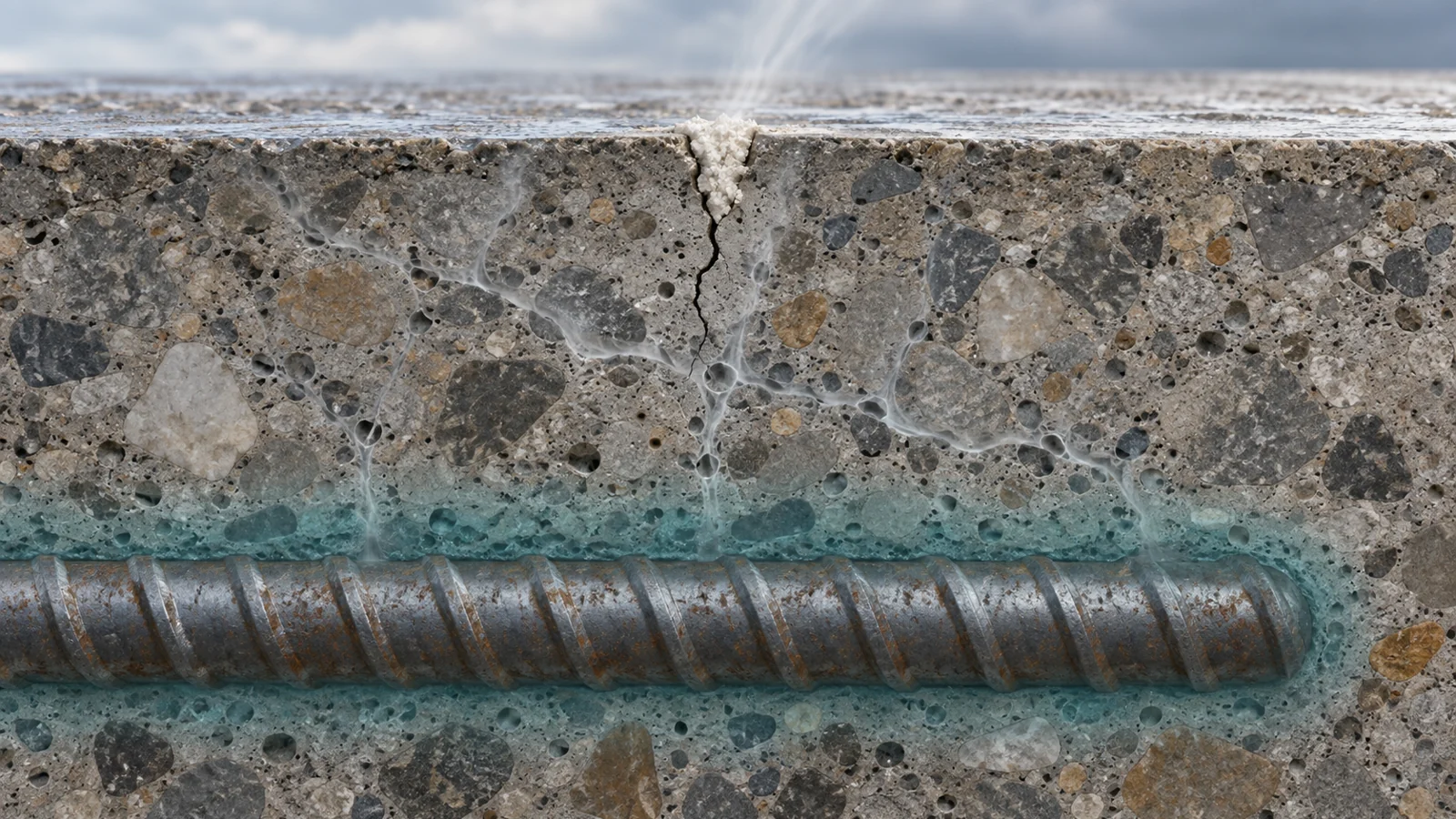
Calcium carbonate appears on both sides of a concrete durability puzzle. Bacteria can help deposit this mineral in cracks, filling spaces through which water and other substances enter. Yet carbonation—the reaction of carbon dioxide with cement constituents—also produces calcium carbonate while reducing the alkalinity that helps protect steel reinforcement.
The mineral’s presence therefore needs a chemical context. Where it forms, how it forms and what happens to the concrete surrounding the steel all matter.
A review published on August 12, 2022, examines this connection between bacterial self-healing and carbonation in reinforced concrete. It brings together studies of mineral formation, crack repair, curing and material properties to explore whether bacteria could help preserve the conditions reinforcement needs. Its distinctive question concerns two possible functions of bacterial treatment: closing pathways into concrete and helping maintain its alkalinity. The second remains a proposition the authors explicitly say requires laboratory confirmation.
Why forming limestone can change steel’s surroundings
Concrete contains pores as well as larger cracks. Carbon dioxide from the air can enter this connected pore system and, with moisture available, react with constituents of the hardened cement paste. One reaction converts calcium hydroxide and carbon dioxide into calcium carbonate and water. Carbon dioxide can also react with calcium silicate hydrate, a major binding component of cement paste, removing calcium and producing carbonate and silica gel.
These reactions alter more than the amount of solid material in a pore. They reduce the concrete’s alkalinity. Highly alkaline concrete supports a protective passive layer on embedded steel; as carbonation lowers the pH around reinforcement, that protection becomes vulnerable. The review describes continued carbonation lowering pH below 9, creating conditions in which corrosion can begin.
At the same time, calcium carbonate can accumulate in the pore network and refine the pores in a carbonated surface layer. This explains the apparent contradiction: mineral deposition can make part of the material denser while the associated chemistry weakens the alkaline environment on which steel protection depends.
A useful explanation of carbonation therefore follows both the movement of carbon dioxide and the chemical changes it causes. A deposit near the surface and the conditions around a deeper reinforcing bar describe different parts of that process.
Early curing answers a different question
The timing of carbonation changes its practical meaning. Controlled carbonation curing treats recently cast material under selected conditions. Weathering carbonation progresses through mature concrete exposed during service.
For early curing, researchers can regulate carbon dioxide concentration, pressure, exposure time and the material’s moisture condition. The review describes chamber treatments and preconditioning steps that remove some free water before carbon dioxide exposure. That preparation creates access for the gas and supports carbonate precipitation. These are deliberate manufacturing conditions, quite different from the changing environment around an existing structure.
The paper discusses early strength, surface hardness and reduced porosity as useful outcomes of controlled carbonation. It highlights applications in products without reinforcing steel, including concrete blocks and paving blocks. In those products, the treatment is being assessed for a setting where preserving an alkaline environment around embedded reinforcement is not the same central requirement.
A reinforced member exposed over time presents a different problem. Its cement chemistry, pore structure and surroundings determine how carbonation develops toward the steel. Useful results from early curing help explain what carbonation can do to a material, but transferring them to reinforcement durability requires answering this separate exposure question.
How bacteria reach a crack and form a mineral filling
Bacterial healing depends on a sequence of conditions. Suitable organisms must be introduced, survive their surroundings and have access to the substances needed for mineral formation.
The review describes three delivery approaches: adding bacteria directly to a concrete mix, enclosing them in a protective material within the mix, or applying them to cracks by spraying or injection. These choices affect where organisms are placed and how they encounter the concrete environment. Survival matters because cement-based materials can be highly alkaline, and the paper emphasizes the need for suitable bacterial strains.
Water and nutrients then help make biological activity possible. In systems using spores, water entering a crack can allow germination when nutrients are available. Depending on the biological pathway, the treatment also needs appropriate chemical supplies for calcium carbonate precipitation. The resulting mineral can build up locally and occupy space in cracks or pores.
Protection during delivery can make a substantial difference. The review recounts a study in which pure bacterial cultures failed to heal cracks, whereas protecting the bacteria with silica gel helped achieve filling. It also summarizes reports of closure at crack widths up to 0.46 millimeters in one study and healing of cracks up to 0.3 millimeters in another. These are results from different reported systems, rather than a general repair limit for bacterial concrete.
Physical filling is one part of the argument. The authors also discuss bacteria that produce urease, an enzyme that catalyzes the breakdown of urea. The associated chemistry can raise pH and support carbonate formation when calcium is available. This leads to the paper’s more specific proposal: urease-associated activity might help maintain high alkalinity even as carbonation occurs. That proposed chemical function extends beyond the space occupied by a mineral filling.
Moisture and pores shape the outcome
An otherwise similar treatment can encounter very different conditions in different concrete. The pore network influences access for carbon dioxide and water, while the concrete’s composition determines the chemical material available to react. The review identifies water-to-cement ratio, cement content, porosity and the degree of pore saturation among the internal factors affecting carbonation.
Moisture creates an interaction rather than a simple rule that more is better. Water supports carbonation reactions and can enable bacterial activation. But water already occupying pores also affects the routes through which gas can enter. This is why the curing procedures discussed in the paper include drying before controlled carbon dioxide exposure.
The review cites a relative-humidity range of 50–70% as particularly active for carbonation in the literature it discusses. That observation concerns the carbonation process; it does not establish a universal humidity setting for bacterial healing or reinforcement protection. A favorable condition for one process may change another part of the system.
Outside the concrete, carbon dioxide concentration, temperature, humidity and pressure also affect exposure. Inside it, composition and pore structure influence the response. Bacterial survival, mineral precipitation and carbonation must operate within these conditions together. The paper’s conclusion accordingly treats bacteria as an additional material whose usefulness depends on the surrounding concrete and environment.
What the assembled evidence establishes
This paper is a review of earlier work, not a new controlled demonstration that bacterial treatment protects reinforcement from carbonation-induced corrosion. Its examples span different materials, bacterial delivery methods and curing conditions. Reports of crack filling, greater compressive strength and reduced water or chloride transport show why the approach attracts interest, but they cannot be combined as though they came from one shared experiment.
Each of those observations also measures a particular function. Crack closure describes filling. Compressive strength describes resistance to compression. Water and chloride transport concern passage through the material. None alone establishes that the concrete around steel retains sufficient alkalinity during carbonation, or that the steel remains protected over time.
The authors make the crucial limitation explicit in their discussion of urease: maintaining high alkalinity after carbonation requires further laboratory study to confirm the theory. Their proposed connection between biological activity and reinforcement protection is therefore a research question emerging from the assembled work.
The paper also uses bibliometric analysis to examine research attention. It maps author keywords from 282 Scopus articles selected using topic, language, document-type and recent-year filters. Within that selection, self-healing appeared much more often than carbonation or corrosion protection. The pattern helps explain why the authors focus on the intersection of these subjects. Keyword frequency cannot measure healing performance or demonstrate corrosion resistance, and the description of a five-year selection does not establish an exact literature cutoff.
What this means for reinforced concrete
The practical consequence is that a bacterial treatment should be evaluated against the function it is intended to serve. For surface sealing, the immediate questions concern where mineral forms, how well it fills accessible cracks and whether it reduces ingress. For reinforcement protection, the investigation must extend through the concrete to the steel.
Following the review’s argument, that would mean connecting healing and reduced transport with sustained alkalinity around reinforcement and the condition of the steel under stated exposure conditions. Concrete composition, moisture, bacterial delivery and carbon dioxide exposure would give those observations their meaning. This is a consequence of the proposed mechanism, rather than a testing standard established by the paper.
The August 2022 contribution is to bring cement chemistry into the assessment of biological repair. It makes the intended benefit more specific: a filling that helps seal an entry route and a treatment that helps preserve the steel’s surroundings perform related but distinct jobs. Understanding their connection is what would make bacterial healing useful for the long-term durability of reinforced concrete.
Key Sources
- Primary source: Review on Carbonation Study of Reinforcement Concrete Incorporating with Bacteria as Self-Healing Approach.
DOI or Journal Page · Review or Meta-Analysis · 2022-08-12