
Since the previous research note · Earlier expectation not tested
Track continuity
Since the previous research note: Could bacteria give recycled tire rubber a useful role in stronger concrete?
Previous expectation: Bacterial assistance might make recycled-rubber concrete useful for suitable applications and eventually reduce localized repairs if strength and repeated healing persisted in service.
What this study adds: The current paper supplies a microstructure-based transport and precipitation model for generalized bacterial concrete, with literature-calibrated comparisons and explicit limits on mechanical coupling. It does not test the recycled-rubber formulation or repeated healing under service loads.
What changed in this study
Concrete designed to seal its own cracks has an appealing promise: bacteria help produce a mineral that fills damaged spaces without requiring every small repair to be carried out by hand. But producing repair material and distributing it through a crack are separate engineering problems.
A study published on May 6, 2025, examines that second problem with a computer model. Rather than testing a new concrete formulation, the paper simulates how bacterial healing agents move through realistic crack and pore networks, where they accumulate, and how calcium carbonate precipitation may develop over time.
The useful question is not simply whether bacteria can produce a mineral. It is where the mineral-forming ingredients can actually reach.
Making a concrete crack computable
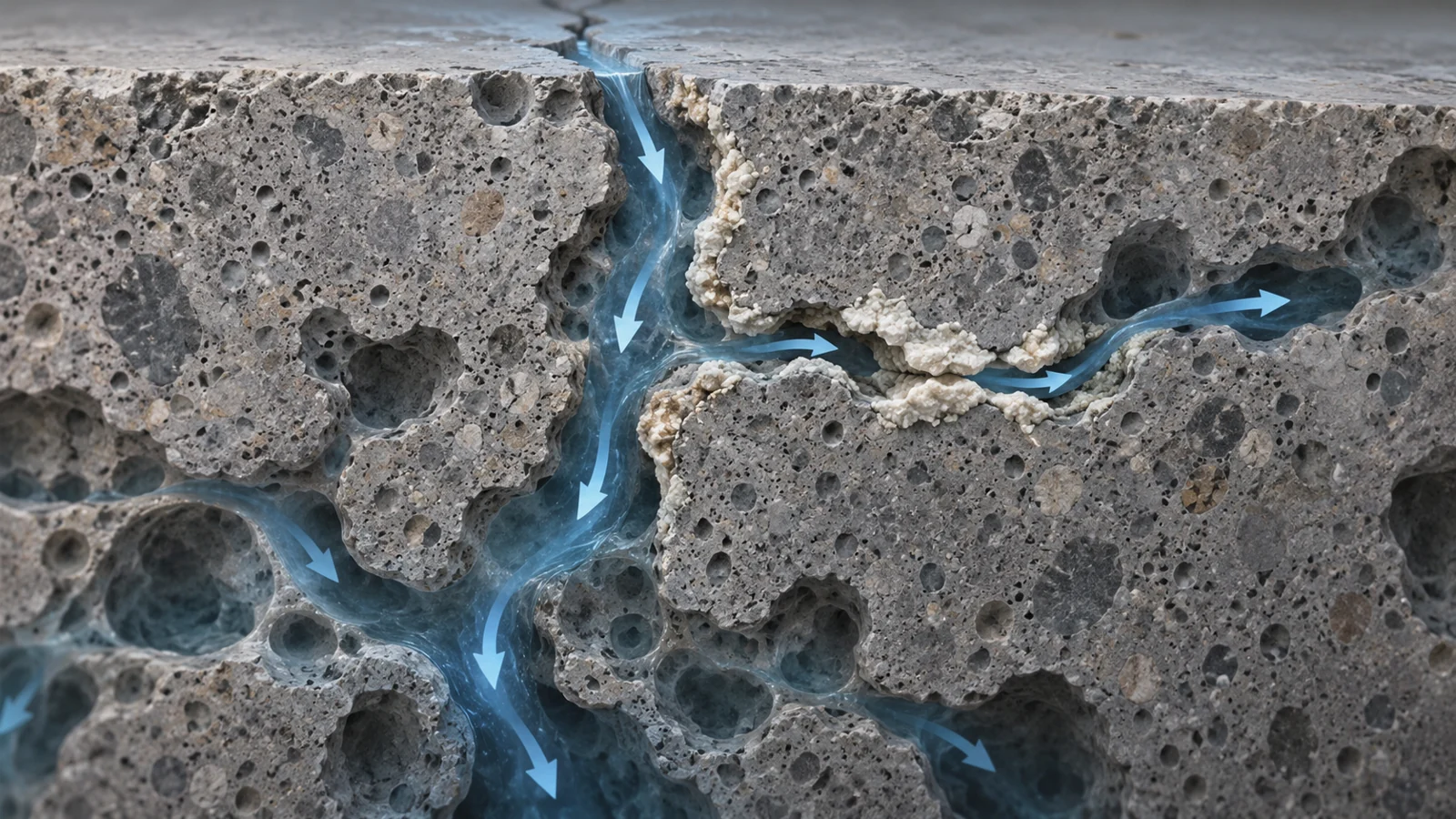
The researchers began with X-ray micro-computed tomography data. Micro-CT can represent the shapes and connections of pores and cracks inside a sample, giving the model a more irregular geometry than a simple straight slit or uniform channel. Those reconstructed features were converted into a finite element mesh, which divides the geometry into many small computational regions.
The mesh lets the calculation follow concentration changes from one region to the next. In this study, diffusion describes the movement of dissolved healing agents through available pathways, while reaction terms describe the conversion of calcium and carbonate ions into calcium carbonate, or CaCO3.
The central transport equation has a straightforward interpretation. Concentration changes over time according to diffusion through the geometry, reduced by material being consumed or transformed in the reaction. The precipitation calculation uses a rate linked to the lower available concentration of calcium and carbonate ions. In plain terms, mineral formation is constrained by whichever ingredient is less available locally.
The geometry, diffusion coefficients, reaction terms and bacterial conditions are inputs to the calculation, not findings produced by it. The paper identifies the Micro-CT-based geometry as literature-derived. The model then calculates concentration fields, transport patterns and precipitation-related outcomes for the selected setup.
The setup also made a specific assumption about where healing agents begin. The crack surface was treated as a high-concentration zone for calcium and carbonate ions, while the surrounding cement matrix began at a lower background concentration. That represents a situation in which encapsulated bacteria or an external reservoir supplies material near the damaged interface. It is a useful starting condition for studying movement away from the crack surface, but it is still a starting condition chosen by the model.
A crack can receive repair unevenly
At the beginning of the simulated process, the largest concentration gradients drive rapid movement along open cracks and connected pores. The model shows healing-agent concentration falling along the crack path as diffusion carries material away from the high-concentration region. Early movement can therefore be fast near the entry area while leaving less material available farther along the crack.
This creates a spatial problem. A crack may contain enough ingredients for substantial deposition in one region but not enough access for equally strong deposition deeper inside. The result is not necessarily a uniform mineral plug extending through the entire damaged path. Geometry controls the routes, and distance from the concentration source changes the supply available along them.
The paper reports that narrow cracks below 0.5 millimetres healed efficiently under the modeled conditions, while cracks wider than 0.8 millimetres became limited by diffusion. These ranges belong to this model and its selected inputs; they are not universal thresholds for every bacterial concrete system. They illustrate how a larger open space can require more material to be delivered across a pathway that may already be losing concentration with distance.
Bacterial loading introduces another tradeoff. More bacterial activity can increase the ingredients available for calcium carbonate precipitation, but excessive precipitation may obstruct the same routes that ions need to travel through. A deposit that fills one section of a crack can reduce access to regions beyond it. In that sense, producing more mineral is not automatically equivalent to distributing repair more effectively.
The model represents a familiar engineering tension: a healing system must generate enough material to seal a crack, while retaining enough permeability for ingredients to reach the places that still need them. Encapsulation and nutrient release are therefore delivery decisions as well as biological decisions.
Water and temperature change the calculation
The same bacterial healing system can behave differently when its surroundings change. Water affects ion mobility through the cement matrix and also affects bacterial survival. With too little available moisture, transport slows and bacteria may lose viability or receive nutrients less effectively. The study identifies relative humidity below 50% as a condition that can slow the modeled precipitation process.
Temperature affects the biological side of the process. Within the study’s sensitivity analysis, temperatures near 30 °C supported favorable activity, while temperatures above 45 °C could suppress bacterial viability and enzyme activity. The paper also identifies relative humidity above 70% as favorable in the modeled conditions.
These values make the dependency tangible, but they should not be read as a construction recipe. They are parameter ranges used to explore how environmental conditions influence metabolism and transport in the simulation. A material that performs well in one exposure environment could distribute ingredients differently, or support less biological activity, in another.
The model also treats encapsulation in a generalized way rather than distinguishing the transport behavior of different encapsulation types. That matters because a carrier that releases material quickly could create a different concentration pattern from one that preserves bacterial viability and releases nutrients more gradually. The study identifies this as an area where a more detailed model could improve the representation of real systems.
What the percentages actually measure
The paper reports a simulated crack-closure efficiency of 65.5%. That number is a computational result from the modeled transport and precipitation process. It should not be translated directly into 65.5% recovered strength, load-bearing capacity or service-life extension.
The authors compared recalibrated model runs with published experimental results discussed in the paper. In one comparison, a published experiment reported about 90% healing within 72 hours under highly favorable laboratory conditions involving small cracks and encapsulated bacteria. When the model was adjusted to those conditions, it predicted about 88% healing. The numerical proximity suggests that the calculation can reproduce a reported trend in a matched case.
A different comparison used a published report of 42.8% compressive-strength recovery over 70 days. Because that report did not provide a directly equivalent crack-closure percentage, the study inferred a time-dependent healing curve from relationships used in the literature and then predicted roughly 75% crack closure. The two numbers describe different outcomes: one concerns measured strength recovery, while the other concerns a modeled crack-sealing trajectory.
That difference is central. A crack can look more filled without regaining the same mechanical performance as an undamaged section. Mineral may be deposited unevenly, fail to interlock through the full crack depth, or restore visible continuity without reproducing the original load path. Numerical agreement between a predicted closure value and a strength-related experiment therefore cannot establish equivalent performance.
The comparisons are also recalibrated cases, not a demonstration that the model has predicted previously unseen service conditions. Their value is in showing how the calculation behaves when its inputs are adjusted to resemble selected published scenarios. Independent testing under different geometries, environments and loading histories would be a separate question.
A closure estimate within a fixed crack geometry
The paper reports crack-closure efficiency while also stating that the current framework keeps the Micro-CT-derived microstructure fixed. There is no two-way mechanical calculation in which mineral deposition changes stiffness, the crack boundary moves, and the altered geometry then redirects transport.
The reported percentage is a modeled healing outcome, not a time-lapse measurement of a crack physically shrinking inside the computer. The calculation follows agent movement and precipitation within a fixed representation of the crack and pores. Its closure result must therefore remain separate from a demonstration of changing crack geometry or restored mechanical performance.
The authors also use simplified reaction kinetics. The precipitation rate is treated as constant, even though bacterial enzyme activity, pH and calcium availability can change the speed and location of mineral formation. Excess deposition can itself reduce later ion movement, a feedback that a more dynamic biological and chemical description could represent in greater detail.
The resulting 65.5% is useful as a model-dependent comparison point, not as a direct claim about restored structural integrity. The framework’s present contribution is to make delivery and deposition visible inside realistic-looking microstructural geometry. Its remaining gap is the coupled behavior that begins once deposits alter the crack’s mechanical and transport properties.
What this could change
Concrete formulations could eventually be designed to deliver mineral-forming ingredients more evenly and sustain useful sealing in small cracks under the exposure conditions where they are intended to operate. If those modeled transport advantages persist in service and the resulting deposits remain durable, infrastructure owners could eventually reduce some localized repair interventions. The immediate contribution of this study is narrower but important: it gives engineers a way to examine where a bacterial healing system may run out of access, build up too quickly, or depend strongly on water and temperature before those issues are evaluated in practice.
Key Sources
- Primary source: Finite element simulation of bacterial self-healing in concrete using microstructural transport and precipitation modeling.
DOI or Journal Page · Peer-Reviewed Paper · 2025-05-06