
Since the previous research note · Earlier expectation not tested
Track continuity
Since the previous research note: How bacteria-associated minerals connect repair mortar with cracked travertine
Previous expectation: Durable, conservation-compatible bacterial mortar repairs could help conservators stabilize localized travertine damage while retaining original stone.
What this study adds: The July 2023 source introduces predictive modeling of cracked-area repair in concrete formulations containing bacteria and fibers. Its reported model fits concern formulation development and do not test the earlier travertine-conservation expectation.
What changed in this study
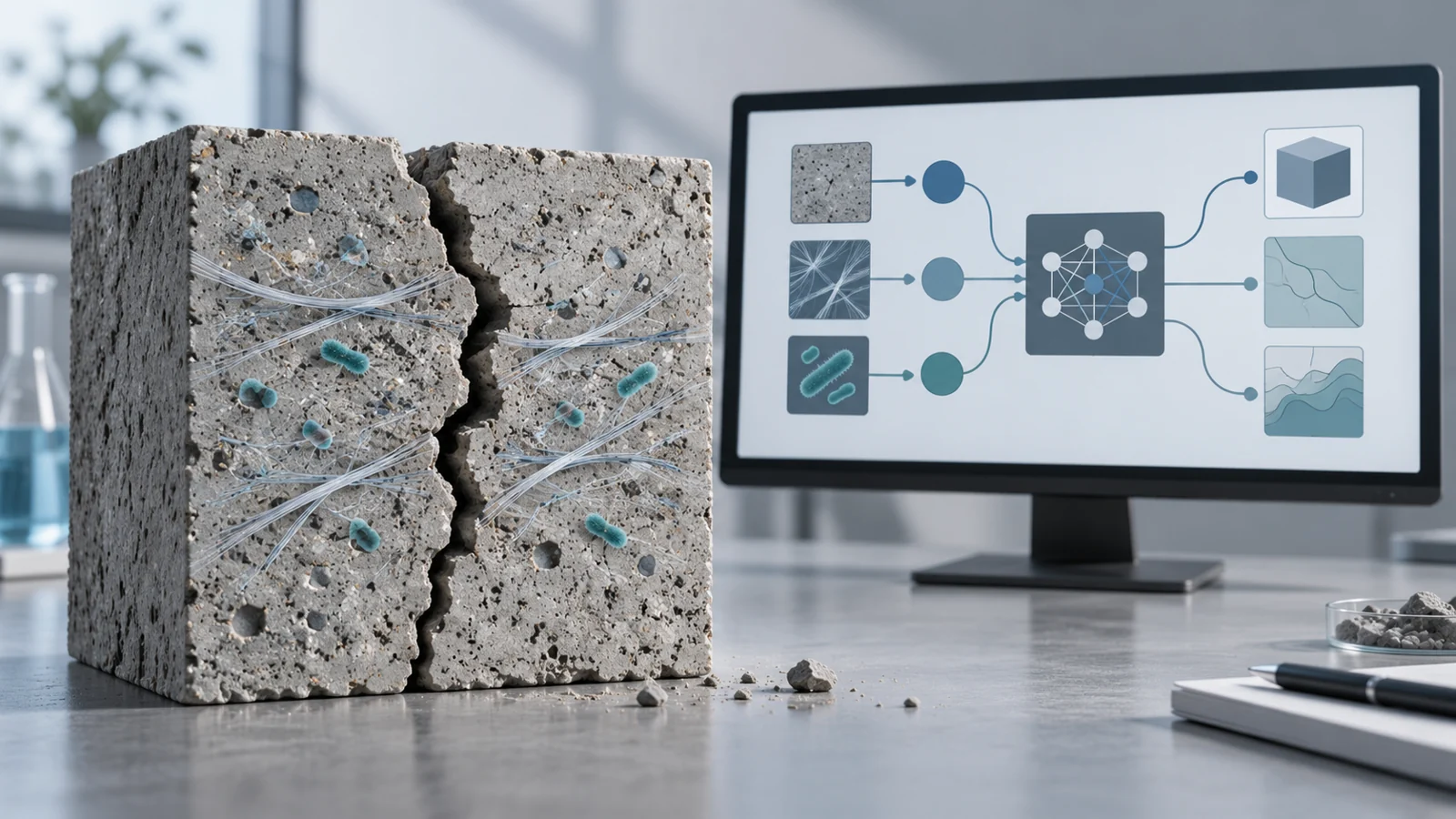
Concrete usually depends on repairs after cracks appear. A July 5, 2023 report asks whether computer models can help researchers decide which mixtures deserve closer laboratory attention. Its subject is self-healing concrete—formulations containing bacteria and fibers that are intended to repair cracked areas—not a machine that heals a structure after deployment.
A computer aid for mixture selection
Laboratory experiments can be costly and time-consuming, especially when researchers are comparing many possible formulations. The study proposes machine-learning models as a way to assist that search. A model could help identify mixtures that look worth testing more closely, concentrating experimental effort where the reported inputs suggest a stronger chance of crack-area repair.
That is a proposed research role, not a demonstrated reduction in testing time or cost. The value depends on whether a model remains useful when researchers apply it to genuinely new mixtures and whether physical tests confirm the intended repair performance.
The target was a reported repairing rate
The models were developed to predict and analyze the repairing rate of the cracked area in concrete containing bacteria and fibers. In practical terms, the target concerns how the reported cracked area changes under the study’s repair assessment. The abstract does not provide enough detail to establish the target’s exact operational definition, units, or time basis, so the result should not be translated into a universal healing percentage.
Three approaches were compared: multiple linear regression, support vector machines, and random forest regression. The reported outcome is therefore a model comparison around one defined research target, rather than evidence that any particular concrete mixture has been validated for construction use.
The best reported fits still need context
The radial-basis support vector model had a reported R-squared of 0.927, while the random forest regressor reached 0.984. R-squared is a measure of how closely a model’s estimates fit variation in the reported target values under the study’s evaluation. It is not the percentage of cracks healed, and it is not the percentage of predictions that were correct. The higher value indicates a stronger reported fit in this comparison, not proof that the random forest will rank unfamiliar mixtures reliably.
The abstract also reports mean absolute error values of 0.053 for the radial-basis support vector model and 0.019 for the random forest, alongside root mean squared error values of 0.004 and 0.000. The definitions and scaling needed to interpret those figures together are not available here. In particular, the rounded zero should not be read as error-free prediction.
Usefulness beyond the reported fits would depend on how the data were assembled and evaluated. Dataset size, composition, heterogeneity, the evaluation procedure, and performance on independently collected data or new formulations all affect what these scores can support. Predicting repair of cracked area also leaves separate questions about restored structural strength, long-term durability, service-life extension, and deployment. It does not establish durable, conservation-compatible repair of historic travertine either; that is a different materials question from the one addressed here.
What this could change
For materials researchers, the practical possibility is a computational screening step before committing to a large set of laboratory trials. If the reported models continue to perform usefully on genuinely new bacteria-and-fiber mixtures, they could focus experiments on formulations more likely to repair cracked areas. Physical testing would still need to confirm that performance and determine whether it matters for durable concrete.
If model-guided selection eventually yields mixtures that repair cracks and retain that ability under real exposure conditions, it could help develop concrete that needs fewer external crack repairs. The reported fits do not establish that outcome: it would require reliable predictions on new mixtures and physical evidence of durable repair, with structural performance assessed separately.
Key Sources
- Primary source: Prediction of self-healing properties of concrete modified with bacteria and fibers using Machine Learning
DOI or Journal Page · Peer-Reviewed Paper · 2023-07-05