
Since the previous research note · Partly supported
Track continuity
Since the previous research note: Why making more room for bacteria did not produce the strongest mortar
Previous expectation: Directly mixed bacteria could eventually help cementitious materials seal small cracks and reduce repair needs if bacterial function persists without compromising material performance.
What this study adds: This study reports mineral deposition, reduced water uptake and mechanical recovery after loading in directly amended mortar and reinforced laminates maintained under moist laboratory conditions. It supports portions of that causal route without establishing service-life persistence or testing the earlier air-entrainment formulation.
What changed in this study
Stronger mortar does not automatically demonstrate self-repair. A mixture can develop a denser structure as it hardens, carrying more weight before damage ever occurs. To investigate healing, researchers also need to examine what happens after a material has been stressed.
A laboratory paper published July 5, 2022, in Heliyon examined both questions. Researchers added bacteria and calcium lactate to mortar, measured its properties during curing, and tested separate specimens after earlier loading and a further period kept wet. Their results connect mineral deposits and reduced water uptake with evidence of mechanical recovery. Understanding that connection requires keeping ordinary strength development separate from the loading-and-retesting experiment.
What went into the mortar
The team used two species, named Bacillus pasteurii and Bacillus sphaericus in the paper, at reported additions of 0.25% and 0.50% of cement weight. Each bacterial addition came with calcium lactate. According to the mixture table, the lower bacterial addition was paired with 0.125% calcium lactate and the higher with 0.25%.
The base mortar contained three parts sand to one part cement by weight, with a water-to-cement ratio of 0.45. The untreated control contained neither bacteria nor calcium lactate. Consequently, the comparison tests the combined formulation; it cannot assign every difference to bacteria alone.
This was work on small specimens. Compression tests used 7-centimeter cubes, bending tests used prisms measuring 4 × 4 × 16 centimeters, and reinforced laminates measured 35 × 15 × 3 centimeters. Those thin laminates contained expanded metal mesh at mid-depth. They provide a way to examine reinforced mortar under bending at laboratory scale.
Moisture was part of the preparation and testing conditions. Specimens were kept in wet cloth and sprayed daily with tap water, with observations extending to 120 days. The additions also changed how the fresh mixture set. Treated mortar began setting earlier but finished setting later than the control. A biological formulation therefore affects the working material before any later recovery is assessed.
Mineral deposits and the routes water takes
Microbially induced calcite precipitation, or MICP, uses microbial activity to encourage formation of calcium carbonate minerals. Bacterial surfaces can also provide places where crystals begin growing. The paper discusses calcium-lactate conversion and urea hydrolysis as possible pathways for the species studied, without establishing how much each pathway contributed inside these specimens.
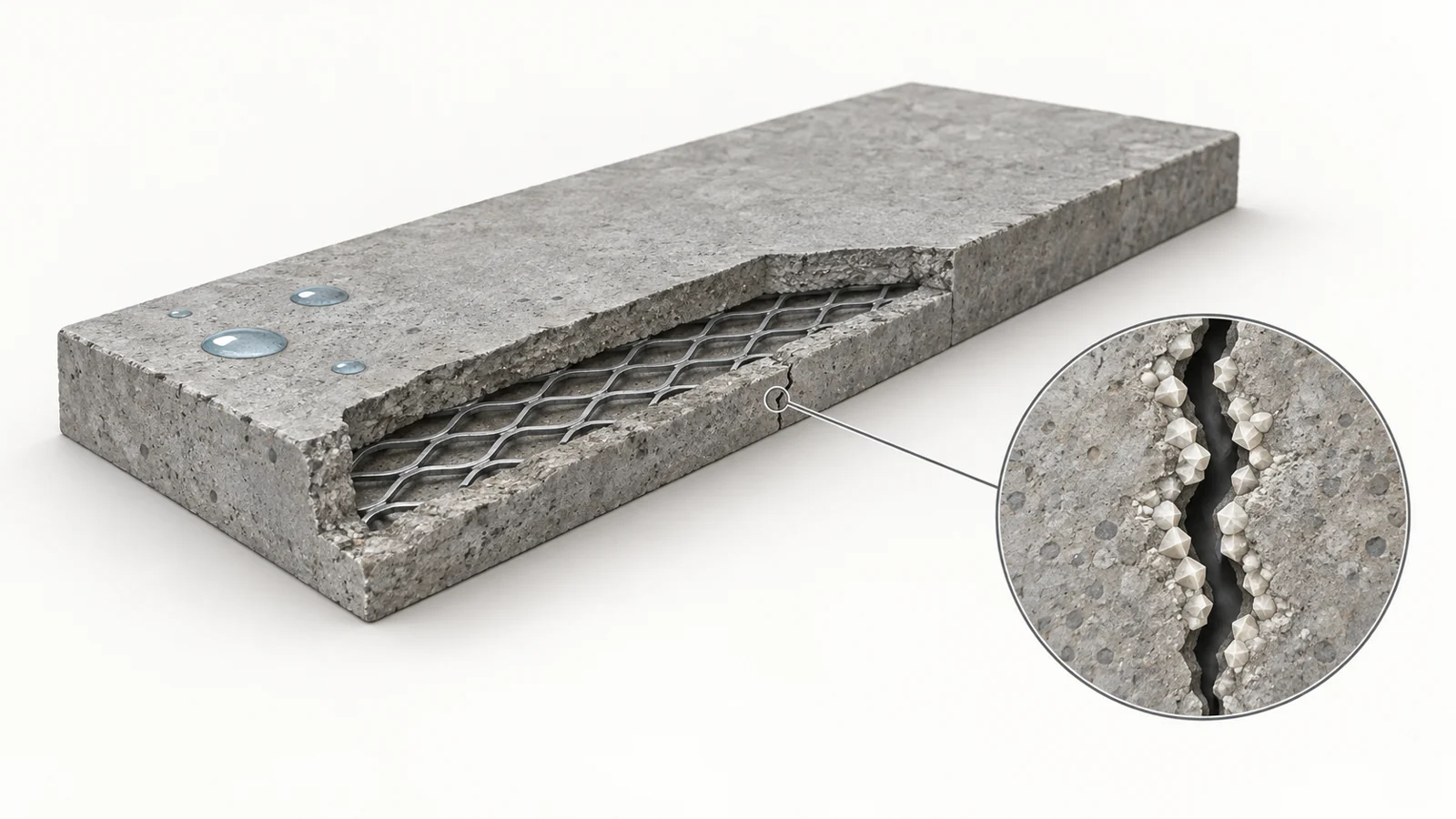
The proposed material effect is physical. Mineral deposits occupy spaces in the hardened cement matrix, including pores and parts of microcracks. Filling some of those spaces can restrict the connected routes through which water moves.
Several measurements supported that interpretation. Electron microscopy showed a denser structure with fewer visible voids in treated samples, together with deposits the authors identified as calcite crystals. Images from the recovery experiment also showed mineral precipitation associated with microcracks. These observations locate deposits within the material, but a selected image cannot establish that every crack has closed.
Elemental analysis detected calcium, carbon and oxygen in the examined deposits, consistent with calcium carbonate. It adds chemical information to the images, although the presence of those elements alone does not uniquely establish a crystal structure. Thermal analysis supplied another kind of evidence: carbonate-related decomposition behavior differed between treated mortar and the control. The authors interpreted those differences as increased carbonate content and crystallinity.
The three methods contribute different pieces of the explanation—appearance and location, elemental composition, and behavior during heating. Together, they support the authors’ mineral-deposition interpretation more strongly than any one observation would by itself.
Water tests provided a corresponding material-level result. Treated specimens took up less water, had lower capillary permeability and contained a smaller volume of permeable voids than the control. Capillary transport is the drawing of water through small connected spaces. Its reduction matters because cracks and pores can provide entry routes for water and substances carried with it. Here, the researchers measured changes in those transport properties, rather than the eventual lifespan of an exposed structure.
Strength depended on age and on how it was tested
Compression and bending challenge mortar differently. Compression measures resistance to being squeezed. Bending places part of a specimen in tension, making its response sensitive to cracks that can open on the stretched side. A formulation that performs best in one test need not lead in the other.
After 28 days of ordinary curing, the bacterial formulations had compressive strengths 28–50% higher than the same-age control, according to the paper. The table gives 34.7 megapascals for the control and 44.4–52.1 megapascals for treated mortar. The highest value at that age belonged to the lower B. pasteurii addition.
The relative advantage changed as the control continued developing strength. At 120 days, the table lists 50.0 megapascals for the control and 52.1–56.1 megapascals for the treated formulations. Those later differences are substantially smaller than the 28-day percentage gains. The early advantage cannot be treated as a fixed improvement that persists unchanged with age.
Bending produced a different pattern. At 120 days, the authors reported flexural-strength increases of 19.29–65.94% relative to the control. Both B. sphaericus formulations outperformed the B. pasteurii formulations at that endpoint. In separate laminate tests, bacterial specimens deflected less than controls under the same load, indicating stiffer behavior under those test conditions.
These results describe how the formulations developed mechanical properties. They do not, on their own, reveal how much damage was repaired. Nor do they identify one recipe as best across ages, species and loading conditions.
What happened after the first load
The recovery experiment introduced an earlier loading step. To define that step for compression, the researchers loaded an untreated control to complete failure and used half its ultimate load as the preliminary load. Other specimens received this half-failure load at 7, 28 or 90 days after casting. They were then kept wet and tested to failure at 28, 90 or 120 days, respectively.
The distinction between those two loads is essential. The preliminary load was intended to produce internal damage without destroying the specimen. The later destructive test measured how much load the specimen could carry after the intervening wet period. This was not a demonstration of broken mortar pieces joining back together.
The reinforced laminates followed a related schedule. They were initially loaded to half-failure load at 28 or 90 days, maintained wet, and retested for bending performance at 90 or 120 days, respectively. These schedules examine recovery over defined intervals at different specimen ages. They do not establish an unlimited sequence of damage and repair in the same component.
The authors reported substantial restoration of mechanical performance in treated specimens and described poorer recovery in controls. At 120 days, their reported compressive restoration values ranged from about 95% to 104% relative to what they called the original specimens. Microcrack images showing mineral deposits during the healing process add evidence that a physical filling process accompanied the mechanical results.
That combination goes beyond the ordinary strength comparison. The specimens had experienced prior loading, spent time under conditions allowing further material change, and then carried load again. The mechanical response and microcrack observations support a healing interpretation within this protocol.
The restoration percentages nevertheless need careful reading. The paper shifts among descriptions of restoration, increases and comparisons with “original” or unloaded specimens. Its broad claim that all treated laminates exceeded their original flexural strength at 90 days also sits alongside a listed value of 87% for one formulation. It is therefore inappropriate to translate the results into a claim that every mixture completely recovered—or that a restoration figure near 100% means a further 100% strength gain.
The supported conclusion is narrower and still useful: previously loaded bacterial formulations showed mechanical recovery under prolonged moist laboratory conditions, with mineral observations consistent with microcrack filling. The exact extent of complete restoration is less secure than the overall recovery pattern.
What the recovery interval leaves unresolved
Mortar continues to change while it cures. Between the initial load and the final test, ordinary cement hydration can develop strength, and nonbacterial processes can contribute to filling cracks. Keeping specimens wet supports those processes as well as the proposed microbial activity.
The controls help establish that the treated formulations behaved differently, but the study does not quantify how much of each recovered unit of strength came from bacterial mineral production. Calcium lactate changed alongside bacterial addition, and the reported mixture table contains no nutrient-only mechanical control. Those coupled ingredients limit independent attribution to the organisms.
Choosing a practical formulation also remains unsettled. Performance varies by age and endpoint, while the calcium-lactate pairing in the paper’s concluding recipe statement differs from its mixture table. The experimental table supports describing what was compared; the paper does not provide a consistent basis for declaring a universal optimum.
Exposure conditions pose a separate question. These specimens had sustained access to moisture. A component in use may spend long periods dry or experience changing wetness, temperature and loading. The laboratory results do not establish persistent bacterial function under those conditions, a repairable crack-width range, or complete closure throughout a component. Specimen ages reaching 120 days cannot establish reliable performance over a structure’s service life.
What this could change
If directly incorporated bacteria remain functional in service, and their mineral deposition limits water ingress after small cracks develop, producers could develop cementitious components with an internal response to early damage. Restricting those entry routes could slow some deterioration processes and reduce how often small defects require external repair.
For infrastructure owners and users, that could mean fewer repair interventions, less disruption and lower maintenance demands. Those benefits depend on the recovery process working under real exposure conditions and on a formulation that can be mixed, placed and maintained reliably. The 2022 experiment supplies laboratory evidence linking formulation, mineral deposits and performance after loading. It makes that route to reduced repair needs more plausible, without measuring maintenance savings, service-life extension or environmental benefits.
Key Sources
- Primary source: Microbially-Induced-Calcite-Precipitation (MICP): A biotechnological approach to enhance the durability of concrete using Bacillus pasteurii and Bacillus sphaericus .
DOI or Journal Page · Peer-Reviewed Paper · 2022-07-05